Does the US have the right to defend itself? If so why doesn't any nation have the right to defend itself? What is the best way for the US to deal with Iran?
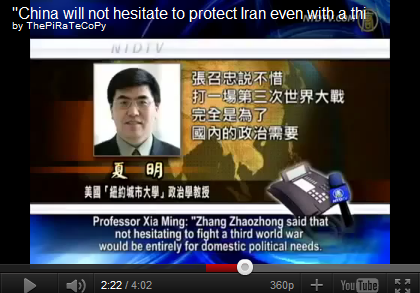
Here is a video in Chinese, with English subtitles, in which China says it will defend Iran.
Here are a few panels about 2 minutes 15 seconds into the video in which China states an intent to protect Iran, if Iran is attacked, even if it means World War III.
I support the position (a few moments later and shown in the screen shot below) that suggests the Iranian people have little trust in their leaders and the best way to deal with Iran is to let the people rise up against the government as happened in Egypt and Libya.
With the US threatening Iran at every turn, and with the needless war in which the US destroyed Iraq killing or ruining the lives of hundreds-of-thousands of Iraqis, it is no wonder Iran wants to protect itself. Any country would want to do the same.
The US has no business instigating another war, yet that is exactly what economic sanctions are. The downright scary policies of Mitt Romney and Newt Gingrich go even further, and would have the US marching off to World War III before we know it.
The best way for the US to deal with Iran is to support the Iranian people (not the leaders). Nearly all the private citizens of Iran would have no grudge against the US if we would simply stop our policies of aggression in the region.
We do not need another war and certainly cannot afford one. Ron Paul offers the best hope of stopping yet another disastrous, and needless march to war.
Our theme for Q4 was ‘Maximum Intervention’ and today was a new high for this exact concept. The day after the European Union Finance Ministers (ECO-FIN) meeting (which once again failed to produce any progress on the EU debt crisis) the Chinese cut the RRR-ratio - the minimum reserves each commercial bank must hold of customer deposits and notes - from 21.5 percent to 21.0 percent. (The RRR started the year in 18.5 percent and this is the first cut since 2008. Back in 2006 the RRR ratio was just below 8.0 percent for a number of years.) This is an indication that China’s help to the growing outlook of a ‘Perfect Storm’ will be monetary easing despite relatively stubborn inflation numbers.
Coup-de-grace
Then in coup-de-grace style the Federal Reserve and five other major central banks cut the dollar funding rate for overnight swaps by 50 basis points, down from 100 basis points, and at the same time made this programme run through to February 2013.
This immediately raises the hope for further cuts in policy rates in the US and Europe. Right now, foreign banks can fund themselves cheaper in US Dollars than US banks. This will almost certainly mean the discount rate will be cut by 25 bps and before the weekend.
Mounting pressure on Monti
The market loves liquidity and this action shows the true determination of policymakers to address the growing funding crisis, but its ultimate success will depend on progress in the EU debt crisis, and whether this will again merely be a stand-alone action of throwing liquidity at a problem which remains one of solvency. In other words, the lack of structural changes in Europe – are the same both before and after this coordinated intervention. Alas, technocrat Monti remains more important to the future of this risk-on move than the move itself.
However, it should not be ignored that the market is looking for excuses to take the S&P 500 index higher, and there is no denial that the underlying economic data from the US has continuously surprised to the upside over the past month. Fundamentals are improving in the US, and the ADM report this morning gave indications that Non-Farm Pay-Rolls data on Friday could yet be another positive news story.
'Monster Santa' rally
Earlier this week I described this week as likely to be one of consolidation and potential for a rest at 1215/1220 – we have now clearly overshot this on the upside and the target 1240/50 might well be in full view. The market also likes the “seasonal play” of buying into year-end, and I am getting plenty of ammunition from tech-based analysts that the price action reminds them of September/October 2010 – the post Jackson Hole rally - making this the start of a 'monster Santa' rally.
I will remain sidelined with a negative bias, if only because, my generic models are short, and from a tactical point of view, I feel that to get a real solution to solvency, unlike liquidity, we need to see stock markets in mini-crash mode before politicians and policymakers truly understand the necessity to make a long-term commitment to austerity and growth. The signal today was: We are prepared to buy more time, and feel confident enough to float the market with cheap liquidity and an indication of further easing to come. The market will love that, but investors should also remember to stay sober when drinking from the cool-aid name: cheap money.
Go Santa,
Safe travels!
Discount Rate Discussion
The Federal Reserve website has this discussion of the Discount Rate.
The discount rate is the interest rate charged to commercial banks and other depository institutions on loans they receive from their regional Federal Reserve Bank's lending facility--the discount window. The Federal Reserve Banks offer three discount window programs to depository institutions: primary credit, secondary credit, and seasonal credit, each with its own interest rate. All discount window loans are fully secured.
Under the primary credit program, loans are extended for a very short term (usually overnight) to depository institutions in generally sound financial condition. Depository institutions that are not eligible for primary credit may apply for secondary credit to meet short-term liquidity needs or to resolve severe financial difficulties. Seasonal credit is extended to relatively small depository institutions that have recurring intra-year fluctuations in funding needs, such as banks in agricultural or seasonal resort communities.
The discount rate charged for primary credit (the primary credit rate) is set above the usual level of short-term market interest rates. (Because primary credit is the Federal Reserve's main discount window program, the Federal Reserve at times uses the term "discount rate" to mean the primary credit rate.) The discount rate on secondary credit is above the rate on primary credit. The discount rate for seasonal credit is an average of selected market rates. Discount rates are established by each Reserve Bank's board of directors, subject to the review and determination of the Board of Governors of the Federal Reserve System. The discount rates for the three lending programs are the same across all Reserve Banks except on days around a change in the rate.
Further information on the discount window, including interest rates, is available from the Federal Reserve System's discount window web site.
Equity futures sharply reversed an overnight pullback on a pair of central bank actions, one in China, the other an agreement between the US and Europe.
China Cuts Bank Reserve Ratios by .5 Percentage Points
The People's Bank of China, China's central bank, said Wednesday it will cut the reserve-requirement ratio for banks by half of a percentage point, the first such cut since December 2008. The cut essentially frees up banks to lend additional money.
The cut late Wednesday in Beijing cheered European markets, with the benchmark Stoxx Europe 600 index up 0.8% midday, while London's FTSE was up 0.8%.
"The data for the last few weeks has been bad," said Mark Williams, China economist at Capital Economics. "There's zero growth in property starts, electricity output growth has slowed, the export numbers for November will be awful and they may have had a sneak preview of that. All of these things could have triggered a shift in policy."
Wednesday's move will take the reserve-requirement rate to 21% for major banks. It will free up around 390 billion yuan (about $61 billion) in funds for the banks to lend, according to calculations by The Wall Street Journal based on data for bank deposits in October.
The cut in reserve ratio "is a clear signal that Beijing has decided that the balance of risks now lies with growth, rather than inflation," said Stephen Green, regional head of research in Greater China for Standard Chartered, in a note following the PBOC's move. Mr. Green predicts that China will reduce the reserve ratio again in January due to a potential liquidity crunch coming up before Chinese New Year.
The PBOC has raised the reserve requirement ratio six times so far this year, and has raised benchmark lending and deposit rates five times since October last year to combat stubbornly high inflation. The previous reserve ratio increase took effect June 20, and the last interest rate hike was effective July 7.
There will likely be more such reserve ratio cuts, with one more cut of 0.5 percentage point coming as soon as the beginning of next year, said Yao Wei, China economist with Société Générale, adding that she doesn't expect any interest rate cut in the next six months.
European stocks rallied for their longest stretch of gains in seven weeks as the Federal Reserve and five other central banks lowered the cost of dollar funding and China cut its reserve ratio for banks.
The Fed, Bank of Canada, Bank of England, Bank of Japan, European Central Bank and Swiss National Bank agreed to reduce the interest rate on dollar liquidity swap lines by 50 basis points and extend their authorization through Feb. 1, 2013.
Finance ministers of the 27-nation European Union are meeting in Brussels today to seek agreement on how to temporarily guarantee banks’ bond issuance in order to improve funding conditions for lending. EU leaders agreed last month to provide the guarantees to restore investor confidence in banks.
The yield on 1-year German bunds turned negative today for the first time ever, according to Bloomberg data, as the European Central Bank looks set to ramp up measures to fight the debt crisis.
The yield on the 1-year note fell 13 basis points to -0.05% by midday. This is the first time it has seen a negative yield since Bloomberg began compiling data on the asset class in 1995.
Yields on the 6-month bunds, known as Bubills, turned negative last week, dropping to -0.05% on Friday. It was the first time 6-month bunds have offered a negative yield since the creation of the euro.
S&P Equity Futures are up another 3 Percent, Bond Market Yawns
Global equities are sharply higher with this global coordinated action. S&P 500 futures are up another 3 percent and will gap higher.
Meanwhile Spanish 10-year bonds rallied (yields fell) a mere 7 basis points to 6.32%, Spanish 2-year bonds rallied a mere 8 basis points to 5.51%, Italian 10-year bonds rallied 10 basis points to 7.13%, and Italian 10-year bonds rallied 9 basis points to 7.00%.
Whatever the equity markets see, the bond market doesn't. A flight to safety of German bonds is back on, that China needs to cut reserve requirements is a huge sign of weakness (and no it will not stop a hard Chinese landing).
Also bear in mind that on September 15, there was coordinated swap-line action that did nothing.
The Frankfurt-based ECB said today that it will coordinate with the Federal Reserve and other central banks to conduct three dollar liquidity-providing operations with a maturity of approximately three months. The loans are in addition to the bank’s regular seven-day dollar offerings and will be conducted as fixed-rate tenders with full allotment, the bank said. It will offer the loans on Oct. 12, Nov. 9 and Dec. 7.
“The dollar funding situation has caused headaches for some banks,” said David Schnautz, a fixed-income strategist at Commerzbank AG based in London. “The ECB’s measures help ease those problems. It will be interesting to see if there is more to come.”
Basis swaps allow banks to borrow in one currency, while simultaneously lending in another.
The ECB’s measure is a “really big deal,” according to Dartmouth College Professor David Blanchflower. “The fact that these central banks have acted together and said we’ll backstop banks is really big news,” Blanchflower, a former member of the Bank of England’s Monetary Policy Committee, said today at the Bloomberg Markets 50 Summit in New York.
Here is an interesting chart on ZeroHedge that shows what happened the last time there was coordinated swap-line action.
What's Changed?
Nothing much that I can see. China cut the reserve-requirement rate to 21% from 21.5% and the Fed and ECB renewed swap lines at a slightly lower rate.
Yields on Italian bonds are still at or above 7%, and nothing has been done to solve any long-term structural issues.
Nonetheless it's party time for equities, crude, and metals, particularly gold and copper.
Europe's "big bazooka" bail-out fund is not ready and won't stem the debt crisis that on Tuesday pounded Italy and the European Central Bank (ECB), admitted Wolfgang Schauble, Germany's finance minister.
Mr Schauble said eurozone finance ministers, who are meeting in Brussels, could not agree on the terms of the European Financial Stability Facility (EFSF). He told Germany’s Handelsblatt that although Europe needed a fund “capable of action”, plans for the EFSF were too “intricate and complex” for investors to understand.
The finance ministers, who were meeting ahead of a full Ecofin summit today, acknowledged the €440bn (£376bn) fund would not win support to leverage it up to €1 trillion. Its capacity would be between €500bn and €700bn instead – a total that is unlikely to be big enough to rescue Spain and Italy.
However, the ministers concurred that the €8bn of international aid to Greece should be disbursed before Athens runs out of cash in two weeks. Evangelos Venizelos, Greece’s finance minister, said: “In Greece we have all the necessary conditions in order to go ahead with the next disbursement.”
Necessary Conditions Met?!
The only way "necessary conditions" can possibly have been met is if "necessary conditions" have changed.
Germany, the Netherlands, and the IMF have all insisted that all Greek coalition leaders sign off on agreement to IMF and EU demands.
European bonds had a good day today. A good day is when nothing blows up.
Italy 10-Year Government Bonds
Italy 2-Year Government Bonds
Germany 10-Year Government Bonds
Germany 2-Year Government Bonds
After a brief spurt higher, which sent S&P futures down a percent last evening, Italian bonds settled flat as did German bonds. In spite of the fact that Italian debt yields are above 7%, this was a "good" day.
Belief in Fairy Tales
Steen Jakobsen, chief economist from Saxo Bank in Copenhagen notes a huge belief in fairy tales. Steen writes via email ....
There is HUGE believe in the ECOFIN meeting producing news, good news on the fiscal union. Some commentator speculate we will be in EU Heaven.
Clearly these things takes a lot longer time wise than we would like but declaring the EU either dead-or-alive by the next EU Summit on December 9th is slightly overdone. The EU process continues and the politicians clearly feel they have ample time on their hands.
EU monetary history is full of delays and Germany giving in to pressure. Merkel’s position is under pressure and the Bund Yield has become our barometer for pro-EU solutions – for now the trend is clear – we are on-route to Germany giving up and soon.
Still short since last FOMC – market still oversold – could be 1210/1220 on month-end manipulation, but overall low volumes and stress-indicators continuing higher creates two-way risk.
Safe travels,
Steen
Italy and Spain Bond Schedule through 2021
Here are bond schedule charts from Bloomberg that highlight the difficulty for Italy and Spain for the next few years.
Yesterday, we were struck by the increasing convergence of the views of various market observers as to the outcome of the ongoing crisis. It seems now widely accepted as almost a fait accompli that the euro will disintegrate within weeks. Even Jim Cramer (euro bears please take note…) is now on 'Defcon 3', predicting imminent 'financial collapse'. The Economist writes 'Unless Germany and the ECB act quickly, the single currency's collapse is looming'.
We certainly agree that Mrs. Merkel is possibly underestimating the speed and ferocity at which a market panic could crush her ambitious integration plans. We also agree that there are a number of potential events that could become the triggers for such a panic. There is considerable risk that in the case of the failure of a big bank, a wave of cascading cross-defaults could engulf the system. As noted before, Italy and Spain are unlikely to be able to refinance their debts in the markets for very long with bond yields at 7% or higher. To be more precise, they may well be able to roll over their debt at such yields, but sooner or later market access would close down due to the arithmetic of the debt spiral these high yields would inexorably produce.
However, if you thought it cannot get any more apocalyptic than that, Zerohedge reports that Moody's is now reviewing the ratings of 87 banks in 15 countries with a view toward downgrading their subordinated debt. When it rains, it pours.
Considering all these panicked invocations of imminent collapse one is left to wonder though, why did the DJIA rise by nearly 300 points yesterday? If we are not completely mistaken about the meaning of positioning data, then we would argue that with virtually everyone already sitting on the same side of the boat, the markets will begin to do the unexpected – which in this case means the euro should at least see some short term strength, which in turn would have affect many other markets due to the well-known and well-worn inter-market correlations that the systematic black boxes and robots trade off.
The boat was too one-sided for now. However, a relief rally and a global recovery are two different things.
The euro-boat is filling up with water and will eventually sink, only the timing of when and how is unknown.
The central OECD forecast is "muddling through" with US growth recovering slowly. Europe allegedly will enter a "minor recession"
Let me opine, that global "muddling through" is the absolute best one could conceivably expect and even that would take a near-miracle.
Is "muddling through" what the stock market is priced for? I think not. The idea Europe will have a "minor recession" is nonsense in and of itself.
Reflective of the Keynesian clowns they are, the OECD jumps on the fiscal stimulus idea, ignoring the fact we are in this mess precisely because of inane monetary stimulus by the Greenspan Fed accompanied by inane fiscal stimulus policies globally.
The Keynesian clown prescription is always more-more-more until and even after things blow sky high.
I have on numerous occasions made the claim that Henry Paulson is guilty of coercion and fraud. For those actions, he should be arrested and criminally tried.
However, the latest disclosure in which hedge funds say they were tipped off by Paulson while he told Congress and reporters blatant lies is allegedly not even criminal behavior.
Treasury Secretary Henry Paulson stepped off the elevator into the Third Avenue offices of hedge fund Eton Park Capital Management LP in Manhattan. It was July 21, 2008, and market fears were mounting. Four months earlier, Bear Stearns Cos. had sold itself for just $10 a share to JPMorgan Chase & Co. (JPM)
On the morning of July 21, before the Eton Park meeting, Paulson had spoken to New York Times reporters and editors, according to his Treasury Department schedule. A Times article the next day said the Federal Reserve and the Office of the Comptroller of the Currency were inspecting Fannie and Freddie’s books and cited Paulson as saying he expected their examination would give a signal of confidence to the markets.
At the Eton Park meeting, he sent a different message, according to a fund manager who attended. Over sandwiches and pasta salad, he delivered that information to a group of men capable of profiting from any disclosure.
The secretary, then 62, went on to describe a possible scenario for placing Fannie and Freddie into “conservatorship” -- a government seizure designed to allow the firms to continue operations despite heavy losses in the mortgage markets.
Stock Wipeout
Paulson explained that under this scenario, the common stock of the two government-sponsored enterprises, or GSEs, would be effectively wiped out. So too would the various classes of preferred stock, he said.
The fund manager says he was shocked that Paulson would furnish such specific information -- to his mind, leaving little doubt that the Treasury Department would carry out the plan. The managers attending the meeting were thus given a choice opportunity to trade on that information.
Law professors say that Paulson himself broke no law by disclosing what amounted to inside information.
At the time Paulson privately addressed the fund managers at Eton Park, he had given the market some positive signals -- and the GSEs’ shares were rallying, with Fannie Mae’s nearly doubling in four days.
William Black, associate professor of economics and law at the University of Missouri-Kansas City, can’t understand why Paulson felt impelled to share the Treasury Department’s plan with the fund managers.
“You just never ever do that as a government regulator -- transmit nonpublic market information to market participants,” says Black, who’s a former general counsel at the Federal Home Loan Bank of San Francisco. “There were no legitimate reasons for those disclosures.”
The fund manager who described the meeting left after coffee and called his lawyer. The attorney’s quick conclusion: Paulson’s talk was material nonpublic information, and his client should immediately stop trading the shares of Washington- based Fannie and McLean, Virginia-based Freddie.
Seven weeks later, the boards of the two firms voted to go into conservatorship under the newly created Federal Housing Finance Agency. The takeover was effective Sept. 6, a Saturday, and the companies’ stock prices dropped below $1 the following Monday, from $14.13 for Fannie Mae and $8.75 for Freddie Mac (FMCC) on the day of the meeting. Various classes of preferred shares lost upwards of 85 percent of their value.
Who Was at the Meeting?
Mindich, a former chief strategy officer of New York- based Goldman Sachs, started Eton Park in 2004
Daniel Stern of Reservoir Capital Group
Singh, a former head of Goldman’s proprietary-trading desk, also began his fund in 2004, in partnership with private- equity firm Texas Pacific Group Ltd.
Frank Brosens, founder and principal of Taconic Capital Advisors LP, who worked at Goldman as an arbitrageur and who was a protege of Robert Rubin, who went on to become Treasury secretary.
Non-Goldman Sachs alumni who attended included short seller James Chanos of Kynikos Associates Ltd., who helped uncover the Enron Corp. accounting fraud;
GSO Capital Partners LP co-founder Bennett Goodman, who sold his firm to Blackstone Group LP (BX) in early 2008;
Roger Altman, chairman and founder of New York investment bank Evercore Partners Inc. (EVR);
Steven Rattner, a co-founder of private-equity firm Quadrangle Group LLC, who went on to serve as head of the U.S. government’s Automotive Task Force.
Tipping Hands
Brosens and Rattner both confirmed in e-mails that they had attended and said they couldn’t recall details. They didn’t respond when asked whether they traded in Fannie Mae- or Freddie Mac-related instruments after the meeting. Chanos declined to comment.
A Blackstone spokesman confirmed in an e-mail that GSO’s Goodman attended the meeting. Blackstone doesn’t believe market- sensitive information was discussed, and in any event Blackstone didn’t take any positions in Fannie or Freddie between the luncheon and Sept. 6, he wrote.
Paulson often contacted Wall Street participants throughout his tenure, according to his calendar. On that July trip to New York alone, he talked to Lehman Brothers Holdings Inc. CEO Richard Fuld, Washington Mutual Inc. CEO Kerry Killinger and Citigroup senior adviser Rubin.
Morgan Stanley and BlackRock Inc. both helped the Federal Reserve and OCC prepare the reports on Fannie Mae and Freddie Mac that Paulson told the New York Times would instill confidence the morning of the Eton Park meeting.
The manager who described the Eton Park meeting says he also discussed it with an investigator from the FCIC. The discussion was confirmed by a former FCIC employee.
That manager says he ended up profiting from his Fannie Mae and Freddie Mac positions because he was already short the stocks. On his lawyer’s advice, he stopped covering his short positions and rode Fannie and Freddie shares all the way to the bottom.
What did PIMCO know and When?
Anyone who says they do not remember a meeting like that is a liar. Anyone who says "no comment" is indeed commenting and the possible interpretation is not pretty. So what else did Paulson say?
I would like to know who Paulson talked to outside the meeting.
Bill Gross at PIMCO put on a huge bet, buying not equity shares but Fannie and Freddie bonds in the belief their debt would be guaranteed by the government. Gross bet the firm and won his bet as shareholders were wiped out.
So, what did Gross know and when? Was it a guess, or a known deal?
Sadly, there is no way to avoid questions of this nature when treasury secretaries and other high-ranking public officials have routine conversations with former colleagues giving them valuable inside information while telling blatant lies to the public.
How many people were suckered into buying Fannie and Freddie while hedge funds were told in advance to dump shares?
What Paulson did may not have been illegal (acting on the information would have been), which makes the comment by William Poole, a former president of the Federal Reserve Bank of St. Louis seem downright bizarre.
Said Poole ... "It seems to me, you’ve got to cut the guy some slack, even if he tipped his hand. How do you prepare the market for the fact that policy has changed without triggering the very crisis that you’re trying to avoid? What is he supposed to say without misleading these people?"
On second thought, Poole's comments are not bizarre, they are 100% inane, well beyond the inane idea that the market needs to be prepared for anything, even IF there was a legal way to do it.
Poole's idea of preparing the market means telling the big boys how to make billions, while screwing the little guy. Poole is another player deserving your contempt and scorn.
Rolling List of High Profile Fraud Targets
This list is incomplete. I have stopped updating it, it got so long.
In the following interview video on Fox News, Ron Paul explains his plan for monetary freedom and a return to a gold standard. Paul also addresses a dangerous competing idea for the IMF take over control of setting international monetary standards. Finally, Paul explains how he has been temporarily stymied on his plan for a full and complete Fed audit.
Introduction and questions by Judge Andrew Napolitano, senior judicial analyst for Fox News.
Transcript
Judge Napolitano:
Here is a man who has single-handedly educated the nation to the evils of worthless money and to the dangers of a central bank with a printing press, and who continues to believe that fighting for economic liberties is just as important as fighting for civil liberties.
Who else but Texas Republican Congressman and Republican presidential hopeful, Ron Paul.
Congressman Paul, always a pleasure. Welcome to this special edition of "Freedom Watch" on money.
Ron Paul:
Thank you very much.
Judge Napolitano: What would happen in a Ron Paul presidency if we were to return to a gold standard. How soon could this happen and how would it happen?
Ron Paul:
I wish we could do this overnight and we could do a few things like repealing the executive order of Nixon but that in and of itself wouldn't be enough.
We know what to do. We did it once after the Civil War. We went from a paper standard back to a gold standard, and the event was not that dramatic. Today the big problem is both the conservatives and the liberals have a big appetite for big government for different reasons. Therefore they need the Fed to tide them over and monetize the debt.
So if you do not get rid of that appetite, it's going to be more difficult. But the transition is not that difficult. You have to get your house in order, you have to balance the budget, you have to not run up debt, and you have to promise to not print any more money.
That's what they did after the Civil War and it was accepted and we went right back to the gold standard.
I would like to have a transition period. Just legalize gold money, and allow us to use gold and silver as legal tender. And we can work our way back.
Judge Napolitano:
I have to agree with you, but I would even go a step further and say, if gold and silver became currency, that would drive paper money out. Who would want the paper money when you have real gold and real silver out there?
Ron Paul:
If there was a fixed exchange rate, sure, we would never pay our bills off with gold. We would pay it off with paper because it drives the good money out of circulation. But if you want a checking account and you want to deal with gold, you put your money in, you could buy and sell in gold and save in gold, so it would be parallel rather than having a fixed exchange rate between the two.
If you tried to fix the exchange rate it would not work.
Judge Napolitano:
Is this a Pipe Dream or might you and I at some time in the near future, actually be able to show up at the gold window, the one Nixon closed in 1971, and receive from that person the equivalent fair market value of actual gold or actual silver? Might that happen?
Ron Paul:
Well it might, but you would have to be completely on the gold standard. But that's not on the near horizon.
What we want to do is legalize the use of gold and silver as the constitution dictates rather then punishing the people who try to do that.
But yes, it will come about. I am quite convinced the system we have here will not be maintained and that's what these last four years are all about, and that's what the turmoil in Europe is all about.
So the question is: Are we going to move towards constitutional form of money or are we going to go another step further into international money? Instead of having an international gold standard based on the market, will we go towards a UN, IMF standard, where they are going to control with the use of force, another fiat standard?
That's what many people are working for. I consider that a very, very dangerous move.
Judge Napolitano:
The last time you proposed the Federal Reserve should be audited, you had more than half of the House of Representative agree with the proposal, and it passed overwhelmingly. Even some of your polar opposites ideologically were agreeing with you. Where does it stand in this Congress, this time around? Are we going to get a real serious, true audit of the Federal Reserve because everybody (liberals, conservatives, Democrats, Republicans, Libertarians, progressives) have had enough.
Ron Paul:
I wish I could tell you we are better off now since we [Republicans] are in charge of the House, but unfortunately we are not moving. Sometimes these things are done in a partisan manner.
Where these bills to audit the Fed used to come through the domestic monetary policy subcommittee, of which I am the chairman, has no longer directed to that committee, it has been sent over to Government Oversight. So I have been hamstring to a degree, on actually pushing that type of legislation. That means their heart is not in it, and that means we need a lot more work from the people to put pressure on members of Congress.
That's why we did get so far last time, because we mobilized the people and they were telling their member of Congress, you better support the position of auditing the Fed, but right now there is a lot more talk about the "super-committee" and how they are going to mess around with the budget under pretense they are going to cut. That is dominating the news.
Judge Napolitano:
When you and I first met, which was a long time ago, you may have been the only member of Congress talking about auditing the Fed. But am I hearing you say, congressman Paul, that their might actually be more resistance from Republicans, particularly the Republican leadership in the House of Representatives, than anybody else to this vital piece of legislation, to reveal secrets that everybody has a right to know?
Ron Paul:
I don't have concrete evidence. I haven't had a statement, but I do know that I could have had more jurisdiction than I have now. I've had it in the past, and committees have always had it in the past, but its gone in a different direction this time. I think that when push comes to shove, there are people at the leadership of both Republicans and Democratic parties have too much at stake to mess around with the Federal Reserve unless there's a political gamesmanship play in there and they can gain some politics out of it.
If you want change, and polls suggest you do, there is precisely one candidate who will give you the change this country desperately needs. That person is Ron Paul.
In the wake of the recent real-estate meltdown, the borrower of a nonperforming loan called his lender with promising news: "I have a buyer looking to make an all-cash offer for my Florida property. Will you meet with us tomorrow?" The lender's answer: "No."
Disturbingly, this implausible response is not uncharacteristic of lenders who exploit FDIC loss-share agreements by seeking to foreclose on nonperforming loans, even when prudent business judgment calls for short sale or loan modification solutions. By perverting the terms and spirit of loss-share agreements, these lenders are reaping windfalls while prolonging the foreclosure crisis, depressing real-estate values and sticking taxpayers with the bill.
FDIC Sponsored Fraud
Rather than comment directly, I asked Patrick Pulatie at LFI Analytics to chime in. Pulatie writes ....
I wrote an article about IndyMac and the Shared Loss Agreement (SLA) two years ago, before I quit working with most homeowners. Essentially, here is what is going on.
Shared Loss Agreements were executed by the FDIC with the banks that took over failed institutions. Some had the terms that the author describes. Others did not have the same terms, and were much more restrictive. The author is referring to the Shared Loss Agreements similar to OneWest Bank/IndyMac, which I wrote about.
The SLA for OneWest Bank worked in the following manner:
• It only applied to the Portfolio Loans being purchased. It did not apply to servicing rights. 1st Mortgage Loans were purchased for 70% of the original balance. Second Mortgage Loans were purchased at a much lower rate, at 55% or lower at times. I shall only mention First's from here on out, but Seconds apply as well.
IndyMac had a large portfolio of Neg Am loans, so the 70% purchase price of individual loans might be "lower" if the loan had accrued a Neg Am balance above the original loan amount. If there were a large number of 30 year fully amortized loans, then there might be a greater than 70% purchase price. There is no way to break down the proportion of each.
• The first 20% of losses on the "Total Portfolio" purchase would be absorbed by OneWest Bank. There would be no reimbursement on those losses.
• The next 10% of losses, up to 30%, are reimbursed at 80%. So to begin to make claims, the 20% level must be reached.
• From 30% on, the reimbursement rate is 95%. But the 30% loss level must be reached before the 95% can be claimed.
• The total purchase of Portfolio loans was approximately $12.5 billion, so a 20% loss would be $2.5 billion before claims could begin.
• If every single loan (first mortgage) had defaulted on the first day of purchase, and after reimbursement, the agreement, every $.70 spent would have resulted in $.745 being returned. Not bad! But that is not all.
Most of the loans were not in default. Therefore, interest would continue to be earned until the loan refinanced, or defaulted, so they were making a profit, and as their filings have shown, they made very good profits on these loans.
As you can see, it is always in the best interests of OneWest Bank to foreclose on defaulted properties. The sooner that the 20% loss is reached, then the quicker that they can make claims for reimbursement.
Has OneWest Bank reached the 20% threshold? That has not been announced. However, it has been 2.75 years since the Shared Loss Agreement went into effect in March 09. One would think that the 20% level has been reached.
In Feb 2010, a person I know claimed to have seen the paperwork on one loan showing that reimbursement had occurred on that loan. I did not see the paperwork, but since this person did the Good Bank/Bad Bank scenario for the FDIC in the early 90's, I have to accept that he knew what he was looking at.
Who Benefits: George Soros, Michael Dell, John Paulson
OneWest Bank was created on Mar 19, 2009 from the assets of Indymac Bank. It was created solely for the purpose of absorbing Indymac Bank. The principle owners of OneWest Bank include Michael Dell and George Soros. (George was a major supporter of Barack Obama and is also notorious for knocking the UK out of the Euro Exchange Rate Mechanism in 1992 by shorting the Pound).
When OneWest took over Indymac, the FDIC and OneWest executed a “Shared-Loss Agreement” covering the sale. This Agreement covered the terms of what the FDIC would reimburse OneWest for any losses from foreclosure on a property. It is at this point that the details get very confusing, so I shall try to simplify the terms. Some of the major details are:
OneWest would purchase all first mortgages at 70% of the current balance
OneWest would purchase Line of Equity Loans at 58% of the current balance.
In the event of foreclosure, the FDIC would cover from 80%-95% of losses, using the original loan amount, and not the current balance.
How does this translate to the “Real World”? Let us take a hypothetical situation. A homeowner has just lost his home in default. OneWest sells the property. Here are the details of the transaction:
The original loan amount was $500,000. Missed payments and other foreclosure costs bring the amount up to $550,000. At 70%, OneWest bought the loan for $385,000
The home is located in Stockton, CA, so its current value is likely about $185,000 and OneWest sells the home for that amount. Total loss for OneWest is $200,000. But this is not how FDIC determines the loss.
‘FDIC takes the $500,000 and subtracts the $185,000 Purchase Price. Total loss according to the FDIC is $315,000. If the FDIC is covering “ONLY” 80% of the loss, then the FDIC would reimburse OneWest to the tune of $252,000.
Add the $252,000 to the Purchase Price of $185,000, and you have One West recovering $437,000 for an “investment” of $385,000. Therefore, OneWest makes $52,000 in additional income above the actual Purchase Price loan amount after the FDIC reimbursement.
At this point, it becomes readily apparent why OneWest Bank has no intention of conducting loan modifications. Any modification means that OneWest would lose out on all this additional profit.
The sale of IndyMac Federal Bank was concluded Thursday, and the new owners wasted no time in ditching its tainted name. Starting today, IndyMac is OneWest Bank.
The Pasadena bank's new owners, organized under OneWest Bank Group, bought the bank's $20.7 billion in loans and other assets for $16 billion. That includes $9 billion in financing from the Federal Deposit Insurance Corp. and the Federal Home Loan Bank.
The ownership group is led by Steven Mnuchin of Dune Capital Management in New York. The bank's investors include J. Christopher Flowers, who has specialized in distressed bank purchases, and hedge fund operators George Soros and John Paulson.
Check out the last line and primary lie in the above article:
The management team has been working with the FDIC on a loan modification program to attempt to keep people in their homes.
The billionaires' club of private financiers who took over the remains of IndyMac Bank from the Federal Deposit Insurance Corp. turned a profit of $1.57 billion last year on the failed mortgage lender -- more than they invested less than a year ago.
Yet under the sale agreement, the federal deposit insurance fund still could lose nearly $11 billion on bad loans that the Pasadena institution made before it was sold last March and renamed OneWest Bank.
In taking over IndyMac's assets, the investor group, led by Steven Mnuchin of Dune Capital Management, put up $1.55 billion to revitalize the bank. Other investors included hedge-fund operators George Soros and John Paulson, bank buyout expert J. Christopher Flowers and computer mogul Michael S. Dell.
OneWest's financial results were filed with regulators Friday. Regulators and the investors declined to comment on the profit.
As much as $11 billion is set to go straight into the hands of the desperately needy: George Soros, John Paulson, Michael Dell, and Christopher Flowers. The regulators and the investors parasites declined to comment.
Boycott Dell
If you are thinking about buying a new computer, and you are considering Dell, you may wish to reconsider.
It's difficult to catch the early news from Europe and the US open as well, unless one never sleeps. Here we are in the midst of another flatline gap-up rally.
Here is an intraday chart of the S&P 500.
S&P 500 3-Minute Chart
As with the last gap-up on rumors now dead, I confidently predict this nearly-3% gap will fill sooner, rather than later.
Let's take another look at the bond market.
Italy 10-Year Government Bonds
Italy 2-Year Government Bonds
Spain 10-Year Government Bonds
Spain 2-Year Government Bonds
The yield on 10-Year Italian bonds barely budged. In contrast there was wild action in 2-year bonds, opening up at 8.11% then finishing 100 basis points down from the high and 56 basis points lower than Friday's close. This intraday move is probably another 6-Sigma event.
2-year bonds for Spain showed similar action, but the swings were not as dramatic.
Nonetheless, in spite of these swings, the yield on both 10- and 2-year Italian bonds is over 7%, and Spanish bonds are sick as well.
If there was any reason to believe "elite bonds" would help Italy, or the IMF would help Italy, then 2- and 10-year yields would not be above 7%, and the 2-year yield certainly would not have soared to a new high above 8%.
Equity markets are responding to something the bond market does not see, most likely pure nonsense.
Expect More Nonsensical Rumors
Don't worry, when the equity gaps fill, there will be still more nonsensical rumors to excite the stock market.
Equity futures are ripping tonight primarily on a pair of rumors regarding Italy. The first rumor is the IMF would buy Italian debt, now denied but the equity markets could care less.
No sooner than one ridiculous rumor goes up in flames than does another ridiculous rumor spring up in its place.
The German government is considering the possibility of issuing joint bonds with five fellow triple A euro zone countries that are being referred to as "elite bonds" or "AAA bonds," newspaper Die Welt reported on Monday.
Chancellor Angela Merkel and her center-right government have repeated ruled out collectivizing debt and the introduction of common euro zone bonds.
The conservative daily cited "high European Union diplomats" involved in fighting the sovereign debt crisis saying the Berlin government was nevertheless considering issuing bonds jointly with France, Finland, Netherlands, Luxembourg and Austria.
The joint bonds could be used not only to finance borrowing for those six countries but also could be used to raise funds under strict conditions for countries such as Italy and Spain, the newspaper reported.
The goal would be to stabilize the situation in the AAA countries as well as "building a credible firewall to calm the financial markets," Die Welt said. The interest rate for the bonds should be somewhere between 2 and 2.5 percent -- or only slightly above the level for German government bonds.
The newspaper said the euro zone countries without AAA ratings should not be included initially.
Far be it from me to rule out complete stupidity from any politician at any level, but this story does not remotely smack of the truth.
I have no doubt some low or mid-level German bureaucrat might concoct such an idea but it makes no sense that Angela Merkel would go along with it.
Notice the report cited "high European Union diplomats", not Merkel and not even German officials.
Even if Merkel was willing to go along with this nonsense, the German Supreme Court wouldn't.
Dead on Arrival
This idea is dead on arrival no matter what the equity market thinks.
Check out the action in bonds.
Italy 10-Year Government Bonds
Italy 2-Year Government Bonds
Spain 10-Year Government Bonds
Spain 2-Year Government Bonds
Italian debt yields are modestly lower but only after the two-year bond yield soared to a new high of 8.12%. Spain yields are essentially flat.
If there was any reason to believe "elite bonds" would help Italy, or the IMF would help Italy, then 2- and 10-year yields would not be above 7%, and the 2-year yield certainly would not have soared to a new high above 8%.
Anything can happen in the next few hours I suppose, but equity markets are responding to something the bond market does not see, most likely pure nonsense.
ICAP Plc is preparing its electronic trading platforms for Greece's potential exit from the euro and a return to the drachma, senior executives at the inter-dealer broker said Sunday.
ICAP is the latest firm to disclose such preparations, joining the growing ranks of banks, governments and other key players in the global financial system whose officials are worried enough about the stability of the common currency to be making contingency plans for a possible break-up.
The firm has been testing systems that would allow dealer banks to trade the drachma against both the dollar and the euro, the ICAP executives said, cautioning that the measures taken in recent weeks were precautionary. They said the currency pairs would not be accessible for trading unless required by market events, and may never be used.
Certain decisions, such as how many decimal places would be used when representing the drachma's exchange rate, have not been finalized. But ICAP said the currency templates could be tweaked depending on dealer requests, and that the project could be used as a roadmap for how to prepare for an outcome involving multiple currencies leaving the euro. So far, testing has only involved the drachma, no other currencies.
ICAP has reloaded the drachma templates for spot foreign exchange and derivatives called nondeliverable forwards that were removed from the system when Greece's old currency was replaced by the euro in 2001.
A Barclays Capital research report last week showed that nearly half of 1,000 investors surveyed thought at least one country will leave the euro in 2012.
Separately, a Bank of America Merrill Lynch research report Friday titled: "Eurozone: thinking the unthinkable," said a partial union with only some countries exiting the euro was the "most probable scenario" out of all the breakup possibilities. But the researchers stressed that while the currency implications were "worth examining," a breakup of the euro was still a far-fetched event.
Politicians never give up on bad idea except by death or removal from office.
In spite of obvious failures to leverage the EFSF fund (still without rules as to how the fund even works), French president Nicolas Sarkozy is back at it, hoping to create a three-fold expansion of the EFSF via tradeable insurance certificates with guarantees on as much as 30 percent of the bonds.
The European Financial Stability Facility may insure bonds of troubled countries with guarantees of between 20 percent and 30 percent of each issue to be determined in light of market circumstances, according to EFSF guidelines to be considered by finance ministers this week.
The insurance would be in the form of tradable partial protection certificates, to be issued by an independent Luxemburg-based special purpose vehicle, the guidelines show. The step is one of several new tools including setting up private funds with investors and selling short-term debt aimed at increasing the EFSF’s power to combat the debt crisis.
Euro-area finance ministers are due to meet in Brussels on Nov. 29 as governments bid to regain the confidence of financial markets.
The proposal to attach guarantees of up to 30 percent of future EFSF bond issuances’ worth may create a threefold expansion of the 440 billion-euro ($583 billion) fund, according to the guidelines distributed to lawmakers in Berlin. The EFSF’s pool of potential aid would also be increased by setting up so- called credit investment funds with private investors to buy the bonds of euro-region states that struggle to sell their debt.
French President Nicolas Sarkozy has said that the bailout fund might be worth $1.4 trillion after European governments agreed last month on steps to leverage existing guarantees as much as fivefold. European leaders are next due to hold a summit on Dec. 8-9.
The new instruments may need to be supplemented further, German Finance Minister Wolfgang Schaeuble told reporters in Berlin on Nov. 25 following talks with Dutch Finance Minister Jan Kees de Jager and Finnish Finance Minister Jutta Urpilainen.
Leaders will seek a “separate path” of help from the International Monetary Fund to boost the EFSF, Schaeuble said. IMF help must be “substantial enough to help Italy and Spain,” de Jager told reporters, saying that talks on creating credit investment funds had run into “problems.”
Given there are few details on the proposal it's difficult to say precisely how this will fail, but fail it will, more than likely within a few days of announcement.
Assuming the guarantees are separately tradeable as stated, the guarantees themselves may (or may not) trade at a reasonable valuation, but what about the underlying junk?
Also recall the bigger the leverage, the faster the EFSF will eat up its principle.
Then what?
IMF to the Rescue?
Not a single one of these clowns is taking into consideration the fact the German Supreme court has said "no more". What happens when the EFSF is quickly consumed on Portuguese, Spanish, and Italian debt?
Is that when the IMF is supposed to come to the rescue? Or before?
The European desperation is palpable ahead of the EURUSD open in a few hours, which has to deal with the aftermath of the Friday afternoon downgrade of Belgium, the junking of Portugal and Hungary, and the prospect of an imminent downgrade of AAA-stalwarts Austria and France. So what does Europe do instead of actually proposing the inevitable debt repudiation that is the only and final outcome? Why more rumors of course.
To wit: last night saw the preannouncement of Welt am Sonntag indicating that in order to bypass the lengthy process of treaty changes, Europe would instead proceed with bilateral agreements that would somehow enforce fiscal stability and convince the market that European states would follow the German leader. Well since that is sure to have absolutely no impact, overnight Italian La Stampa is out with a fresh new rumor which cites "IMF sources" according to which the US-headquartered and funded organization would provide a €600 billion loan to Italy at 4-5%. In other words, Uncle Sam, in his role as primary funding agent of the IMF would lose massive amount of money on the "market to fair value" arbitrage, only to bail out the latest European domino.
From Dow Jones:
The International Monetary Fund could offer Italy between EUR400 billion and EUR600 billion in financial support to give Italian Prime Minister Mario Monti a window of 12 to 18 months to enact reforms sufficient to restore waning market confidence in Italy's ability to repay its debt, Turin daily La Stampa reported Sunday, citing IMF sources.
The IMF "Italy package" would consist of loans at an interest rate of between 4% and 5%, compared with the 7% to 8% the country paid at its most recent bond auctions, the report says.
However, ZeroHedge also points out a Dow Jones wire from September ...
The IMF board of governors agreed in December to roughly double quotas from around $375 billion to around $750 billion. But out of the 187 member countries, only 17 have legally accepted the increase, including Japan, the U.K. and Korea. Most of the countries with the biggest quotas, such as the U.S., China and Germany, haven't yet gone through the legal process, such as parliamentary or congressional approval, need to hand over their promised dues.
Think this Congress will throw more money at the IMF? I don't.
Thus, once again, all we have for another week is more nonsensical rumors and a rehash of leverage ideas that have already failed in the market.
The Economist is frequently a mixed bag. Here is an article on the global housing market that pretty much hits the right spot. Please consider House of horrors, part 2
The bursting of the global housing bubble is only halfway through.
MANY of the world’s financial and economic woes since 2008 began with the bursting of the biggest bubble in history. Never before had house prices risen so fast, for so long, in so many countries. Yet the bust has been much less widespread than the boom. Home prices tumbled by 34% in America from 2006 to their low point earlier this year; in Ireland they plunged by an even more painful 45% from their peak in 2007; and prices have fallen by around 15% in Spain and Denmark. But in most other countries they have dipped by less than 10%, as in Britain and Italy. In some countries, such as Australia, Canada and Sweden, prices wobbled but then surged to new highs. As a result, many property markets are still looking uncomfortably overvalued.
The latest update of The Economist’s global house-price indicators shows that prices are now falling in eight of the 16 countries in the table, compared with five in late 2010.
Home Price Indicators
To assess the risks of a further slump, we track two measures of valuation. The first is the price-to-income ratio, a gauge of affordability. The second is the price-to-rent ratio, which is a bit like the price-to-earnings ratio used to value companies. Just as the value of a share should reflect future profits that a company is expected to earn, house prices should reflect the expected benefits from home ownership: namely the rents earned by property investors (or those saved by owner-occupiers). If both of these measures are well above their long-term average, which we have calculated since 1975 for most countries, this could signal that property is overvalued.
Based on the average of the two measures, home prices are overvalued by about 25% or more in Australia, Belgium, Canada, France, New Zealand, Britain, the Netherlands, Spain and Sweden (see table). Indeed, in the first four of those countries housing looks more overvalued than it was in America at the peak of its bubble. Despite their collapse, Irish home prices are still slightly above “fair” value—partly because they were incredibly overvalued at their peak, and partly because incomes and rents have fallen sharply. In contrast, homes in America, Japan and Germany are all significantly undervalued. In the late 1990s the average house price in Germany was twice that in France; now it is 20% cheaper.
This raises two questions. First, since American homes now look cheap, are prices set to rebound? Average house prices are 8% undervalued relative to rents, and 22% undervalued relative to income (see chart). Prices may have reached a floor, but this is no guarantee of an imminent bounce. In Britain and Sweden in the mid-1990s, prices undershot fair value by around 35%. Prices in Britain did not really start to rise for almost four years after they bottomed.
....
Jingle mail
American prices fell sharply, even though homes were less overvalued than they were in many other countries, because high-risk mortgages and a surge in unemployment caused distressed sales. In most other countries, lenders avoided the worst excesses of subprime lending, and unemployment rose by less, so there were fewer forced sales dragging prices down. America is also unusual in having non-recourse mortgages that let borrowers walk away with no liability.
An optimist could therefore argue that our gauges overstate the extent to which house prices are overvalued, and that if markets are only a bit too expensive they can adjust gradually without a sharp fall. It is important to remember, however, that lower interest rates and rising populations were used to justify higher prices in America and Ireland before their bubbles burst so spectacularly.
Another concern is that Australia, Britain, Canada, the Netherlands, New Zealand, Spain and Sweden all have even higher household-debt burdens in relation to income than America did at the peak of its bubble. Overvalued prices and large debts leave households vulnerable to a rise in unemployment or higher mortgage rates. A credit crunch or recession could cause house prices to tumble in many more countries.
Implications
That analysis is about as good as mainstream media gets. However, The Economist fails to address the global implications.
What happens if home prices plunge (and they will) in Australia, Belgium, Canada, France, New Zealand, Britain, the Netherlands, Spain and Sweden?
How will those central banks react?
Except for France which has no direct control, I will tell you how. Central banks will cut interest rates and/or launch various quantitative easing programs.
All other things being equal, that is net US dollar supportive.
Moreover, if prices and transaction volumes collapse in China (and they will), what will that do to the demand for commodities? In turn, what would falling demand for commodities in China do to the economies of Canada and Australia?
The Economist asks "Since American homes now look cheap, are prices set to rebound?"
That is a good question.
The Economist answers (correctly) "Average house prices are 8% undervalued relative to rents, and 22% undervalued relative to income (see chart). Prices may have reached a floor, but this is no guarantee of an imminent bounce."
However, The Economist fails to discuss the possibility that US rents are artificially high due to people seeking rental properties after being foreclosed on.
Moreover, income statistics are very skewed. Most of the gains in income are on the "high end", not people in financial trouble.
Still, as I said, this article is about as balanced as one can expect from mainstream media. It provides much opportunity for further commentary (both positive and negative) from bloggers.
The Economist correctly states "The bursting of the global housing bubble is only halfway through."
However, it's the non-discussed ramifications that are important.
German chancellor Angela Merkel and French President Nicolas Sarkozy proposed a "quick new stability pact" that allegedly will bypass the need for treaties. However, there is already disagreement over the role of the ECB.
German Chancellor Angela Merkel and French President Nicolas Sarkozy are planning more drastic means - including a quick new Stability Pact - to fight the euro zone sovereign debt crisis, Welt am Sonntag reported on Sunday.
The report, which echoed a Reuters report on Friday from Brussels, quoted German government sources as saying that the crisis fighting plan could possibly be announced by Merkel and Sarkozy in the coming week.
The report said that because it would take too long to change existing European Union treaties, euro zone countries should avoid such delays be agreeing to a new Stability Pact among themselves - possibly implemented at the start of 2012.
Desperate Logic
Excuse me! There does not need to be treaty changes because a subset of the treaty signers can agree among themselves to trash it? Exactly what kind of desperate logic is that?
Among the countries in the Stability Pact there would be a treaty spelling out strict deficit rules and control rights for national budgets.
The European Central Bank should also emerge more as a crisis fighter in the euro zone. The ECB is independent and governments cannot tell it what to do. But the expectations on the ECB are clear, Welt am Sonntag wrote.
"Based upon these measures, there should be a majority within the ECB for a stronger intervention in capital markets," Welt am Sonntag said. It quotes a central banker as saying: "If the politicians can agree to a comprehensive step, the ECB will jump in and help."
ECB to Jump in and Help?!
Excuse Me! Since when will Germany agree to that? Since when will the ECB agree to that?
The European Commission, the EU executive arm, put forward proposals on Wednesday to grant it intrusive powers of approval of euro zone budgets before they are submitted to national parliaments, which, if approved, would effectively mean ceding some national sovereignty over budgets.
This could lead to joint debt issuance for the euro zone, where countries would be liable for each others' debts.
Germany strongly opposes the joint issuance idea fearing spendthrift countries would piggyback on its low borrowing costs - meaning no gain for the virtuous and no pain for the sinners.
Maastricht Treaty Trashed by Committee
I see Germany does not agree to that. Does the ECB?
What about other countries that might not like to see the Maastricht Treaty trashed because a handful of countries agree to do just that?
This is an incredibly slippery slope, and hopefully the German Supreme Court puts an end to the idea before it gets too much further along.
A Bay of Plenty farmer who set a car alight in a protest in central Wellington this afternoon has been arrested and charged with arson.
The 40-year-old man set his car on fire in Wellinton's Cuba mall at about 1.30pm.
The man said in a video posted on Facebook that he was an ex-employee of the chairman of the Rural Bank of New Zealand.
"I've learnt a lot of stuff since then, and I've had enough. I'm gonna make this car disappear," he said.
He claimed that "fractional reserve lending is the root of all our problems" before walking to the boot of the car, which was filled with rubbish, with what appeared to be a lighter.
There were shrieks from by-standers as he was thrown backwards from the force of the explosion that followed.
He then threw flaming material back into the boot of the car before closing it.
He announced to shocked witnesses that the car was full of petrol and asked them not to put it out.
"I'm just waiting for police to turn up, I've made my statement."
Plum cafe owner David Fenwick said he heard a loud bang about 1.50pm and ran out of his cafe to see what was going on.
"Suddenly we heard an explosion, so I ran out the front and saw a red station wagon, and there was a fire behind it. I thought it was a street performance gone wrong."
Mr Fenwick ran inside to grab a fire extinguisher, and with a neighbour shop employee, put out the pile of burning rubbish.
"Unfortunately it took hold pretty fast....and the fuel tank exploded. And then it was just noxious smoke and a burning car in the mall on a lovely sunny day."
The fuel tank explosion took part of the body work off, and the car was now a charred wreck with blown-out windows, he said.
The man had spraypainted the message "what is fractional reserve banking...Google it" next to the car, he said.
The YouTube video does not show the explosion or the man's statement. This Facebook video does.
Warning: Harsh hanguage as the protester is blown backwards by the explosion he caused.