MISH'S
Global Economic
Trend Analysis

Recent Posts

Recent Posts

Saturday, May 07, 2011 8:49 PM


Jean-Claude Juncker, Luxembourg PM and Head Euro-Zone Finance Minister says "When it becomes serious, you have to lie"


Earlier today in EU Seeks Collateral for More Greek Aid; Trichet Reiterates Restructuring "Not on the Agenda", Market Reiterates "Trichet is a Pompous Fool" I Called ECB President Jean-Claude Trichet and Luxembourg Prime Minister Jean-Claude Junker, a pair of arrogant, pompous fools.

I failed to mention that Jean-Claude Junker readily admits something we should all know anyway, that he is a blatant liar.

Please consider Market jitters bring difficult choice between truth and lies for politicians, spokespeople

On March 29, when speculation swirled that Portugal needed a bailout, Prime Minister Jose Socrates denied — again — that that would happen despite clearly unsustainable market pressures.

"I'm sick of saying we won't" be requesting help, he told journalists.

Just eight days later, in a chastened appearance on national television, Socrates did just that.

For Jean-Claude Juncker, the prime minister of Luxembourg, the threat of immediate market turbulence means the usual norms of transparency don't apply.

"When it becomes serious, you have to lie," Juncker, who as the chairman of the regular meetings of eurozone finance ministers is one of the currency union's key spokesmen, said in recent remarks.
When you readily admit you are a liar, why should anyone ever believe you?

Note that "serious" is subject to a huge variance interpretation. Also note that any time someone does think "things are serious", the only reasonable course of action is to assume an admitted liar is indeed lying.

If the market presumes you are lying, what good does it do to lie? Indeed, the market might over-react not understanding the seriousness of the lie, or even if it is a lie.

Now, given that Junker is a liar, precisely why should anyone possibly believe him when he says there was no discussion of Greece leaving the Euro? In fact, given that things are clearly "serious", why should we believe a single thing he says.

I had missed this admission by Junker and I thank Ilargi at Automatic Earth for pointing it out in Trojan Lies.

Mike "Mish" Shedlock
http://globaleconomicanalysis.blogspot.com
Click Here To Scroll Thru My Recent Post List

1:41 PM


EU Seeks Collateral for More Greek Aid; Trichet Reiterates Restructuring "Not on the Agenda", Market Reiterates "Trichet is a Pompous Fool"


Once again ECB president Jean-Claude Trichet thinks he can tell the market what is going to happen. And once again the bond market says Trichet is a stubborn, arrogant fool.

Trichet Says No Greek Debt Restructuring

Please consider Trichet: Restructuring of Greek debt is “not on the agenda”

Greek debt restructuring, anticipated by markets, is “not on the agenda,” insisted Thursday the president of the European Central Bank Jean-Claude Trichet in Helsinki. Greece has adopted a plan of budget cuts, said Jean-Claude Trichet. “The important thing is to fill point,” he added, saying that it is the only way for this country to regain its “credibility” in the markets.
Trichet Says No Irish Debt Restructuring

The ECB sings the same tune for Ireland as noted in Trichet reiterates opposition to Irish debt restructuring
EUROPEAN CENTRAL Bank (ECB) chief Jean-Claude Trichet has reiterated his opposition to any debt restructuring by Ireland, saying the terms of the EU-IMF bailout plan for the State have been approved by “the entire world”.

Mr Trichet’s remarks before a committee of the European Parliament come against the backdrop of demands for the renegotiation of key elements of the deal by Fine Gael and Labour, which hope to be in government within weeks.

“We have plans. The plans have to be executed, have to be implemented in the best fashion possible as has been the case the world over and it is very, very important in my opinion not to confuse things,” he said.

“We have a programme, approved by the international community, approved by the IMF board, the entire world, approved by the European [Union], approved and financed by the IMF and the European [Union].
Complete Nonsense

The world did not approve these bailouts. Instead, the bailouts were approved by the creditor nations at the expense of the debtor nations for the sole benefit of creditor nation banks.

Greece, Ireland, and Portugal cannot possibly pay back debts on the terms "agreed to" and Trichet is an arrogant fool if he thinks he can dictate his will on the markets.

Greek 2-Year Government Bonds


Ireland 2-Year Government Bonds


Portugal 2-Year Government Bonds


Collateral for Extra Greek Aid

Bloomberg reports EU Said to Consider Requiring Collateral for Extra Greek Aid

European Union officials may require Greece to provide collateral for aid as policy makers struggle to prevent the euro area’s first sovereign debt restructuring, said a person with direct knowledge of the situation.

Expanding the 110 billion-euro ($158 billion) lifeline Greece received last year may mean that assets or revenue from asset sales are used to secure extra funds, the person said. Demanding collateral, an idea floated last year by Finland, may help avoid a political backlash against bailouts.

European Union finance officials, who held an unannounced meeting last night in Luxembourg, are preparing the help to ease a debt burden that some investors say will lead to a restructuring. Other steps may include lower interest rates or longer maturities on bailout loans, said Norbert Barthle, budget spokesman for German Chancellor Angela Merkel’s ruling party.

“We think that Greece does need a further adjustment program,” Luxembourg Prime Minister Jean-Claude Juncker, who chairs the group of euro-area finance ministers, said after yesterday’s gathering. “We’re not discussing the exit of Greece from the euro area. This is a stupid idea -- no way.”

Greece has already received an extension on bailout loans this year and policy makers in Athens say another lengthening would help avoid a broader restructuring.

Increasing aid may run into opposition in Germany and Finland, where bailouts have sparked a backlash. Finnish Finance Minister Jyrki Katainen, who suggested seeking collateral for Ireland for its November bailout, is leading talks to form a government that may include the euro-skeptic True Finns party.

The True Finns oppose the bailout for Portugal and see a Greek default as inevitable.

“It’s a question of time before a default will happen,” Party leader Timo Soini told Bloomberg Television May 5. “The bailout doesn’t work; we have seen that in Greece.”
Whole World Except ECB Thinks Default is Coming

If Trichet wants to address the world he would be advised to ponder what the world minus the ECB thinks of his statements. With the ECB emergency bailout fund nearly used up, and with Germany and Finland in opposition to more bailouts, it has now come down to "margin maintenance", which is to say, no more loans without collateral.

What if Greece tells the ECB to "go to hell"? What if Ireland does the same? What happens as soon as Spain needs a bailout?

I will tell you what happens: This whole mess will quickly go spinning totally and completely out of control. Thus, all this posturing and grandstanding by Trichet is not doing him or the ECB any good. The sooner Trichet accepts the obvious, the better off Europe will be.

The idea that sovereign debt cannot be defaulted on is preposterous. If it wasn't preposterous, Greek bonds would be trading at the same yield as German bonds.

If the bond market consistently and persistently insists haircuts are coming, I am not going to argue.

Perhaps at the emergency meeting this weekend, they manage to put another Band-Aid on the wound. Unfortunately, what's needed is an amputation.

Greece Denies Discussing Abandoning the Euro

The Telegraph reports Greek prime minister denies talking about plan to leave the euro
A German news magazine set off a flurry of speculation among markets and caused the euro to fall sharply against the dollar after it reported discussions of a plan for Greece to leave the euro and return to the drachma - a move which would trigger a financial and political earthquake.

George Papandreou, the Greek prime minister, who also attended the clandestine gathering, said: "The meeting in Luxembourg was aimed at discussing various logical steps. But these wild scenarios are very negative for everyone, for the Greek public, for foreign interests who want to invest in Greece.

"These are groundless reports, provocations put out by irresponsible people aimed at speculation, at profiteering."

Jean-Claude Juncker, head of the group of euro zone finance ministers who attended the meeting, also scrambled to deny that Greece was considering a secret plan to withdraw. "We have not been discussing the exit of Greece from the euro area," he said. "This is a stupid idea. It is an avenue we would never take."
Arrogance of Jean-Claude Junker

Jean-Claude Juncker, head of euro zone finance ministers (not to be confused with ECB head Jean-Claude Trichet), is also an arrogant fool. It is not up to the EU finance ministers to tell countries what they can or cannot do. If Greece decided to abandon the Euro, there is not a damn thing Junker can do about it.

Greece in Nasty Bind

Note that Greece is in a particularly nasty bind because its pension plans are loaded up with Greek sovereign debt garbage. Imagine what a default would do to the value of those bonds and the value of those pensions.

That pension debt, which Greece should have dumped long ago is the only reason Greece is so adamant there will not be a default. For the same reason it may be stuck with the Euro.

Perhaps Greece foolishly does pledge collateral. If so, it will be interesting which islands it is prepared to lose because the bond market says default is coming regardless of what Trichet thinks or what Greek Prime Minister George Papandreou thinks or says.

Mike "Mish" Shedlock
http://globaleconomicanalysis.blogspot.com
Click Here To Scroll Thru My Recent Post List

Friday, May 06, 2011 3:51 PM


Crude Heads for Biggest Weekly Drop Ever; Silver Biggest Weekly Drop Since 1980


A number of commodities remain under pressure with corn, crude, and silver lower. Gold bucked the trend, up $10, as oil and silver suffered record drops.

Reuters reports Oil heads for biggest weekly loss on record

Oil erased early gains and turned negative in late afternoon trade as the dollar rose, extending Thursday's shock-inducing collapse, when Brent fell as much as $12, a record, in a furious, high-volume session that saw waves of selling as key technical levels were broken.

Selling pressure on oil and other commodities came on several fronts this week, with investors weighing factors from the death of Osama bin Laden to the impact of higher fuel and commodity costs on the economies of consumer nations to monetary policy in major economies.

Brent crude fell $1.37 to $109.43 a barrel by 2:56 p.m. EDT in heavy trade, with volumes twice the 30-day moving average. The contract was down $16.25 a barrel for the week, on track for its largest weekly decline ever.

U.S. crude futures settled down $2.62 at $97.18 a barrel, after trading at $102.38 following the release of supportive U.S. jobs data. U.S. crude ended down $16.75 for the week, the biggest weekly drop since the contract began trading in 1983.
West Texas Intermediate Daily Chart


click on any chart for sharper image

West Texas Intermediate Weekly Chart


Brent Daily Chart


Brent Weekly Chart


Margin Hikes on Crude Denied

Today there were rumors of margin hikes on crude futures but those rumors have been denied. We'll see.

Technically both Brent and West Texas crude have solid bands of support $70-$82. Fundamentally, there is every reason to believe prices will see that level again.

For a discussion, please see Oil Consumption Demand Destruction vs. Speculative Futures Positions.

Those talking $200 crude can go back into hibernation for a while.

Silver has biggest weekly drop since 1980

MarketWatch reports Silver has biggest weekly drop since 1980
The thinly traded front-month silver contract had its worst week since late March, 1980. Silver for May delivery /quotes/comstock/21e!f1:si\k11 SIK11 -3.22% dropped 27% in the five-day period, its largest percent drop since that date. The most-active July contract /quotes/comstock/21e!f1:si\n11 SIN11 -2.55% also dropped 27% on the week. Repeat margin increases spurred a stampede out of the metal. July silver fell 2.6% to settle at $35.29 per ounce on Friday. The May contract ended at $35.28 an ounce. The week's losses have shaved silver yearly gains to 14%.
Silver Daily Chart


Silver Weekly Chart


Folly of Buy-the-Dip Mentality on Parabolic Spikes

Once again we have seen the folly buy-the-dip of corrections off parabolic spikes.

Technically there is a small bit of support for silver at the $30 level on the daily chart. From a weekly perspective silver looks vulnerable to give back the entire parabolic rise from the low $20's.

History suggests the entire move up in parabolic spikes will retrace. Then again, with currency debasement by all central banks it is hard to know just what to expect.

Finally, I would like to point out this is a seasonally unfavorable period for precious metals. Historically speaking August to January is a good time to own precious metals with other times more spotty. Another round of QE can easily change this in a flash.

Mike "Mish" Shedlock
http://globaleconomicanalysis.blogspot.com
Click Here To Scroll Thru My Recent Post List

12:57 PM


Kidnapping, Torture, and Reflections on Alleged "American Values"


I do not agree with using torture, nor do I believe the end justifies the means. The problem with both is that others can act the same way.

If the US can torture to extract vital information, then why can't Iran and every other country on the planet?

It is pure hypocrisy to think that the US has a monopoly on "justified torture". Indeed, there is no such thing as "justified torture".

This has been my position forever. I bring it up because of a post Barry Ritholtz made yesterday stipulating “Torture didn’t provide useful, meaningful, trustworthy information”

“Torture [at the Guantanamo Bay detention camp] didn’t provide useful, meaningful, trustworthy information. Everyone [at the CIA] was deeply concerned and most felt it was un-American and did not work.” - Glenn L. Carle, a retired C.I.A. officer who oversaw the interrogation of a high-level detainee in 2002

“The bottom line is this: If we had some kind of smoking-gun intelligence from waterboarding in 2003, we would have taken out Osama bin Laden in 2003. It took years of collection and analysis from many different sources to develop the case that enabled us to identify this compound, and reach a judgment that Bin Laden was likely to be living there.” - Tommy Vietor, spokesman for the National Security Council.

Khalid Shaikh Mohammed was waterboarded 183 times — repeatedly misled interrogators about the courier’s identity. ...
Barry Ritholtz went on to say "Thinking that torture is wrong is not a liberal or conservative value — it is an American value."

I sure wish Barry was correct. Sadly he is not, at least right now. Both president Bush and president Obama have condoned torture.

Moreover, President Obama had a campaign pledge to shut Guantanamo Bay. Sadly, I report Guantanamo Bay is still in operation. On March 8, 2011, the Irish Times noted Guantánamo trials freeze lifted
Hina Shamsi, director of the American Civil Liberties Union's National Security Project, said the best way to get out of "the Guantanamo morass" would be to use the US courts.

"Instead, the Obama administration has chosen to institutionalise unlawful, indefinite detentions and to revive illegitimate military commissions, which will do nothing to remove the stain on America's reputation that Guantánamo represents," she told Reuters.

There are still 172 detainees at Guantánamo. About three dozen were set for prosecution in either US criminal courts or military commissions. There were 242 detainees when Mr Obama took office. Many have been held there for more than nine years.

"The president's ongoing commitment to close the prison at Guantánamo Bay holds," a senior administration official said.
How many lies can we take from Obama before we simply call him a bald-faced liar.

Kidnap and Torture of Wrong Man

Please consider US ‘Warned’ Germany Over Bungled El-Masri Kidnapping
With over a quarter of a million WikiLeaks documents coming to light today a number of previously stalled stories are being given new life, including the bungled kidnapping of German citizen Khalid El-Masri and his subsequent abuse in US custody.

Masri was kidnapped in early 2004 by CIA officials and sent to Baghdad and later Afghanistan, where he was repeatedly abused before officials finally discovered that they meant to kidnap Khalid al-Masri, an entirely different person with a similarly spelled name.

A 2007 State Department document revealed the US “warned” the German government against making any moves to secure the arrests of the CIA agents responsible for the kidnapping, saying any such move would have “repercussions” to the relationship between the two nations.

Despite the warnings the German government did issue Interpol arrest warrants for CIA officials involved in the kidnapping, though they dropped them a few months later. El-Masri attempted to sue the CIA over his torture in a US court but the case was thrown on “national security” grounds.
The El-Masri Cable

Harper's Magazine reports on The El-Masri Cable
Over the Christmas-New Year’s holiday in 2003, Khaled El-Masri traveled by bus to Skopje, Macedonia. There he was apprehended by border guards who noted the similarity of his name to that of Khalid al-Masri, an Al Qaeda agent linked to the Hamburg cell where the 9/11 attacks were plotted. Despite El-Masri’s protests that he was not al-Masri, he was beaten, stripped naked, shot full of drugs, given an enema and a diaper, and flown first to Baghdad and then to the notorious “salt pit,” the CIA’s secret interrogation facility in Afghanistan. At the salt pit, he was repeatedly beaten, drugged, and subjected to a strange food regime that he supposed was part of an experiment that his captors were performing on him. Throughout this time, El-Masri insisted that he had been falsely imprisoned, and the CIA slowly established that he was who he claimed to be. Over many further weeks of bickering over what to do, a number of CIA figures apparently argued that, though innocent, the best course was to continue to hold him incommunicado because he “knew too much.” Dana Priest furnished the core of this account in an excellent 2005 Washington Post story. Other aspects have been slowly confirmed by German criminal investigators. By studying El-Masri’s hair and skin samples, for instance, they were able to confirm allegations that he was drugged and subjected to a bizarre starvation regimen. Throughout this process, El-Masri’s account of what transpired, part of which he wrote up as an op-ed in the Los Angeles Times, has consistently been vindicated.
What kind of pathetic judge tosses out kidnapping and torture crimes for the sake of "national security"?

These are things we know about. We also know about torture in Iraq which the president campaigned to disclose, then changed his mind.

Of course Vice President Cheney has long condoned torture and did not even have the decency to apologize for the kidnapping and torture of the wrong man. Instead, the CIA held an innocent man because he "knew too much".

Cheney is a pathetic human being for openly condoning torture, but at least he was honest. President Obama is a liar and a hypocrite when it comes to torture.

Thus, as much as I would like to agree with Ritholtz, I can't. However, I can easily modify his statement to make it correct: "Thinking that torture is wrong is not a liberal or conservative value - it is simply a value."

It is high time the US disavow torture and charge those doing it with crimes. Just don't expect that anytime soon given that kidnapping, torture, and holding people for 9 years without trial are actions openly condoned by Republican and Democrats presidents alike. That is the sad state of affairs of alleged "American Values".

Mike "Mish" Shedlock
http://globaleconomicanalysis.blogspot.com
Click Here To Scroll Thru My Recent Post List

10:15 AM


BLS Jobs Report: Nonfarm Payroll Headline Number Looks Good, Beneath the Surface, Awful


Thoughts on the Jobs Report Thoughts on the Jobs Report

On the surface, this was the third consecutive solid jobs report, not as measured by the typical recovery, but the best back-to-back reports we have seen for years. The Payroll Survey Establishment Data showed employment up by 244,000.

At that pace of hiring, the unemployment number would ordinarily drop, but not fast.

Instead, the unemployment rate ticked up. The reason is beneath the surface, employment fell by 190,000 according to the Household Survey.

According to the Household Survey, the number of unemployed rose by 205,000. Another 131,000 dropped out of the labor force or the unemployment rate would have been even higher.

Which survey to believe?

It is hard to say on one month's data. However, during a recovery the household survey is supposed to lead. Moreover, the household survey is more consistent with three recent reports.

  1. Weekly Unemployment Claims Soar to 474,000; Bogus Excuses Offered

  2. Oil Consumption Demand Destruction vs. Speculative Futures Positions

  3. Non-Manufacturing ISM Plunges Below Prediction of All 73 Economists, New Orders Collapse, Prices Firm; Did Rosenberg Capitulate at the Top?


Unless the Household Survey is an outlier, the implications are not good

Last month I said "It is very questionable if this pace of jobs keeps up."

Well, it kept up if the Payroll Survey is correct, it sure didn't if the Household Survey is to be believed.

Recall that the unemployment rate varies in accordance with the Household Survey not the reported headline jobs number, and not in accordance with the weekly claims data.

Digging deeper into the Household Survey, we see some more interesting data. In the last year, the civilian population rose by 1,817,000. Yet the labor force dropped by 1,099,000. Those not in the labor force rose by 2,916,000.

In January alone, a whopping 319,000 people dropped out of the workforce. In February another 87,000 people dropped out of the labor force. In March 11,000 people dropped out of the labor force. In April, 131,000 dropped out of the labor force. The 4-month total for 2011 is 548,000 people dropped out of the labor force.

Many of those millions who dropped out of the workforce would start looking if they thought jobs were available. Indeed, in a 2-year old recovery, the labor force should be rising sharply as those who stopped looking for jobs, once again started looking. Instead, an additional 548,000 people dropped out of the labor force in the first four months of the year.

Were it not for people dropping out of the labor force, the unemployment rate would be well over 11%.

As I said, the report looks good on the surface, it does not look good if you poke around in the details.

April 2011 Jobs Report

Please consider the Bureau of Labor Statistics (BLS) April 2011 Employment Report.

Nonfarm payroll employment rose by 244,000 in April, and the unemployment rate edged up to 9.0 percent, the U.S. Bureau of Labor Statistics reported today. Job gains occurred in several service providing industries, manufacturing, and mining.

Unemployment Rate - Seasonally Adjusted

Nonfarm Employment - Payroll Survey - Monthly Look - Seasonally Adjusted


click on chart for sharper image

Nonfarm Employment - Payroll Survey - Annual Look - Seasonally Adjusted

Notice that employment is lower than it was 10 years ago.

Nonfarm Employment - Payroll Survey - This Month - Seasonally Adjusted


Employment in the private sector rose by 268,000 in April. Since reaching a low point in employment in February 2010, the private sector has added 2.1 million jobs—an average of 149,000 per month.

Statistically, 127,000 jobs a month is enough to keep the unemployment rate flat.

Index of Aggregate Weekly Hours


In April, the average workweek for all employees on private nonfarm payrolls was unchanged at 34.3 hours. The average workweek for production and nonsupervisoryemployees on private nonfarm payrolls was also unchanged at 33.6 hours.

The index of aggregate weekly hours for all employees rose by 0.3 percent over the month. Since reaching a low point in October 2009, the index has increased by 3.3 percent.


Average Hourly Earnings vs. CPI


Average hourly earnings of all employees in the private sector increased by 3 cents in April to $22.95. Hourly earnings are up 1.9 percent over the year.

Between March 2010 and March 2011, the consumer price index for all urban consumers (CPI-U) increased by 2.7 percent.


Not only are wages rising slower than the CPI, there is also a concern as to how those wage gains are distributed.

BLS Birth-Death Model Black Box

The big news in the BLS Birth/Death Model is the BLS has moved to quarterly rather than annual adjustments.

Effective with the release of January 2011 data on February 4, 2011, the establishment survey will begin estimating net business birth/death adjustment factors on a quarterly basis, replacing the current practice of estimating the factors annually. This will allow the establishment survey to incorporate information from the Quarterly Census of Employment and Wages into the birth/death adjustment factors as soon as it becomes available and thereby improve the factors.

For more details please see Introduction of Quarterly Birth/Death Model Updates in the Establishment Survey

In recent years Birth/Death methodology has been so screwed up and there have been so many revisions that it has been painful to watch.

It is possible that the BLS model is now back in sync with the real world. Moreover, quarterly rather than annual adjustments can only help the process.

The Birth-Death numbers are not seasonally adjusted while the reported headline number is. In the black box the BLS combines the two coming out with a total.

The Birth Death number influences the overall totals, but the math is not as simple as it appears. Moreover, the effect is nowhere near as big as it might logically appear at first glance.

Do not add or subtract the Birth-Death numbers from the reported headline totals. It does not work that way.

Birth/Death assumptions are supposedly made according to estimates of where the BLS thinks we are in the economic cycle. Theory is one thing. Practice is clearly another as noted by numerous recent revisions.

Birth-Death Number Revisions


Inquiring minds note enormous backward revisions in Birth-Death reporting.

Birth Death Model (as reported in January)


Birth Death Model Revisions 2010 (as reported February)


Is this new model going to reflect reality going forward?

That's hard to say, but things were so screwed up before that it is unlikely to be any worse. One encouraging sign is several negative numbers in the recent chart. January would have been negative too, had they shown it. Historically there were only 2 negative number every year, January and July. That anomaly broke November of 2010.

Birth Death Model April 2011

Do NOT subtract 175,000 from the headline number. That is statistically invalid.

Household Data

In the last year, the civilian population rose by 1,817,000. Yet the labor force dropped by 1,099,000. Those not in the labor force rose by 2,916,000.

Were it not for people dropping out of the labor force, the unemployment rate would be well over 11%.

Table A-8 Part Time Status


click on chart for sharper image

There are now 8,600,000 workers whose hours may rise before those companies start hiring more workers.

Note the number rose by 167,000 in the last month

Table A-15

Table A-15 is where one can find a better approximation of what the unemployment rate really is.


click on chart for sharper image

Distorted Statistics

Given the total distortions of reality with respect to not counting people who allegedly dropped out of the work force, it is hard to discuss the numbers.

The official unemployment rate is 9.0%. However, if you start counting all the people that want a job but gave up, all the people with part-time jobs that want a full-time job, all the people who dropped off the unemployment rolls because their unemployment benefits ran out, etc., you get a closer picture of what the unemployment rate is. That number is in the last row labeled U-6.

While the "official" unemployment rate is an unacceptable 9.0%, U-6 is much higher at 15.9%.

Things are much worse than the reported numbers would have you believe, and this month's report was exceptionally weak beneath the surface.

Mike "Mish" Shedlock
http://globaleconomicanalysis.blogspot.com
Click Here To Scroll Thru My Recent Post List

2:23 AM


Oil Consumption Demand Destruction vs. Speculative Futures Positions


Commodities got smacked hard across the board on Thursday with silver and crude leading the way. Silver is now down close to 30% from the peak, and crude is down close to 13% from the peak four days ago. The rest of this post deals specifically with crude.

West Texas Intermediate Daily Chart


click on chart for sharper image

Discounting the civil war in Libya and Mideast disruption concerns in general, there is no fundamental reason for crude to be above $100.

Oil Consumption Demand Destruction

My friend Tim Wallace follows petroleum distillates usage closely. He is concerned over what demand destruction says about the economy. Tim writes ...

Hello Mish

Attached please find some charts on petroleum distillates demand. These are based off peak demand, which for the USA was Feb '07 to Jan '08. Those are the highest months of demand in our history. Demand has never approached those numbers again.

As you can see on the first chart, titled "Year-Over-Year vs. Peak", the months of January through May are measured against the peak years for 2008 to 2011. Note that except for April, this year is by far the biggest drop off peak in this depression. This May has begun with a significant drop off last year after a big rise off 2009.

Last May more than likely reflects the rebound on "shovel ready" paving projects that ate up a lot of distillates products. This May has begun with the first week showing scary down numbers! Needless to say we need to look again at the rest of the month, but this is the worst week of the year to date.

The second chart shows each month by year off the peak period. May is off to a rocky start. It will be very interesting to see how this May ends up.

The third chart shows how the historic petroleum distillates demand has trended since the early '90's. I learned back in the '70's in my days at Exxon that any demand growth of less than 0.8% showed a weak economy, anything less than 0.5% was recessionary as you can see in the recession of 2001/2002 on the chart.

Look at the numbers now and tell me where we are headed.

Tim
Oil Consumption Year-Over-Year vs. Peak


click on chart for sharper image

Oil Consumption Drop From Peak Usage


click on chart for sharper image

Oil Consumption Historical Growth vs. Peak


click on chart for sharper image

2010 Rebound in Oil Usage Collapses

For all the brouhaha over the "recovery" one cannot see it in oil usage. However, you can see it at the pump!

You can also see it in oil futures speculation.

Oil Futures Speculation

Here is a chart of oil futures Commitment of Traders courtesy of SentimenTrader.


click on chart for sharper image

Annotations in blue on the chart are mine. Jason Goepfert at SentimenTrader was kind enough to allow me to post the chart.

Volume Spike on Mideast Disruption

Note that futures volume went through the roof earlier this year as shown by the blue oval.

For those not familiar with futures, for every long there is a short. Big Speculators (typically hedge funds, pension plans, etc), are long record numbers of futures.

The commercial traders have taken the other side of the bet. Rules of the game are simple: someone has to take the other side of the trade because for every long there is a short.

The commercial traders may be producers willing to sell into the spike or they may be market makers.

Expect Trade to Unwind

One certainly cannot use this information as a timing device, but it is interesting to see everyone plow into this "sure thing" trade right as demand has collapsed.

Unwinding this trade can easily collapse the price of oil and send the US dollar higher, and I think it will.

For more on the US dollar and currencies in general, please see Trichet Backs off Rate Hikes; US Dollar Up Sharply; Currency Fundamentals

Mike "Mish" Shedlock
http://globaleconomicanalysis.blogspot.com
Click Here To Scroll Thru My Recent Post List

Thursday, May 05, 2011 3:39 PM


Trichet Backs off Rate Hikes; US Dollar Up Sharply; Currency Fundamentals


ECB President Jean-Claude Trichet has backed off his usual way of signaling a rate hike, which is to use the phrase "strong vigilance". Instead, Trichet said today "the ECB will monitor inflation risks very closely".

The market interpreted this change as a pause in rate hikes by the ECB. Unlike most, I had been expecting this action by Trichet for many reasons. I gave some of those reasons in my speech last week at Saxo bank. (See Meeting with Saxo Bank Chief Economist; My Speech in Copenhagen; Images of Stockholm and Copenhagen) for a discussion and lots of digital images.

Why I expected Trichet to Curtail Rate Hikes

  • Strengthening Euro is hurting European exports
  • ECB's One Size Fits Germany Policy is not viable.
  • Rate hikes would exacerbate problems Spain, Greece, Portugal, Italy, Ireland, Greece, and Spain (the PIIGS)
  • The recovery in Europe is not on solid footing
  • Hiking rates to combat oil prices makes no sense if the spike in oil prices is not caused by a rise in demand

Fundamental Factors Affecting Currencies


  1. Expected and actual interest rate actions
  2. Direction of interest rate differentials
  3. Actual interest rate differentials
  4. Demand for dollars in debt deflation credit crunch
  5. Deficits
  6. Actions on Deficits
  7. Trade imbalances

The top reason the Euro has been soaring was an expectation the ECB would hike three times or more and the Fed none. Trichet threw cold water on that expectation today, and the Euro promptly sank 3 cents vs. the US dollar.

Euro 15-Minute Chart


click on chart for sharper image

Minneapolis Fed Noise About Rate Hikes

Meanwhile, not that anyone believes it (I sure don't), but Minneapolis Fed President Narayana Kocherlakota says ‘Modest’ Rise in Key Rate Is Desirable This Year.
Federal Reserve Bank of Minneapolis President Narayana Kocherlakota said it would be “desirable” to lift the target for the benchmark U.S. interest rate by a “modest amount” this year, based on his inflation forecast.

The Federal Open Market Committee “should raise the fed funds rate by around 50 basis points” if core inflation rises by 1.5 percent this year, he said today in remarks prepared for a speech in Santa Barbara, California. “Under my baseline forecast, it would be desirable for the FOMC to raise the fed funds target interest rate by a modest amount toward the end of 2011,” said Kocherlakota, who votes on monetary policy.
Fed Won't Hike

I highly doubt the Fed seriously entertains the notion of hiking this year. I even have a December Eurodollar options bet on inaction by the Fed. I see a slowing economy and a likely collapse in commodity prices to boot.

However, the noise from Kocherlakota comes at the perfect time today to support the US dollar given the widely unexpected announcement from Trichet today.

Commodity Factor

Moreover, should commodities collapse, it is highly likely the commodity currencies such as the Australian dollar and Canadian dollar sink with it.

If the Reserve bank of Australia acts to support the Australian property bubble collapse with rate cuts (an action I expect but the market doesn't), that will pressure the Australian dollar.

Note once again points number 1-3 above regarding currency fundamentals. Although there is a huge interest rate differential between Australia and the US, if the direction of differential narrows, especially if it narrows unexpectedly, the Australian dollar will likely give up ground to the US dollar.

Finally, should there be another US credit crunch (an event I think is probable but have no specific time frame in mind), demand for US dollars to pay back debts will be high.

Few understand the role of credit and debt when it comes to debt-deflation demand for dollars.

All things considered, anti-US Dollar sentiment is so extreme and fundamentals so poor for other currencies (as compared to widely expected actions and commodity fundamentals), a rise in the US dollar could easily last for months to the absolute astonishment of the hyperinflation fanatics.

Everyone understands the problems with the US dollar. Few bother to look at problems elsewhere or other factors including reversals in extreme sentiment.

Mike "Mish" Shedlock
http://globaleconomicanalysis.blogspot.com
Click Here To Scroll Thru My Recent Post List

12:18 PM


Weekly Unemployment Claims Soar to 474,000; Bogus Excuses Offered


The number of people filing initial unemployment claims soared to 474,000 this week, surpassing the most bearish forecast of all 46 economists in a Bloomberg economic survey.

Please consider the Department of Labor Unemployment Insurance Weekly Claims Report for the week ending April 30, 2011.

In the week ending April 30, the advance figure for seasonally adjusted initial claims was 474,000, an increase of 43,000 from the previous week's revised figure of 431,000. The 4-week moving average was 431,250, an increase of 22,250 from the previous week's revised average of 409,000.
Weekly Claims and 4-Week Average Up 3 Consecutive Weeks


Seasonally Adjusted 4-Week Moving Average of Initial Claims


Bogus Excuses Offered

Please consider U.S. Jobless Claims Unexpectedly Jump on Auto Shutdowns
The number of claims for U.S. unemployment benefits unexpectedly rose last week, pushed up by auto-plant shutdowns and other unusual events that seasonal variations failed to take into account, the Labor Department said.

A spring break holiday at schools in the state of New York prompted workers to file claims, which the seasonal adjustment factors didn’t expect last week, the Labor Department official said. In addition, Oregon began a new emergency benefits program for the long-term unemployed that also pulled in some new claimants, he said. Finally, auto plant shutdowns due to parts shortages caused by the earthquake and tsunami in Japan also contributed to the increase, the official said.
Spring Break in New York? New Oregon Benefits?

From the first link...
The largest increases in initial claims for the week ending April 23 were in New Jersey (+5,326), Massachusetts (+4,027), Pennsylvania (+2,306), Ohio (+1,700), and Connecticut (+1,601), while the largest decreases were in Florida (-1,861), North Carolina (-1,662), Missouri (-1,618), New Mexico (-1,417), and Arizona (-1,138).
An Eye Test

Just to make sure that I am not blind, does anyone see either New York or Oregon in that list?

However, I must point out that was for the week ending April 23, not April 30. Then again, the Oregon extension kicked in for the week ending April 23.

This of course has me wondering what extended emergency benefits have to do with "initial" claims in the first place unless someone dropping off the list then coming back on a week later counts as an "initial" claim.

As a point of reference, also note the Spring Break in New York City was as follows: Monday April 18 Through Tuesday April 26 including Good Friday, Easter and Passover.

What kind of silly system allows teachers to file for unemployment benefits for a one-week recess? For that matter, why should they be able to file even for a whole summer?

Nonetheless, let's watch to see next week if there is some huge jump for New York or Oregon. If not, this was a huge smoke-blowing exercise.

Manufacturing Slowdown Theory vs. Service Sector Theory

There is some merit to the possibility of a manufacturing slowdown caused by Japan.

However, I have a more likely explanation. Here it is: Non-Manufacturing ISM Plunges Below Prediction of All 73 Economists, New Orders Collapse, Prices Firm; Did Rosenberg Capitulate at the Top?

Rate of growth in the service sector unexpected plunged in April. Employment is barely expanding. Given the service sector is a huge percentage of the economy, and the plunge was missed by 73 of 73 economists, I will stick with my explanation vs. the explanation of the Department of Labor unless proven otherwise.

Mike "Mish" Shedlock
http://globaleconomicanalysis.blogspot.com
Click Here To Scroll Thru My Recent Post List

2:05 AM


Ponzi Financing Involving Copper Trade Gone Wild In China


As I have repeated numerous times, those looking for massive inflation can find it in China, not the United States. Demand for credit is so insane in China, that businesses will go to any length to get it.

Courtesy of Michael Pettis at China Financial Markets, please check out the insane way some companies in China obtain credit. Via Email, Pettis writes ...

In this week’s newsletter I will argue that in spite of the rising wages, appreciating currency, and interest rate hikes we’ve seen in recent months, China is not actually rebalancing.  Instead it is creating a change in the structure of the industrial base that may, unfortunately, be the opposite of what Beijing says it is aiming for.

But before getting into why, I want to bring up once again the goings-on in the commodity markets.  Since January I’ve been writing about – and trying to figure out – the strange happenings in the Chinese copper market.  The issue has been a regular topic of conversation in my central banking seminar at Peking University, where much of the most imaginative analysis I’ve seen has been done. 

China had been importing for many months far more copper than was needed for real use – and this in spite of a huge surge in domestic infrastructure and real estate development which has boosted the demand for copper.  Imports continued even when London prices exceeded Shanghai prices by more than the equivalent of China’s value-added tax.

Instead of being shipped to end users, it seems that copper was being stockpiled in warehouses.  Why?  One possibility of course was pure speculation.  If you think domestic Chinese copper use is going to soar, and with it prices too, then it might make sense to buy copper and hoard it. But there seemed to be a lot more hoarding than normal, and anyway with London prices often above the tax-adjusted Shanghai prices, why would anyone want to speculate on foreign copper when it could be bought more cheaply domestically?

It turns out, that the copper purchases were not entirely, or even mainly, speculative.  They were part of a financing scheme for companies that, in spite of the avalanche of new lending occurring both within and outside normal RMB lending, were having trouble accessing bank credit. 

credit-starved companies were importing copper because they could obtain trade finance or some other sort of foreign financing, and then used the physical copper (or warehouse receipts, I guess) as collateral for domestic borrowing.  The financing was continually rolled over.  Buying copper was just a way to borrow for companies that needed loans and were otherwise unable to get them.

As I mentioned two weeks ago, when I discussed this in February with a senior executive in a major commodities company, he responded by saying that he thought the same thing might also be happening in soya.  Borrowers are resorting to some fairly convoluted and expensive ways of obtaining short-term credit largely because they cannot obtain financing from the local banks.

Here’s how it works.  Even when London prices are above Shanghai prices, companies eager for loans are importing copper in order to get back-door financing, whereas local traders, noticing that domestic demand isn’t strong enough to justify those import quantities, and perhaps eager to arbitrage the prices, are selling copper abroad.  The weird distortions in the banking system, where credit isn’t rationed by price but by quantity and hierarchy, has turned China, at least temporarily, into a revolving door for copper imports and exports.  This is great for copper traders, of course, but perhaps not so good for the overall economy since someone has to pay for those outsized trading profits.

I still need to find out more about this.  I am only speculating and I don’t have real data to support me, but it does fit together nicely into a pretty consistent narrative on everything we are hearing in China, both about copper and about credit.

China’s share of total global demand for a selected list of non-food commodities:


China’s share of total global demand for a selected list of food commodities:


What is most noteworthy about these tables, of course, is the disproportion between China’s share of global GDP and China’s commodity consumption. 

The tables give a very good sense of what might happen to global demand for various commodities as China rebalances. 

Take iron, for example.  If Chinese demand declines by 10%, this would represent a reduction in global demand of nearly 5%.  I am not an expert in the commodity markets, but I guess that supply and demand considerations are fairly finely balanced, and a 5% reduction in demand should have significant price repercussions – especially if a material part of Chinese demand represents stockpiling and this stockpiling is reversed.
Copper Weekly Chart


click on chart for sharper image

Note that those companies holding copper, especially those new to this wild financing scheme, are very vulnerable to a decline in the price of copper. Alternatively, those companies taking out loans based on copper collateral then selling the copper back to the exchanges have managed to get loans with no collateral.

Interestingly, Pettis insists that credit cannot really be considered tight in China, rather demand for credit has gone through the roof.

In my model, rapidly expanding credit is a sign of a huge inflation problem. For comparison purposes, many forms of credit are still stagnant or declining in the US.

This is supposed to end well? For who?

There is much more in Pettis' email including a more detailed discussion of China's rebalancing that is not happening, who pays for the adjustment, and currency valuations.

Under terms of agreement with Pettis I cannot print the entire email so I picked the section on commodities to excerpt. Pettis will post more on his website later.

Mike "Mish" Shedlock
http://globaleconomicanalysis.blogspot.com
Click Here To Scroll Thru My Recent Post List

Wednesday, May 04, 2011 9:43 PM


Recession Sessions - 16 Songs About the "Great Recession"


Ryan Stotland of the Bull and the Bear band pinged me with an email about an album of songs regarding the "Great Recession".

Hello Mish

We just released Recession Sessions, which is an album of economics-themed songs dedicated to the Great Recession. It's pioneering the genre of "financial folk", and we're hoping to use the album as a springboard to raise money and awareness for the Somerville Homeless Coalition.

Ryan
In an Email exchange with Ryan, he confirmed that 33% of money raised will go to the Somerville Homeless Coalition.

The song that started it all three years ago is called Central Bankers' Dilemma. Since then, the group has added 15 more songs. For more information about the artists and the songs please see Recession Sessions.


Three years and several continents later, the album is finished, but Ryan asks "is the crisis really over yet?"

I have a one word answer to that question: No.

Mike "Mish" Shedlock
http://globaleconomicanalysis.blogspot.com
Click Here To Scroll Thru My Recent Post List

3:11 PM


Rasmussen Employment Survey: 19% of Workers Report Their Firm is Hiring, 25% Laying Off


In contrast to a Gallup poll that shows more companies are hiring than firing, a Rasmussen Reports poll shows the opposite.

Please consider Rasmussen Employment Index
19% of Workers Report Their Firm is Hiring, 25% Laying Off

The Rasmussen Employment Index, which measures workers’ perceptions of the labor market each month, regained five points in April after falling to a recent low in March. At 74.9, the Employment Index is up two points from a year ago and 11 points from two years ago. Yet despite April’s gain, confidence in the Labor Market is still down from the beginning of 2011.


Just 19% of working Americans now report that their firms are hiring while 25% say their firms are laying workers off. Those numbers are little changed from the month before. It has been nearly three years since the number reporting that their firms are hiring has topped the number reporting lay-offs.


Twenty-eight percent (28%) of workers are now worried about losing their jobs in the near future. That’s down a point from a month ago when concern reached the highest level since September 2010.

The survey of 8,522 working Americans was conducted in April 2011 by Rasmussen Reports. The margin of sampling error is +/- 1 percentage points with a 95% level of confidence.
28% Worried About Losing Their Job

One of the key finding in the survey is the number of people worried about losing their job. Those with such worries are not likely to go on spending sprees.

However, I cannot explain the huge divergence between the Rasmussen survey and the recent Gallup survey.

Gallup Survey Question

Based on what you know or have seen, would you say that in general, your company or employer is --
1) hiring new people and expanding the size of the workforce
2) not changing the size of its workforce
3) letting people go and reducing the size of its workforce


Gallup hiring minus firing = +13.
Rasmussen hiring minus firing is-6.

That is a huge difference for which I have no explanation.

For details and commentary on the Gallup survey, please see Gallup: U.S. Job Creation At Post-Recession High; What's Next? How Congress Can Spur Job Creation

Mike "Mish" Shedlock
http://globaleconomicanalysis.blogspot.com
Click Here To Scroll Thru My Recent Post List

12:35 PM


Non-Manufacturing ISM Plunges Below Prediction of All 73 Economists, New Orders Collapse, Prices Firm; Did Rosenberg Capitulate at the Top?


The April 2011 Non-Manufacturing ISM plunged 4.5 points to 52.8 from 57.3 The drop was below expected range of all 73 economists in a Bloomberg ISM Survey.

The range of economists' forecasts in the Bloomberg survey was 54.5 to 59 with the median forecast up a tick to 57.4.

Tellingly, new orders collapsed by 11.4 points from 64.1 to 52.7. Employment, one of the weaker measures and up only 8 consecutive months fell to 51.9. One more reasonably bad month and services employment will contract.

Please consider the April 2011 Non-Manufacturing ISM Report On Business®

Economic activity in the non-manufacturing sector grew in April for the 17th consecutive month, say the nation's purchasing and supply executives in the latest Non-Manufacturing ISM Report On Business®.


click on chart for sharper image

New Orders

The 12 industries reporting growth of new orders in April — listed in order — are: Management of Companies & Support Services; Arts, Entertainment & Recreation; Agriculture, Forestry, Fishing & Hunting; Mining; Real Estate, Rental & Leasing; Wholesale Trade; Information; Health Care & Social Assistance; Public Administration; Construction; Other Services; and Educational Services. The four industries reporting contraction of new orders in April are: Finance & Insurance; Retail Trade; Professional, Scientific & Technical Services; and Utilities.


Employment

Twelve industries reported increased employment, five industries reported decreased employment, and one industry reported unchanged employment compared to March.

The industries reporting an increase in employment in April — listed in order — are: Arts, Entertainment & Recreation; Mining; Agriculture, Forestry, Fishing & Hunting; Management of Companies & Support Services; Other Services; Information; Construction; Accommodation & Food Services; Finance & Insurance; Public Administration; Wholesale Trade; and Transportation & Warehousing. The industries reporting a reduction in employment in April are: Real Estate, Rental & Leasing; Educational Services; Health Care & Social Assistance; Professional, Scientific & Technical Services; and Utilities.

Prices

For the second consecutive month, all 18 non-manufacturing industries reported an increase in prices paid, in the following order: Agriculture, Forestry, Fishing & Hunting; Mining; Utilities; Arts, Entertainment & Recreation; Construction; Wholesale Trade; Accommodation & Food Services; Finance & Insurance; Transportation & Warehousing; Real Estate, Rental & Leasing; Management of Companies & Support Services; Educational Services; Professional, Scientific & Technical Services; Retail Trade; Public Administration; Information; Health Care & Social Assistance; and Other Services.
ISM Prices Firm, What About Profits?

This was a pretty grim ISM report, especially compared to expectations with the median prediction from economists was up not down.

Unless this report is an outlier, if prices paid remain firm, profits can't. Employment is also suspect and close to contraction.

One month does not a trend make. However, if this is the start of a directional change, the report does not bode well for GDP, profits, or the unemployment rate.

Expect Keynesian clowns to howl for more stimulus.

Did Rosenberg Capitulate at the Top?

CNBC reports Rosenberg Goes Bullish: Is the End Nigh?
Published: Wednesday, 27 Apr 2011 | 12:52 PM ET

If the bull market will end when the last grizzled bear comes out of his den and comes to the table, then hold onto your portfolio, because it may well be dinnertime.

David Rosenberg, the curmudgeonly senior strategist and economist at Gluskin Sheff in Toronto, told clients Wednesday in his daily newsletter that he’s finally given up his long-held position that the market is heading for a thud, if not an all-out crash.

Even as the major averages have risen 90 percent off their March 2009 lows, Rosenberg hasn’t been convinced, arguing that the economy is still too weak and investor sentiment way too giddy to justify such a relentless rally.

No more.

“This is not about throwing in the towel,” he writes, “it is an acknowledgement of what the market internals are flashing at the current time from a purely tactical and technical standpoint.”

For more than two years now Rosenberg has been advising clients not to trust the rally, defending bonds against “inflationistas” and warning that deflation remains the far greater danger.

But he now marvels—somewhat incredulously, to be sure—at how investors are dispelling concerns over downward GDP revisions, soaring commodity prices, supply disruptions after the Japan disaster and looming European debt default risks.

“The (US dollar) is on a one-way ticket south and so far has been orderly—will that be sustained is anyone’s guess,” he writes. “For now it is being viewed as fodder for the global liquidity and risk-on trades.”

Rosenberg says he is still “nervous” about the US consumer, whose weakness in the wake of the credit collapse hasn’t bothered Wall Street investors much. He also makes an argument about Chinese inflation and equity weakness there.

But mostly, he sees the market trending toward an “important technical signpost” which he says is a “Holy Grail” that entails “new highs led by higher volume.”

Anyway, Rosenberg cites the “wall of worry” argument that the market will keep moving higher despite its many obstacles.
Wall of Worry? What Wall of Worry?

There has not been any worries for at least a year. What little worry there was a year ago vanished in a sea of liquidity, followed by a Fed-induced Quantitative Easing euphoria.

Yesterday, for the first time ever, I got a cold-call from a commodities broker telling me I should buy silver futures.

It is hard to find anyone who does not think buying this dip right now with both hands is a poor idea.

They could be right. Anything is possible. However, history suggests that buying the first dip following a parabolic spike is not a wise action.

Mike "Mish" Shedlock
http://globaleconomicanalysis.blogspot.com
Click Here To Scroll Thru My Recent Post List

4:52 AM


Is Inflation High and Rising or Low and Falling? A Four-Quadrant Model of Investing Analyzed


I received an interesting email out of the blue yesterday from Archie Kangethe, a Vice President at Morgan Stanley Smith Barney.

Good Morning Mish,

If you have time please check out the chart below from Dr. Kelly at JPMorgan. The data from the US government would lead me to believe we are in the lower left quadrant, but my daily life leads me to believe we are in the upper left. If we are indeed in the upper left and the markets were to perform as it did in the past; commodities and cash could do well.

I would love to read your thoughts.

Archie P. Kangethe
Vice President-Wealth Management
Financial Planning Specialist
Financial Advisor
MorganStanley SmithBarney
2Q 2011 Guide to the Markets

Kangethe forwarded a chart showing "four quadrants of inflation": high and rising, low and rising, high and falling, and low and falling.

I asked to see the context and received a link to 63 page PDF called the 2Q 2011 Guide to the Markets by Dr. David P. Kelly, CFA and four others on the JPMorgan Market Strategy Team.

I did a double-take on this and in case you missed it, Kangethe works for Morgan Stanley, the chart and PDF in question is from JPMorgan.

I found a number of interesting charts in the PDF to comment on and will get to "four quadrants" last. Here are some charts that caught my eye.

In all cases, anecdotes in red or blue on the charts are mine.

Total Private Payroll


In the "Great Recession" 8.8 million jobs were lost. Only 1.8 million have been added. It's worse than it looks because in general, it takes 125,000 jobs a month (1.5 million annually) to keep up with birth rate and immigration. The recession ended June 2009.

In theory (all things equal which they seldom are), unemployment should be rising. The only reason it has fallen from 10.1% to 8.8% is several million people dropped out of the labor force. Millions want a job but stopped looking for work and are therefore not counted as unemployed.

Forward Earnings Estimates


One thing supporting rising earnings is lack of hiring. If you outsource to Asia, and/or get by with fewer workers profits rise. Still, those operating earnings are highly suspect.

A far better valuation case can be made by looking at 10-year normalized "real" earnings as opposed to fluff forward estimates that are frequently wildly off as they were in 2007-2008.

Moreover, most stock market gains and losses do not come from earnings but rather the price investors are willing to pay for those earnings.

GDP - The Great Depression vs. The Great Recession


One of the things that smoothed out GDP is that government spending by definition adds to GDP. Whether anything useful is produced is irrelevant.

When you throw $trillions at a problem one might expect more than the paltry rise in GDP and employment we have seen in this alleged recovery.

However, the question as always is "where to from here?"

US Headwinds

  • Expiring unemployment benefits
  • Cutbacks in state budgets
  • Rising taxes in many states
  • Congressional focus on cutting the deficit
  • Pent-up demand for autos is exhausted
  • Renewed housing slump
  • Massive housing inventory
  • End of QEII
  • Gas prices over $4

Global Headwinds

  • Rising interest rates in Europe
  • Renewed sovereign debt crisis in Europe
  • Rising interest rates in China
  • Regime change in China in 2012
  • Unsustainable growth in China
  • Property bubbles in Australia, Canada, China

That is veritable cornucopia of headwinds. I struggle to see many tailwinds other than exceptionally low interest rates. Worse yet, exceptionally low rates fueled what I believe is another stock market bubble, another commodity bubble, and another round of speculative mania in junk bonds.

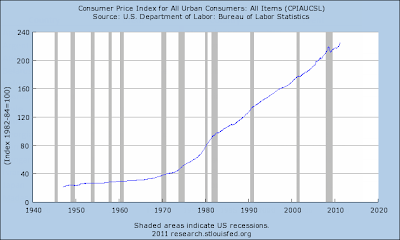
CPI 1960-2011


The above chart shows the CPI as computed by the BLS. Many would dispute that chart. I dispute it for completely different reasons.

I think actual housing prices belong in the CPI, not Owners' equivalent rent that is the single largest component in the CPI with a 25.2% weighting.

I have talked about this many times before but the most recent chart I have is a year old. Please consider Case-Shiller CPI Now Tracking CPI-U; Real Interest Rates Are Once Again Negative
CS-CPI vs. CPI-U


click on chart for sharper image
Note that at the height of the property bubble CS-CPI was at 8% vs. 4% as reported by CPI-U. The opposite happened in the housing crash. Given the renewed downturn in housing, CPI inflation is overstated now.

Four Quadrants of Inflation


click on chart for sharper image

Archie Kangethe wrote "The data from the US government would lead me to believe we are in the lower left quadrant, but my daily life leads me to believe we are in the upper left."

Is one's daily life a measure of inflation? Can one ignore housing? Is there a representative basket? More importantly, where to from here?

Inflation may be high as measured by commodities, education, and energy but not housing, electronics, or food bought on sale and stored. I do all of our grocery shopping and I think food is a bargain. Sale prices on meat are no higher than they were 10 years ago.

As noted above, I do not think one should ignore housing. Housing prices used to be the CPI at one point until someone got the not-so bright idea to use rent prices instead.

The CPI would certainly be lower today if housing prices were factored in. It would have been way higher in 2006. Greenspan missed huge inflation by failing to incorporate housing prices. Bernanke repeated Greenspan's mistake.

Prices a Poor Measure of Inflation

Regardless of how one feels about the above price commentary, prices are a poor measure of inflation for numerous reasons that I have spelled out at length. One such example is Inflation: What the heck is it written way back in 2006.

I have since changed my definition slightly to include a "mark-to-market" valuation of credit.

Certainly by my own definition we have been in a period of inflation since March 2009 even though various measures of credit have declined.

Another way of looking at things is by conditions one might expect to see in periods of inflation, deflation, and hyperinflation as described in Humpty Dumpty On Inflation in December of 2008.

At that time, a table of 16 factors signaled deflation. Most are synonymous with inflation now. However, and I keep point this out to many deaf ears, my model has been the US would go in and out of deflation over a long period of time similar to Japan.

We were in deflation then, we are not now, and I expect another credit crunch and another round of deflation to which Bernanke will likely respond again, probably pushing gold up again.

Four Quadrant Inflation as a Method of Investing

Can it Be that it was all so simple then?
Or has time rewritten every line?


No, it's not that simple. In 13 times since 1971 inflation was "low and falling" yielding a return of 12%. In 2008 inflation was low and falling yielding a return of -50% or so depending on what index one wants to measure. Foreign equities did worse because of the rising dollar.

By the way, I need to be fair to JPMorgan. They posted that quadrant chart without comment. They did not say it was a way to invest.

Nonetheless, assume for a moment that Kangethe is correct, and that inflation is high and rising. Look at the upper left quadrant. Does one expect cash to return 7%? With interest rates near zero, I should hope not.

Are commodities even the place to be now? Personally I doubt it as explained in Manufacturing ISM Prices Paid Hits Another High, Up 22nd Consecutive Month; Inflation Hysteria?

Four Quadrants a Poor Investing Model

The four quadrant model of investing has two more serious flaws.

  1. It fails to consider in valuation
  2. It fails to factor in cycles of PE-expansion and PE-Contraction

Valuations Matter

Valuations are a critical factor in investment decisions.

In case you missed it, please consider Negative Annualized Stock Market Returns for the Next 10 Years or Longer? It's Far More Likely Than You Think
Annualized Rates of Return for Select Years


Click on any table to see a sharper image

Note how much the starting PE valuation matters. Someone who started investing in 1929 received an annualized rate-of-return of 0% for two full decades, even if they religiously reinvested dividends every year.

However, someone investing in 1982 received an excellent annualized rate-of-return for two full decades (12% for the first decade and 9% annualized for 20 years).

Note year 2000. Starting valuations were the highest in history. It should not have been a surprise to discover that 10 years later, the annualized rate-of-return was -2%.

Bear in mind, the Case-Shiller normalized PE for the year ending 2010 is 23. Does that bode well for the next decade?

Cycles of PE Compression and Expansion


Over long periods of time PE ratios tend to compress and expand. Unless "it's different this time", history says that we are in a secular downtrend in PEs. From 1983 until 2000, investors had the tailwinds PE expansion at their back. Since 2000, PEs fluctuated but the stock market never returned to valuations that typically mark a bear market bottom.

Moreover, demographically speaking, the current decade not only starts with very rich valuations, but also comes at a time when peak earnings of boomers have passed. Those boomers are now heading into retirement and will need to draw down savings, not accumulate large houses and more toys.

Of course, the market can of course do anything this year (or the next few years), but history strongly suggests that stock market returns for the next 10 years will be lean years, perhaps negative years.
Commodities Analysis

In regards to Quadrant I investing (high and rising), once again assuming that is where we are (which I doubt), does one really want to plow into silver at $50 up from 5, oil at $110 up from $35, etc?

Someone may, but I don't, especially given the headwinds I noted at the beginning of this post. The time to buy sectors is when they are undervalued and unloved, not when nearly every hedge fund in the world is plowing into commodity futures and leveraged mo-mo bets on equities.

Are there any bears left? On anything other than the dollar and treasuries?

Ironically, cash can do well at zero% if commodities and equities both tank. Given extreme bullish sentiment including a number of prominent bears throwing in the towel, that is a rather likely possibility.

Mike "Mish" Shedlock
http://globaleconomicanalysis.blogspot.com
Click Here To Scroll Thru My Recent Post List


Copyright 2009 Mike Shedlock. All Rights Reserved.
View My Stats