MISH'S
Global Economic
Trend Analysis

Recent Posts

Tuesday, May 31, 2011 8:19 PM


"The Longer you Wait the Higher the Haircut. Greece is not Even in the EU's Hands. Let this be a Warning to the U.S."


Mish Moved to MishTalk.Com Click to Visit.

In the video below, Terrence Keeley at Sovereign Trends LLC discusses Greek restructuring, why Germany backed down on restructuring, and what it ultimately means. The video is outstanding, please play it.


If the video does not play here is the Bloomberg link Sovereign Trends' Keeley Interview

Terrence Keeley, senior managing principal at Sovereign Trends LLC and a Bloomberg Television contributing editor, discusses the outlook for additional aid to Greece from the European Union. EU officials will decide on more aid by the end of June and have ruled out a “total restructuring” of the nation’s debt, said Jean-Claude Juncker, head of the group of euro-area finance ministers. Keeley speaks with Erik Schatzker on Bloomberg Television's "InsideTrack."
Key Quotes

  • The Longer you wait the higher the haircut.
  • Germany backed off over bank threats, Europe is ill-prepared for restructuring.
  • A lot of people talk about getting Greece back on its feet. The truth of the matter is Greece has not been on its feet for several millennium
  • 40% of Greek GDP is government workers. Until that problem is fixed there is no solution for Greece's economy.
  • The reality is Greece is a goner, Ireland is very, very tough and Portugal is the same. We could have more.
  • Keeping the Brady Plan in your back pocket is a very good idea.
  • Everyone is clapping their hands this morning but Greek CDS imply a 70% chance of default. The market expects Greece to default, and the market is right
  • This is not even in the EU's hands.
  • Let this be a warning to the United states. The US can still control its situation, Greece cannot.


I agree with everything Terrence Keeley said in the interview.
Mike "Mish" Shedlock
http://globaleconomicanalysis.blogspot.com
Click Here To Scroll Thru My Recent Post List

11:14 AM


TV Censorship in China; Reflections on the Yuan as a Global Reserve Currency; Hype Sells


Mish Moved to MishTalk.Com Click to Visit.

An interesting article in the Financial Times got me thinking once again about the popular notion that the Yuan is about to replace the dollar as the global reserve currency.

Please consider a couple brief snips from Beijing in fresh TV censorship move

The Chinese government has stepped up censorship of local television in a sign of the broadening of a political crackdown that has landed many dissidents in jail.

China has severely clamped down on activists since February when an anonymous online appeal called for demonstrations along the lines of the “jasmine revolution” sweeping north Africa and the Middle East.

Authorities have detained scores of human rights lawyers, activists, and writers. They have also arrested Ai Weiwei, the contemporary artist.
Reserve Currency Requirements

So what does this political crackdown say about the likelihood that the Yuan will soon replace the US dollar as the world's reserve currency? First consider what it takes to be the world's reserve currency.

  1. Deep, liquid, open bond markets
  2. Floating currency
  3. Property rights, civil rights
  4. Political stability
  5. Political freedom

China flunks on at least 4 of 5 points, and arguably all 5. It may be a decade before China even floats the Yuan. How long before China has a deep, liquid, bond market? You tell me, because I don't know, but I assure you it is not in the next three years.

For further discussion please see Bogus Threats to US Reserve Currency Status: No Country Really Wants It!

Yet somehow hyperinflationists persist in spreading nonsense that the Yuan is somehow on the verge of replacing the dollar as a global reserve currency and that may cause hyperinflation.

There certainly may be more local trading in the Yuan. In fact, it is likely. That does not imply the death of the dollar or the loss of reserve currency status and it certainly does not portend hyperinflation.

Hyperinflation is the complete loss of faith in a currency. Should that happen to the US, the entire global banking system blows up. Global trade blows ups. If China refuses US dollars, then China's exports to the US stop, overnight. So do Japan's.

So what does that do to the economies of Japan and China? What would that do to the economies of Canada and Australia? Think about Chinese and Japanese exports and the demand for commodities.

Whether they realize it or not, that is the story hyperinflationists peddle. It simply is not a credible story as noted in Hyperinflation Nonsense.

Hype Sells

No Virginia, the US Dollar is Not Headed to Zero any time soon. Might the dollar slowly decay over decades? Sure why not? It already has. However, that is not hyperinflation.

Yes, the US has problems, so does Japan, so does China, so does the Euro-Zone, and so does the UK. Indeed global currency problems and insolvent banks are everywhere one looks.

However, myopic eyes are primarily focused on the US. Here's the deal. The US dollar is not suddenly going to zero vs. the Pound, the Yen, the Yuan, or the Euro, yet that is what hyperinflation implies.

Why is the "hyperinflation is imminent" scare everywhere you look? The answer is simple: Hype Sells.

The bigger the hype, the sexier the story, and the more people are attracted by it.

Mike "Mish" Shedlock
http://globaleconomicanalysis.blogspot.com
Click Here To Scroll Thru My Recent Post List

10:19 AM


Hooray! Greece "Saved" Again; Can it Possibly Matter?


Mish Moved to MishTalk.Com Click to Visit.

The overnight markets were all giddy about the notion that Greece will be saved for the umpteenth time. I have a set of questions: How can it possibly matter?

What about Ireland?
What about Portugal?
What happens when Spain needs a bailout?
What happens if the markets lose confidence in Italian debt?

Further problems in Ireland, Portugal, Spain, and Italy are all highly likely, and the first three are a given. So does, it matter that Greece is saved?

By the way, IS Greece saved? How many times can a country be saved?

In case you missed it on this long holiday weekend, please consider Europe at the Abyss; US Housing in the Abyss; Who is to Blame? for a look at structural problems facing Europe and the US and who is to blame for them.

Mike "Mish" Shedlock
http://globaleconomicanalysis.blogspot.com
Click Here To Scroll Thru My Recent Post List

Monday, May 30, 2011 10:23 PM


Retail Sales Plunge in Italy, Dip Elsewhere in Euro-Zone


Mish Moved to MishTalk.Com Click to Visit.

Things are about to get very interesting in Italy where consumers have gone a sudden spending hiatus. Bloomberg reports European Retail Sales Contract to 7-Month Low

European retail sales contracted in May to the lowest level since October 2010, driven by a “sharp drop” in Italy, Markit Economics said.

A gauge of euro-area retail sales fell to 48.8 from 52.2 in April, London-based Markit Economics said today in a statement. The index is based on a survey of more than 1,000 executives and a reading above 50 indicates month-on-month expansion.

Italian retail sales declined at the fastest pace in 11 months in May, while monthly increases in Germany and France, the euro area’s largest economies, were the weakest in seven and three months, respectively, Markit said.
Eurozone retail sales fell in May

Please consider Eurozone retail sales fell in May
Retail sales in the Eurozone fell for the first time in three months in May, according to Markit’s latest PMI (Purchasing Managers' Index) survey. Moreover, sales were only marginally higher than one year earlier, and retailers cut both staff levels and purchasing during the month. Of the three largest euro economies covered, Italy remained the main source of weakness, while France and Germany both registered slower growth.

Across the Eurozone as a whole, retail sales were up only slightly on a year earlier in May. This was in contrast to the trend seen in April, when retail sales grew at the fastest annual pace in nearly three years (although this partly reflected the timing of Easter in 2011 compared to 2010).

In line with the pattern for month-on-month sales trends, Germany and France registered slower annual growth of retail sales in May while Italy posted a steep fall.

In a further sign that the retail sector was contracting, the value of goods purchased by retailers fell during the month. This was the first drop in purchasing activity for seven months.

Moreover, it occurred despite a further sharp rise in average wholesale prices, suggesting a steep fall in the volume of new items bought for resale. Purchase price inflation eased slightly since April, but remained relatively sharp.

Reflecting intense cost pressures and declining sales values, retailers suffered the worst drop in gross margins for a year in May. This contributed to a decline in headcounts in the sector, the first since last November.
Retail Sales by Country


That is one hell of a drop for Italy.

Note how poorly Italy fared in the 2008-2009 recession compared to France and Germany. Unless this is an outlier, Italy is headed for recession. Is the ECB prepared for that? Are the bond markets?

Italy 10-Year Government Bonds


If Italian government bonds break North of that range, not led by a general rise across the Euro-Zone, especially Germany, then kiss contagion-containment goodbye.

Mike "Mish" Shedlock
http://globaleconomicanalysis.blogspot.com
Click Here To Scroll Thru My Recent Post List

12:23 PM


Europe at the Abyss; US Housing in the Abyss; Who is to Blame?


Mish Moved to MishTalk.Com Click to Visit.

Robert Samuelson on Real Clear Politics says Europe at the Abyss

It has come to this. A year after rescuing Greece from default, Europe is staring into the abyss. The bailout has proved insufficient. Greece needs more money, and it can't borrow from private markets where it faces interest rates as high as 25 percent. There is no easy escape.

What's called a "debt crisis" is increasingly a political and social crisis. Already, unemployment is 14.1 percent in Greece, 14.7 percent in Ireland, 11.1 percent in Portugal and 20.7 percent in Spain.

Some causes of Europe's plight are well-known: the harsh recession following the 2008-2009 financial crisis; aging populations coupled with costly welfare states. But there's also another less recognized culprit: the euro, the single currency now used by 17 countries.

Launched in 1999, it aimed to foster economic and political unity. For a while, it seemed to succeed. In the euro's first decade, jobs in countries using the common currency increased by 16 million.

It was a mirage. For starters, the euro fostered a credit bubble that led to booms in housing, borrowing and consumer spending. But one policy didn't fit all: Interest rates suited to Germany and France were too low for "periphery" countries (Greece, Ireland, Portugal and Spain).

Money poured into the periphery countries. There was a huge compression of interest rates. In 1997, rates on 10-year Greek government bonds averaged 9.8 percent compared to 5.7 percent for similar German bonds. By 2003, Greek bonds fetched 4.3 percent, just above the 4.1 percent of German bonds.

"The markets failed. All this would not have occurred if banks in Germany and France had not lent so much," says economist Desmond Lachman of the American Enterprise Institute. "It was like the U.S. housing market." Both American and European banks went overboard in relaxing credit standards.
"Markets Failed" Says Desmond Lachman

Few economic statement make my hair stand straight up more than that bit of complete nonsense from Lachman. The markets did not fail. Bureaucrats who dreamed up the Euro failed.

Those bureaucrats devised a currency union with nothing more than suggestions on fiscal controls. Making matters far worse, countries in the Euro-Zone have widely differing political philosophies and policies.

That currency union was not brought about by the market. The free market would never have done such a silly thing.

Every major currency union in history without a political and fiscal union has failed. There is a nice Table of Monetary Unions on the site Euro Know that shows just that.

Bureaucrats, not the free market knew better. Bureaucrats, not the free market failed.

Not Different This Time

Potential problem were recognized well in advance by many. In February 1995 The Independent wrote a misguided editorial Why we say Yes to a single currency.

The rationale of The Independent was "It's different this time".
The economic arguments that, on balance, Britain will be better off inside the currency union than outside are persuasive. The discipline of a permanently fixed exchange rate would significantly reduce the risk of a return to high inflation and create greater certainty for companies and investors. There would also be lower transaction costs. There is no doubt that a successful single currency would strengthen Europe's position on the global economic stage.

The opponents of the single currency do not agree. They argue that the experience of the ERM and events since Black Wednesday show that to be locked into a single currency is damaging. Exchange rates, they point out, can act as important "shock absorbers" in times of unexpected crisis. These are powerful arguments. They are most powerful when applied to some EU members - notably Spain, Portugal and Greece - whose less developed economies would make the exigencies of a single currency regime punishing, unpopular and potentially disastrous.

But this is not the condition of Britain today. In 1992 the needs of the British economy were at odds with the priorities of the Bundesbank. They were trying to control inflation, we needed to get out of recession. By contrast, in 1999 six or seven countries will find themselves at the same stage in the cycle, with very similar economic priorities. So things are likely to be different.
Points of Failure Predicted In Advance

Things were not different were they?

Ironically, in that 1995 article, The Independent pointed out the exact points of failure: Spain, Portugal and Greece.

Tony Dolphin, Chief Economist of AMP Asset Management, wrote a response to that article less than a week later. Please consider, European monetary union: the benefits, the problems and the traveller's tale
The potential benefits of European monetary union are questionable, the potential costs could be very serious. A successful monetary union requires that the economies joining it are broadly the same, especially in regard to their response to external and internal inflation shocks. This is not the case in Europe. Take two examples: oil and housing.

The effect of a sustained, steep rise in the oil price will be very different in Germany, which is highly dependent on imported oil and gas; in France, where nuclear power is used to generate a high proportion of energy needs; and in the UK, where the North Sea sector of the economy would actually benefit. Imagine trying to set an appropriate, anti-inflationary interest rate policy for a monetary union including these three economies should the oil price double.

The housing sectors of European economies also differ, with the UK's high level of home ownership financed by variable rate mortgages not being found elsewhere. It is easy to envisage a situation where the interest rate policy of a European monetary union was entirely inappropriate for the housing sector of the UK economy.

These and other structural differences between European economies will not disappear over the next four years, nor at any time in the foreseeable future. Until they do, the economic argument against European monetary union is powerful, and far more clear cut than the political arguments for or against.

Yours faithfully,
Tony Dolphin
Chief Economist
AMP Asset Management
Failure of the "One Size Fits Germany Policy"

I have no idea what Tony Dolphin is doing today but put him in the class of those who can say "I told you so." Here is the key paragraph:

"It is easy to envisage a situation where the interest rate policy of a European monetary union was entirely inappropriate for the housing sector of the UK economy."

The UK did not adopt the Euro but Spain did. Interest rates in Germany were not appropriate for Spain. The result was a Spanish housing bubble of epic proportion that has now collapsed.

One interest rate policy simply does not work. For further discussion, please see ECB's "One Size Fits Germany" Policy; Rate Hikes to Stress PIIGS

Compounding Spain's misery, Trichet has embarked on a rate-hiking campaign at the worst possible time, with Spanish unemployment in excess of 20%, and youth unemployment near 40%.

Housing Market Nonsense

Note that Lachman also blames US banks for the housing bubble.

"It was like the U.S. housing market." Both American and European banks went overboard in relaxing credit standards.

That too is nonsense in that it does not place the blame where it belongs, on the Fed. The Fed held interest rates too low, too long. Money was too loose, banks lent.

Blaming banks for lending when real interest rates are hugely negative is tantamount to placing a bottle of vodka in front of an alcoholic, telling the alcoholic it is the best vodka in the whole world, then blaming the alcoholic for what happens next.

Fed is the Problem

Not only did the Fed hold interest rates too low, too long, the Greenspan Fed endorsed derivatives, subprime loans, and adjustable rate mortgages. Meanwhile Bush was praising the "Ownership Society" and Barney Frank was in the back pocket of Fannie Mae and Freddie Mac.

Ben Bernanke was totally clueless, in complete denial about the bubble, going so far as to say home prices were "based on fundamentals".

None what has transpired has had remotely anything to do with the failure of the free markets. We have a failure of regulation, not a failure to regulate. Lachman, like Bernanke, really needs to get a clue.

You cannot fix a problem until you understand what the problem is. Unfortunately, politicians and economists in both the US and Europe are still in denial. Statements by those blaming markets instead of politicians and the Fed, do not help.

Addendum:

The biggest failure of regulation was the very creation of the the Fed. That should be be obvious but the sad state of affairs in regards to economic understanding says I need to spell it out.

Those screaming about the free market need to answer this question: Could the free market possibly have done any worse the serial bubble-blowing moral-hazard policies of the Fed?

Mike "Mish" Shedlock
http://globaleconomicanalysis.blogspot.com
Click Here To Scroll Thru My Recent Post List

10:24 AM


Morocco: Antigovernment protesters clash with police; Kuwait: 2,000 rally to demand resignation of embattled prime minister


Mish Moved to MishTalk.Com Click to Visit.

Here is a pair of stories from the Los Angeles Times regarding still more protests. This time in Morocco and Kuwait.

Morocco

Antigovernment protesters clash with police

Thousands of demonstrators Sunday took to the streets of Casablanca, the country's largest city, in an antigovernment protest police struggled to disperse, driving into the crowd on motorcycles, armed with clubs.

A similar protest in the capital's twin city of Sale on Sunday also was violently disrupted, as was a demonstration in front of the Moroccan parliament Saturday.
Protesters in Casablanca


Moroccan Police Battle Crowds


The LA Times credits the videos to well-known blogger named "Mamfakinch" (which roughly translates as "We won't give up").

Kuwait

2,000 rally to demand resignation of embattled prime minister
Pressure is building on Kuwait's embattled Prime Minister Sheikh Nasser Mohammad Ahmad Sabah, who has come under fire for refusing to be questioned in parliament for allegedly misusing public funds, among other accusations.

Around 2,000 people took to the streets of the oil-rich gulf country's capital amid tight security, chanting, "The people want to topple the head [of government]," in reference to Sheikh Nasser, according to [news agency] Agence-France Presse.

The 71-year-old Sheikh Nasser's five years as premier have been marked by turbulence and he has come under constant fire by the opposition. He has resigned six times, and he formed his seventh Cabinet a couple of weeks ago.

Kuwaiti protesters are reportedly staging new rallies next Friday that they have dubbed "Day of Departure."
Much of the world is simmering from high unemployment, corruption, rising food prices, and austerity programs.

Mike "Mish" Shedlock
http://globaleconomicanalysis.blogspot.com
Click Here To Scroll Thru My Recent Post List

1:18 AM


Panic Capital Flight in Greece, Depositors Yank 1.5 Billion Euros in 2 Days;EU Wants Severe Bail-Out Conditions Including International Tax Collection


Mish Moved to MishTalk.Com Click to Visit.

Courtesy of Google translate please consider They lifted 1.5 billion Thursday and Friday from banks

Only a few steps separating from Friday to yesterday's mass panic! From early morning to counter the banks there is serious pressure for withdrawals of deposits, especially small amounts. The pressure on banks began last Wednesday, culminating in yesterday's day.

It is significant that Thursday and Friday, banking sources estimate that rose around 1.5 billion euros in total! According to the same month in May estimated the outflow estimated at least 4 billion from 2 billion in April.

The majority of depositors rushed to withdraw for pensioners and small savers and amounts ranging from 2-3000 lifted until 10 -15 000 euros. Motivation in most cases it was the fear that led the country into bankruptcy, deposits frozen even temporarily left without cash, or even lose their savings.

Politicians do not seem to fully understand the risks posed by a widespread panic, not only for the stability of the banking system but for the economy and the country.
EU Requests Severe Bail-Out Conditions Including International Tax Collection

The Financial Times reports Greece set for severe bail-out conditions
European leaders are negotiating a deal that would lead to unprecedented outside intervention in the Greek economy, including international involvement in tax collection and privatisation of state assets, in exchange for new bail-out loans for Athens.

People involved in the talks said the package would also include incentives for private holders of Greek debt voluntarily to extend Athens’ repayment schedule, as well as another round of austerity measures.

Officials warned, however, that almost every element of the new package faced significant opposition from at least one of the governments and institutions involved in the current negotiations and a deal could still unravel.

In the latest setback, the Greek government failed on Friday to win cross-party agreement on the new austerity measures, which European Union lenders have insisted is a prerequisite to another bail-out.

Officials think Greece will be unable to return to the financial markets to raise money on its own in March – as originally planned in the current €110bn package – meaning that the IMF is now forbidden from distributing any additional cash. Without the IMF funds, eurozone governments would either be forced to fill the gap or Athens could default.
30,000 Protest in Greece

Courtesy of Google Translate More than 30,000 Greeks in Athens take center inspired by the protests of Spain

Some 30,000 people, police said, more as protesters have gone to the streets Sunday in Athens to protest the Greek political class. The demonstration has been called through social networks, as well as in Spain, and the participants cited the movement as a reference 15M.

"We've had enough. The politicians are laughing at us. If things continue like this, our future will be very hard," said one of demonstrators gathered outside the headquarters of the Greek Parliament in Syntagma Square, while his teammates chanted "Thieves, thieves!".

This is the fifth day of protests in Syntagma Square and this time they have been joined by a Spanish group who wanted to express solidarity with the merger.

"People were outraged, but needed motivation to express themselves. The Spanish have given us that motivation," said Argyrou Iphigenia, an insurance agent, told Reuters. "We're not asleep. We are awake. The IMF must go. There are solutions without them," he argued.
Is it any wonder people are yanking money out of Greek banks? How long before a bank freeze?

Mike "Mish" Shedlock
http://globaleconomicanalysis.blogspot.com
Click Here To Scroll Thru My Recent Post List

Sunday, May 29, 2011 10:49 PM


Who's the Bigger Socialist, President Obama or the Socialist Prime Ministers from Greece and Spain?


Mish Moved to MishTalk.Com Click to Visit.

Courtesy of Google Translate More than 30,000 Greeks in Athens take center inspired by the protests of Spain

Some 30,000 people, police said, more as protesters have gone to the streets Sunday in Athens to protest the Greek political class. The demonstration has been called through social networks, as well as in Spain, and the participants cited the movement as a reference 15M.

"We've had enough. The politicians are laughing at us. If things continue like this, our future will be very hard," said one of demonstrators gathered outside the headquarters of the Greek Parliament in Syntagma Square, while his teammates chanted "Thieves, thieves!".

This is the fifth day of protests in Syntagma Square and this time they have been joined by a Spanish group who wanted to express solidarity with the merger.

"People were outraged, but needed motivation to express themselves. The Spanish have given us that motivation," said Argyrou Iphigenia, an insurance agent, told Reuters. "We're not asleep. We are awake. The IMF must go. There are solutions without them," he argued.
The above link thanks to Bran who lives in Spain. Bran has been sending me links every day for a year. Here is the original link in Spanish: Más de 30.000 griegos toman el centro de Atenas inspirados por las protestas de España

Socialist PMs Selling State Owned Assets, Committed to Anti-Union Reforms

The most amazing thing to me is how socialists in Spain and Greece are committed to selling off state owned assets and property while embarking on a path of reform that is 180 degrees removed from socialism.

Reform is much needed of course but unions protest every step of the way, just as has happened in the US, notably Madison, Wisconsin.

As it sits now, President Obama is a far bigger socialist in practice than either the Prime Minister of Greece, George Papandreou (representing the Panhellenic Socialist Movement party) or José Luis Rodríguez Zapatero, the Prime Minister of Spain (representing the Spanish Socialist Workers Party).

The issue in Europe is whether everything blows sky high before reform takes hold. Given the payback from reform is measured in years, not months, the bond market continues to bet on default.

At the moment, socialist Prime Ministers in Greece and Spain are committed to reform. In the US, president Obama remains committed to the socialist policies that destroyed Greece and Spain.

Mike "Mish" Shedlock
http://globaleconomicanalysis.blogspot.com
Click Here To Scroll Thru My Recent Post List

1:28 PM


French President Says Bondholders Must Share Greek Pain; Greece Mulls Setting up Bad Bank; Lagarde Says Greece Needs "Support" Not Restructuring


Mish Moved to MishTalk.Com Click to Visit.

Christine Lagarde, French finance minister, fully cements her appointment as next IMF Chief, toes the previous IMF line with a nonsensical statement: Greece Needs ‘Support’ Instead of Debt Restructuring

Christine Lagarde, French finance minister and a candidate to head the International Monetary Fund, said Greece needs “support” and its debt shouldn’t be restructured.

“It’s essential that we retain a balance,” Lagarde said today on Europe 1 radio. “Greece has made significant efforts and we have to support those efforts,” she said.
Soft Default

Support, Reprofiling, soft restructuring, and restructuring all mean the same thing: default. As long as everyone is tossing out words to hide the obvious, the words "soft default" have still not been claimed.

Der Speigel Claims Greece Missed All Financial Targets

Via Google translate, please consider EU threatens Greece with funding freeze
Hamburg - It is a clear warning to the Greek government: Because of the lack of pace of reform, the European Union, the payment of the next loan tranche to Greece in question.

The International Monetary Fund (IMF) is considering the words of Prime Minister of Luxembourg Jean-Claude Juncker , the planned transfer to refuse June. "Over the next installment we will decide according to the report of the troika," said Rehn, adding: ". The situation is very serious"

The team of experts from the European Central Bank , IMF and EU Commission, the economic and fiscal condition of Greece examined the will, according to information obtained by SPIEGEL, in its quarterly report on an alarming finding: Greece miss all agreed fiscal targets
For those who can read German, here is the original link: EU droht Griechenland mit Zahlungsstopp

IMF Denies Greece Missed Targets

The IMF and Greek Finance Minister responded to Der Speigel report with Talks Continuing, Targets Not Missed
Greek Finance Minister George Papaconstantinou said talks with European Union and International Monetary Fund officials in Athens were still under way, denying reports the team had said Greece has missed its targets.

“The talks are continuing and will wind up in the next few days,” Papaconstantinou said in a phone interview with Greece’s Mega TV channel. “I have every reason to believe they will end positively for our country and that we will receive the fifth tranche.”

Papaconstantinou spoke to Mega after the TV channel reported unnamed IMF sources as saying the country had missed targets in a review under way under the 110 billion-euro ($157 billion) EU-led bailout. Greece is subject to quarterly reviews by a team of officials from the EU, IMF and European Central Bank before each payment of loans under the bailout.

The minister said Mega’s report and another cited by Mega in German magazine Der Spiegel were inaccurate as the inspection hadn’t finished and no report had been written.
Greece Mulls Setting Up "Bad Bank"

Not that it will accomplish anything useful in regards to avoiding default, MSNBC reports Greece mulls setting up Spanish-style "bad bank"
Greece is considering setting up a Spanish-style "bad bank" to clean up its lenders' accounts from "toxic" Greek bonds and make them more attractive to potential buyers, a Greek paper reported on Sunday.

A 'bad bank', formed to hold risky assets owned by a state guaranteed bank, could be set up to absorb the risky Greek bonds held by state-controlled lenders slated for privatization, such as the Savings Post Bank, To Vima said.

"With problematic, Spanish savings banks (cajas) as a model, the finance ministry is examining proposals to implement the idea in the country," it said, without citing any sources.

Spain's Bankia, created from the merger of seven cajas, said last month it would create such a unit in a bid to attract investors ahead of a stock market listing.

Greek banks are believed to hold roughly 50 billion euros of Greece's outstanding sovereign bonds. The bonds have lost much of their nominal value in the wake of the Greek debt crisis, while a possible Greek debt restructuring could mean additional losses for the lenders.
Bondholders Must Share Greek Pain

Interestingly, French President Nicolas Sarkozy is now at odds with his finance minister, Christine Lagarde, over the need to restructure.

The Independent reports Bondholders must share Greek pain, says Sarkozy
French President Nicolas Sarkozy said bondholders need to share the burden of solving Greece's fiscal woes, following leaders in Germany and Luxembourg in raising the prospect of restructuring Greek debt.

Mr Sarkozy called for a "formula" involving investors, adding to talk that Europe might engineer an extension of Greece's debt-repayment schedule or press bondholders to buy new bonds as old ones mature.

"Restructuring is a poorly used word," Mr Sarkozy told reporters yesterday after a G8 summit in Deauville, France. "If it means that we can think of ways for the private sector, private operators, to take on a share of the burden, it's not restructuring at all; then there are formulas, there is no problem, and we should then converge in that direction."

Greek 10-year bonds trade at less than 55c on the euro, a sign of investors' diminishing expectations of being repaid in full.

Greek leaders meeting in Athens last night failed to agree on Prime Minister George Papandreou's new austerity plan. Conservative leader Antonis Samaras rejected the measures, saying they would "flatten the Greek economy and destroy Greek society".

In his first comments on a potential Greek restructuring, Mr Sarkozy gave no timeline for talks on pushing bondholders to take losses in Greece. A planned permanent European rescue fund would mandate some form of "private sector involvement" as of mid-2013.
No Problem?

Excuse me, but all three rating agencies said that any extension of Greek debt would be considered a default and trigger CDS contracts.

Back of Irish Government Will Crack

Think this crisis can be postponed to mid-2013? Including Ireland and Portugal?

I don't nor does Nouriel Roubini. The article continues ...
For now, economists including Nouriel Roubini estimate that Greece has a financing hole of about €60bn over the next two years.

Meanwhile, Ireland may be plunged into a "disastrous" sovereign debt crisis within three years as the cost of rescuing its banks mounts, Nouriel Roubini, who predicted the global financial crisis, said.

"Eventually the back of the government is going to crack" by "taking all the huge losses of the banking system," said Mr Roubini at a conference in Budapest yesterday.

The approach will "lead us with almost near certainty to a sovereign debt crisis in Ireland in a matter of two or three years".

"Eventually we're going to have a sovereign debt crisis that's going to be disastrous for Ireland and for the eurozone," Mr Roubini said.
Eventually will arrive sooner, rather than later.

Indeed, I would not be surprised if this crisis blew sky high within weeks or even days. That said, perhaps there is one more rabbit in the hat. There always seems to be.

Mike "Mish" Shedlock
http://globaleconomicanalysis.blogspot.com
Click Here To Scroll Thru My Recent Post List

12:20 PM


Yemen Coastal Town Falls to Al Qaeda


Mish Moved to MishTalk.Com Click to Visit.

The New York Times reports Militant Group Tightens Grip on Coastal Town in Yemen

An Al Qaeda group tightened its grip on a Yemeni coastal town on Sunday while a truce was holding in the capital city of Sana after nearly a week of deadly street fighting.

Opposition leaders claimed that President Ali Abdullah Saleh had allowed the city of Zinjibar, on the Gulf of Aden, to fall to the militants in order to raise alarm in the region that would in turn translate to support for the president.

Armed men believed to be from Al Qaeda appeared to have full control of Zinjibar, in the province of Abyan.

Also on Sunday, a breakaway military group called for other army units to join them in the fight to bring down President Ali Abdullah Saleh, piling pressure on him to end his three-decade rule.

“Security withdrew and left the city of Zinjibar to armed Islamic elements that looted government institutions,” Ali Dahams, a leftist opposition official in Abyan province, said. Opposition groups have said they could do a better job of containing al Qaeda than the president.

In Sana, pedestrians and cars returned to streets where pitched battles during nearly a week of fighting killed at least 115 people.

The latest violence, pitting Mr. Saleh’s forces against members of the powerful Hashed tribe led by Sadeq al-Ahmar, was the bloodiest since pro-democracy unrest erupted in January and was sparked by Mr. Saleh’s refusal to sign a power transfer deal.

Forces loyal to Mr. Ahmar handed back control of a government building to mediators as part of the cease-fire deal, witnesses said. It was the first building seized by the tribesmen that was handed back as part of the truce intended to normalize life in Sana, where fighting with machine-guns, rocket-propelled grenades and mortars prompted thousands of residents to flee.
For years the US openly supported the corrupt regime in Yemen. What did it get us? Now Yemen is in financial and moral ruin and an alleged Al Qaeda group holds a city on the Gulf of Aden.

Mike "Mish" Shedlock
http://globaleconomicanalysis.blogspot.com
Click Here To Scroll Thru My Recent Post List

12:33 AM


Political Pandering by Mitt Romney in Iowa Regarding Ethanol from Corn


Mish Moved to MishTalk.Com Click to Visit.

In contrast to what many believe, I do not support political parties. I support and vehemently defend policies that make sense, and attack those that don't.

In case you did not know that, I am going to surprise you with a blast of Republican presidential candidate Mitt Romney who is pandering to the Iowa farmers with a message "I Support the Subsidy of Ethanol".

On his first trip back to the nation's first voting state as a soon-to-be declared presidential candidate, former Massachusetts Gov. Mitt Romney reaffirmed his support for federal ethanol subsidies -- an always important campaign issue in Iowa that figures to take on an even more central role in the divided GOP field.

"I support the subsidy of ethanol," Romney told a potential voter after an event here was cut short by a fire alarm. "I believe ethanol is an important part of our energy solution in this country."

Support for ethanol subsidies has long been considered a political necessity for candidates who want to succeed in the Iowa caucuses, but former Minnesota Gov. Tim Pawlenty tested that maxim on Monday during his official campaign announcement here.

"The truth about federal energy subsidies, including federal subsidies for ethanol, is that they have to be phased out," Pawlenty said. "We need to do it gradually. We need to do it fairly. But we need to do it."

Pawlenty was widely praised in fiscally conservative circles for taking a stance against the subsidies, which cost taxpayers about $5 billion in 2010, while former House Speaker Newt Gingrich has been singled out for criticism by influential conservative media outlets, including the Wall Street Journal editorial board, for his vocal support of subsidized ethanol.

Romney supported ethanol subsidies during his unsuccessful 2008 presidential run, in which he largely banked on winning the Iowa caucuses but finished a disappointing second to former Arkansas Gov. Mike Huckabee.
Political Pandering

Dave, a friend of mine, sent me the above article and said "what a whore".

By the way, Dave is a Republican. He voted for McCain in the last election (I wrote in Ron Paul). We need more Republicans like Dave willing to voice their criticism because that is the only way we are going to get change.

Here's the deal. Either Romney is a whore or he is ignorant. He could be both. Romney may be far better than Obama, but that is beside the point.

The point is ethanol from corn makes no sense. Ethanol from corn costs energy to produce and is only viable because of government subsidies. Ethanol from sugar cane makes sense, but the US has tariffs on Brazilian ethanol in order to support inefficient, energy wasting ethanol from corn.

Remove Tariffs, Legalize Hemp

Want to lower gas prices? Then remove tariffs on ethanol.

If you want biofuels, then legalize hemp.

Hemp needs no fertilizer, its fiber is softer than cotton, its seeds high in oil content, and it grows on poor soil.

Those are admirable properties. Does that make hemp viable for biofuels? I suspect so, but to be truthful, I just don't know. What I do know is if we get government subsidies out of the way and end needless regulation, the free market will find a way.

Get Rid of Big Government

Republican candidates ought to be supporting free market, small government policies. Instead, it is very disheartening to see Romney whoring Iowa voters on the same big government subsidy side as president Obama.

Mike "Mish" Shedlock
http://globaleconomicanalysis.blogspot.com
Click Here To Scroll Thru My Recent Post List

Saturday, May 28, 2011 4:18 PM


Violence in Bracelona: Police Break Up Protesters With Clubs, Rubber Bullets


Mish Moved to MishTalk.Com Click to Visit.

Peaceful protests in Spain have come to an end as Police fire rubber bullets at protesters in Barcelona

Spanish police fired rubber bullets and swung truncheons to disperse anti-crisis protesters in a Barcelona square Friday as cleaning crews cleared their tent camp.

Catalan police in anti-riot gear moved in after about 50 protesters sat down on the street to block a convoy of cleaning trucks leaving the Plaza de Cataluna square with remnants of the encampment.

Police, some with plastic shields, were shown on television dragging protesters along the street and swiping with truncheons at activists, who had been chanting: "They shall not pass."

Demonstrators chanted: "The people, united, will never be defeated!" and "No to violence!"

Cleaning crews with 10 lorries dismantled the last of the tents under police surveillance. Later, police left the square and let thousands of demonstrators flood in.

By the evening, at least 5,000 people were in the square protesting against the police intervention, some having put up tents. A dozen police vehicles were in streets leading to the square.

"What happened today was awful but it is a warning" for the country's leadership, said Ramon Deltran, 50, a psychiatrist.

"This is what police brutality achieves, that much more people protest. But also it is the fault of the politicians who don't listen to us," said Maite Loureiro, 30, an unemployed designer.

In Madrid's Puerta del Sol square, hundreds of demonstrators, many carrying flowers, shouted "Barcelona is not alone."
Violence in Barcelona


Link if above YouTube Video does not play: Indignats | Desallotjament de la Plaça Catalunya

There are also more videos and comments at the above link.

The New York Times has still more videos and commentary in Police Clash With Protesters in Barcelona
El PaĂ­s newspaper reported that 121 people were lightly injured, including 37 police officers, “as the result of a police charge” on the protest camp. Video posted on the Web site of 20minutos, a Spanish news site, showed the officers charging at protesters.

Citing a spokesperson for the authorities, who would not be named according to Catalan policy, Bloomberg News reported that about 300 people had been removed from the square.

The authorities said that police had left the area by 1 p.m. El PaĂ­s reported that protesters had returned to the square. Just a few hours after the arrival of police officers, protesters were passing out fliers decrying their behavior, and calling for people to return to the square at 7 p.m. to protest. On Twitter, an appeal went out for protesters to “bring flowers” when they returned. In the square and elsewhere in the city, there has been a nightly banging on pots and pans at 9 p.m. to show support for the movement.

Update: Here is a photograph of Plaça Catalunya taken by a reader, Víctor Riverola, at 7 p.m. local time on Friday evening showing that thousands of protesters returned:

Mike "Mish" Shedlock
http://globaleconomicanalysis.blogspot.com
Click Here To Scroll Thru My Recent Post List

1:32 PM


ECB Board Member Says Greece Can Raise $429 Billion Selling Assets; Greece’s Papandreou Vows to Press Austerity, Says Greece "Soon Out of the Woods"


Mish Moved to MishTalk.Com Click to Visit.

ECB member Juergen Stark says Greece may raise up to 300 billion euros from selloffs.

The ailing euro zone state, whose debt burden stands at around 330 billion euros, currently aims to raise 50 billion euros from privatizations by 2015 to help stave off a fiscal meltdown.

"The Greek government has shares in listed companies, it owns real estate. Experts estimate the sales potential at up to 300 billion euros," Stark told the newspaper according to a prerelease from its Sunday edition.

"(Greece) needs to intensify its efforts," Stark also said. "(The privatization program) is meant to raise 50 billion euros by 2015 and one should be more ambitious here."
Greece’s Papandreou Vows to Press Austerity

In spite of stiff opposition, Greece’s Papandreou Vows to Press Austerity
Greek Prime Minister George Papandreou said he’ll press ahead with new austerity measures after failing to win backing from the main opposition parties as he races to keep bailout funds flowing and avoid default.

Antonis Samaras, leader of Greece’s biggest opposition party, New Democracy, rejected the plan at a meeting with Papandreou and other opposition leaders in Athens, saying his party wouldn’t be blackmailed. Papandreou said he will go ahead with the measures even while continuing to seek support and ruled out early elections.

“My determination is to continue with this program in a very determined and decisive way,” Papandreou said today at a press conference in Athens. Greece has achieved “impressive” targets and there are signs of improvement in the economy, he said, adding that the country will “soon be out of the woods” by following through with plans for fiscal adjustment, state- asset sales and development of government-owned real estate.

European Union officials have called for consensus on the package, which includes an additional 6 billion euros ($8.6 billion) of budget cuts and a plan to speed 50 billion euros of state-asset sales, before approving more aid that Greece needs to avoid default. The wage cuts and tax increases Papandreou has imposed under a 110 billion-euro bailout last year have prompted strikes and protests, complicating efforts for compromise on the new plan.
Out of the Woods?

If Greece has a debt of 330 billion euros but can get rid of 300 billion euros of it by selling assets, then why does Greece need more aid? Has Greece all of a sudden turned a solvency problem back into a liquidity problem?

Color me skeptical.

If it was so easy, why hasn't it been done? I sense a bazooka bluff statement from Stark hoping to buy more time.

Mike "Mish" Shedlock
http://globaleconomicanalysis.blogspot.com
Click Here To Scroll Thru My Recent Post List

Friday, May 27, 2011 11:57 PM


YouTube Parody of Dominique Strauss Kahn to the tune of "Dominique" by the Singing Nun


Mish Moved to MishTalk.Com Click to Visit.

It's time for some light entertainment heading into Memorial Day weekend. Please consider this YouTube Parody of Dominique Strauss-Kahn to the tune of "Dominique" by the Singing Nun.


Link if the above video does not play: http://www.youtube.com/watch?v=24a-Qb327ok

Mike "Mish" Shedlock
http://globaleconomicanalysis.blogspot.com
Click Here To Scroll Thru My Recent Post List

10:59 AM


Pending Home Sales Plunge 11.6%; NAR Blames "Tight Credit", Weather, Temporary Soft Patch; Excess Reserve Nonsense Yet Again


Mish Moved to MishTalk.Com Click to Visit.

NAR chief economist Lawrence Yun blames banks for "holding onto huge cash reserves" as the primary reason for the latest plunge in housing. He also cites the weather, oil prices, a temporary soft patch, and everything but motherhood and apple pie.

Please consider April Pending Home Sales Drop After Two Monthly Gains.

Pending home sales fell in April with regional variations following increases in February and March, with unusual weather and economic softness adding to ongoing problems that are hobbling a recovery, according to the National Association of Realtors®.

The Pending Home Sales Index,* a forward-looking indicator based on contract signings, dropped 11.6 percent to 81.9 in April from a downwardly revised 92.6 in March. The index is 26.5 percent below a cyclical peak of 111.5 in April 2010 when buyers were rushing to beat the contract deadline for the home buyer tax credit.

The data reflects contracts but not closings, which normally occur with a lag time of one or two months.

Lawrence Yun, NAR chief economist, said the dip in contracts may be due to temporary factors. “The pullback in contract signings is disappointing and implies a slower than expected market recovery in upcoming months,” he said. “The economy hit a soft patch in April from sharply rising oil prices, widespread severe weather with the heaviest precipitation in 20 years, and a sudden rise in unemployment claims.”

Yun notes the growth in retail sales slowed measurably in April, while sales at furniture and home furnishing stores declined sharply. “Nonetheless, the magnitude of the fall in pending home sales is larger than can be implied by broad economic factors, so we need to see if it’s just a one-month aberration.”

Yun said tight credit is the primary long-term factor holding back the market. “No doubt the continuing excessively tight mortgage underwriting process is making the housing market recovery unnecessarily slow,” he said. “Lenders and bank regulators need to be mindful of the historically low default rates among mortgage borrowers of the past two years. A robust economic and housing market recovery cannot occur as long as banks continue to hold onto huge cash reserves.”
Excess Reserve Nonsense

Banks lend when they think they have a good credit risk provided they are not capital impaired or concerned about capital impairment. That provision is critical.

Banks do not lend from reserves or even need reserves to lend. Loans come first, reserves second.

Please see Fictional Reserve Lending for a detailed discussion. Note: I wrote that piece in December 2009 so the charts are old. However, the concept about reserves and lending still applies.

Capital Impairment the Critical Problem

That banks are not lending is a sign of at least one of the following problems, and likely all three.

  • Capital impairment
  • Lack of good credit risks
  • Lack of consumer demand

In spite of what the Fed or the FDIC may want you to believe, many banks are capital impaired. They hold massive amounts of garbage on their balance sheets (especially real estate and commercial real estate), at marked-to-fantasy prices, not marked-to-market prices.

The excess reserves Yun cites are a mirage.

Mike "Mish" Shedlock
http://globaleconomicanalysis.blogspot.com
Click Here To Scroll Thru My Recent Post List

1:43 AM


How to Beat the Market: Follow the Trades of 19 Senators on the Senate Armed Services Committee Who Own Stocks on Prohibited List


Mish Moved to MishTalk.Com Click to Visit.

Want to beat the market? Here's how: Take the investment picks of Congress.

A reader sent me an email from Stansberry & Associates, that purports to do just that:

In a new academic study, four university professors examined investment results on more than 16,000 stock transactions made by 300 House delegates from 1985 to 2001. The result was clear: They beat the market by an average of 0.55% per month, around 6.6% a year. The professors note a previous study showed members of the U.S. Senate did so well they outperformed hedge funds.

In fact, if members of Congress didn't beat the market, they'd be bigger morons than you already think they are. Why? Because insider trading laws don't apply to members of Congress…

You heard that correctly. The Securities and Exchange Act does not apply to members of the U.S. Senate or House of Representatives. Congressional ethics rules say Congressional members aren't allowed to use privileged information for personal gain. But it's just a rule, not a law. It's not legally enforceable. And it's obvious they're taking excess profits out of the stock market…

This must be one of the most underreported financial stories of the century. Take one example: The Senate Armed Services Committee forbids staff and presidential appointees requiring Senate confirmation from owning securities in more than 48,000 companies that contract with the Defense Department.

But 19 of the 28 senators on that same committee held assets worth between $3.8 million to $10.2 million in companies on the prohibited list between 2004 and 2009.
19 Senators Own Stocks on Prohibited List

The "new" academic study referenced by Stansbury and Associates is Abnormal Returns From the Common Stock Investments of Members of the U.S. House of Representatives. The data isn't new. The data is from 2001, as the email even states.

The email goes on to say that "19 of the 28 senators on that same committee held assets worth between $3.8 million to $10.2 million in companies on the prohibited list between 2004 and 2009".

That is new, at least to me, but is it really new news? I will return to that question in a moment. First consider this question ...

Should Insider Trading Laws Even Exist?

My answer: It is debatable whether there should even be insider trading laws, but if such laws should exist at all, the one place they should be just happens to be the one and only place they are not: Congress.

For a nice discussion on my answer above, please consider Robert Murphy's article Is Insider Trading Really a Crime?

Where's the Beef?

Returning to the forwarded email, please note that the allegations regarding "19 of 28 senators".

Who are those senators? You may prefer that phrased as a question we have not heard for a while, "Where's the Beef?"

While pondering "Where's the Beef?", I point you to The Daily Crux article Disgusting rules allow Congress to profit from insider trading
... I also told you on Tuesday how famous investors like Bruce Berkowitz and John Paulson were taking advantage of the government's heavy-handed regulation and backstopping of the financial system.

Well, Berkowitz and Paulson are late to the party. They've got nothing on Amy Friend, the chief counsel to Senate Banking Committee Chairman Christopher Dodd. At the height of the crisis, when the government was making plans to bail out AIG and other large financial institutions, Friend bought $1,000 to $15,000 stakes in Morgan Stanley, Wells Fargo, AIG, Fannie Mae, Freddie Mac, Federal Home Loan Bank bonds, and Fannie Mae debt.

Friend bought FHLB and Fannie Mae debt in June and July 2008, just days before President Bush signed a bill that gave the government housing finance agencies big cash injections from the Treasury. Friend is still in the game today, helping to draft Dodd's sweeping overhaul of the financial regulatory system.

If you or I did what Friend is doing, we'd wind up like Martha Stewart. But for her, Senate rules say it's perfectly legal. No SEC investigation. No insider trading violation.
Martha Stewart went to jail. Senatorial insider trading is ignored.

Search for the Beef

In a "search for the beef" I found a Washington Post article written December 19, 2010 entitled Senate panel ban seen as double standard
The Senate Armed Services Committee prohibits its staff and presidential appointees requiring Senate confirmation from owning stocks or bonds in 48,096 companies that have Defense Department contracts. But the senators who sit on the influential panel are allowed to own any assets they want.

And they have owned millions in interests in these firms.

The committee's prohibition is designed to prevent high-ranking Pentagon officials from using inside information to enrich themselves or members of their immediate family.

But panel members have access to much of the same inside information, because they receive classified briefings from high-ranking defense officials about policy, contracts and plans for combat strategies and weapons systems.

The prohibition is representative of how members of Congress set strict rules on investing for others in sensitive posts in the corporate world and government while allowing themselves to manage their finances however they please.

Nineteen of the 28 senators on the Senate Armed Services Committee held assets in companies that do business with the Pentagon between 2004 and last year, according to an analysis of financial disclosure forms by The Washington Post. Those holdings were worth a total of $3.8 million to $10.2 million.

Ethics laws allow senators to hold stocks in industries they oversee. They also may push and vote for programs that could improve the bottom lines of companies in which they own stock. They are precluded, however, from taking official actions that could boost their personal wealth if they are the sole beneficiaries.

The Senate ethics manual maintains that the financial-disclosure process is a sufficient safeguard against conflicts of interest and that requiring senators to divest is not needed. "Members should not be expected to fully strip themselves of worldly goods," the manual says. Some defense industry analysts said that leeway sends a mixed message.

"The message is: 'It's okay to be fuzzy on the edges,' " said Winslow T. Wheeler, a former national security analyst for several U.S. senators who runs a military reform project at the Center for Defense Information.

Gordon Adams, who oversaw military spending as a top official at the Office of Management and Budget in the 1990s, said committee members and staffers have virtually unfettered access to the highest-ranking officials at the Pentagon, which, with an annual budget of nearly $700 billion, is the largest part of the government.

"You get a great deal of information about the Pentagon's intentions for the future," said Adams, a foreign policy professor at American University. "As a member, you have vastly more information than the average Wall Street adviser or investor."

Five Pages of Beef

My search for the beef quickly uncovered five pages of beef in a well written, comprehensive Washington Post article.

It appears to me that not only did Stansberry & Associates trump up something from 2001 as "new", they also sloppily lifted research from the Washington Post without accrediting the Washington Post.

I am tired of this kind of semi-plagiaristic horses**t.

I take great pains to credit my sources with links. I do not pawn off something from 2001 as new, and except by accident I credit original articles, when I can, not necessarily references where I originally found them.

I do think there is a story here (in addition to the semi-plagiarism), and I think the Washington post covered it nicely. I also think Robert Murphy's article Is Insider Trading Really a Crime? deserves serious consideration.

Prosecution aside, please note that Martha Stewart went to jail not for insider trading, but for lying about it. Had there been no such laws (laws that Congress is exempt from), she would not have been prosecuted in the first place.

Regardless of how you feel about Martha Stewart, for Congress to be exempt from laws that apply to everyone else is simply unacceptable.

Mike "Mish" Shedlock
http://globaleconomicanalysis.blogspot.com
Click Here To Scroll Thru My Recent Post List

Thursday, May 26, 2011 4:02 PM


Former ECB Chief Economist Says "Greece is Insolvent"; Junker Says IMF May Not Pay Next Greek Loan Tranche; Axel Weber Was Right, Trichet Wrong


Mish Moved to MishTalk.Com Click to Visit.

In the battle of words and wills between ECB president Jean-Claude-Trichet and Euro Finance Minister Jean-Claude Junker, the latter says IMF May Not Pay Next Greek Loan Tranche

Greece might be denied the next tranche of financial aid if an audit of its budget accounting shows that the country cannot guarantee financing for the next 12 months, Eurogroup President Jean-Claude Juncker said Thursday.

"I'm not the spokesman of the International Monetary Fund, but the rules say they can only disburse if there is a financing guarantee for the 12-month period," Juncker told reporters at a conference in Luxembourg.

"I don't think that the troika will come to the conclusion that this is given. If the Europeans have to realize that the disbursement of the IMF before June 29 can't operatively happen, the expectation of the IMF is then that the Europeans will take the place of the IMF," he added.

He said some countries, including Germany and Finland, would likely not accept this. "Everything depends on the troika report which is due next week," he added.
"Greece Not Just Illiquid, It’s Insolvent"

Bloomberg has additional details in German 10-Year Yield Drops Below 3%; IMF May Withhold Greece’s Bailout Aid
German government bonds rallied a Luxembourg Prime Minister Jean-Claude Juncker said the International Monetary Fund may not release its portion of aid for Greece next month, boosting demand for the safest assets.

German government bonds have handed investors a return of 2.1 percent since the end of March, trimming this year’s loss to 0.3 percent, according to indexes compiled by the European Federation of Financial Analysts Societies and Bloomberg. Greek debt has lost 14 percent this year, Irish debt 9.1 percent and Portuguese bonds 15 percent. Treasuries returned 2.2 percent.

China may account for a “strong proportion” of demand for Portuguese bailout bonds when the European Financial Stabilization Mechanism rescue fund begins selling them in June, Klaus Regling, chief executive officer of the European Financial Stability Facility, was quoted by the Financial Times as saying yesterday.

Former ECB Chief Economist Otmar Issing said Greece will probably be unable to meet its obligations as the euro region’s most indebted nation is “insolvent.” While it is “not physically impossible” for Greece to honor its obligations, repayment is unlikely, he said today at a press conference hosted by Nykredit A/S in Copenhagen.

“I’m skeptical about Greece,” said Issing, who joined the ECB a year before the euro’s inception in 1999 and stayed there until 2006. “Greece is not just illiquid, it’s insolvent.”
Axel Weber Was Right, Trichet Wrong

We all know that Greece is insolvent. I suspect even Trichet now realizes as much. However, Trichet does not want a default on his watch. Trichet will be gone in October and Trichet's mission is to hang on until then.

However, Trichet cannot duck the problem he arrogantly contributed to.

Former German central bank Axel Weber pleaded with Trichet to not buy Greek government bonds. Following an open feud, Weber, who was not too long ago the heavy favorite to replace Trichet, backed out of the race and resigned as head of the Bundesebank as well.

Feud Details

Flashback February 12, 2011: Ex-Goldman Sachs Managing Director is Leading Candidate to Replace Trichet as ECB President
Philosophical Reasons For Weber Leaving

Weber is not leaving for "personal reasons" per se. He is leaving because of huge feuds with current President Jean-Claude Trichet, and the likelihood he would be in disagreement with the the rest of the ECB as well.

ECB’s Trichet Rejects Weber’s Call to End Bond Purchase Program
Trichet said that as ECB president he is the only one who speaks on behalf of the Governing Council. Weber, who opposed the bond purchases since their inception in May, is regarded by economists as a frontrunner to succeed Trichet when his non-renewable eight-year term expires in just over a year.

European Central Bank President Jean-Claude Trichet rejected Bundesbank President Axel Weber’s call to end the bond purchase program that has provided a lifeline for European governments and banks trying to shore up their finances.

There is only one single currency; there is one Governing Council, only one monetary policy decision, and one president, who is also the porte-parole of the Governing Council", Trichet told La Stampa.
Weber was never in favor of the ECB's bond program to begin with, and that caused a feud at the outset.

Weber felt the ECB was not only violating the Maastricht Treaty, but making unsound decisions on monetary policy as well. Given Weber was in a distinct minority on many decisions he decided to say to hell with it.
Debt Restructuring Could Trigger Contagion

Jens Weidmann, the New Bundesbank head pleads Debt Restructuring Could Trigger Contagion
Weidmann, who took over from Axel Weber as head of the Bundesbank at the start of this month, said in an interview with German newspaper Frankfurter Allgemeine Zeitung that the German central bank was not opposed to the idea of a debt restructuring in principle, but that such a move could have consequences.

"Lengthening debt maturities helps only to a limited degree. There is also the risk that an after-the-fact forced maturity extension would amount to default and have contagion effects on other countries," Weidmann said.

"A soft restructuring could lead to troubles in other euro zone countries' banking systems, when the credibility of other aid programmes would be questioned."

Weidmann is currently being squeezed between his former employer the German government, which argues bond holders should swallow losses if a borrowing country does not pay, and the ECB where he is now a policymaker, which remains vehemently opposed to a restructuring.

One of the possible reasons for the ECB's fierce opposition is that it is estimated to have bought around 40-45 billion euros of Greek debt last year under its Securities Markets Programme which was openly criticised by Weidmann's predecessor, Weber.

Weidmann warned a Greek restructuring would hit the ECB and trample over the rules of monetary union.

"In principle, the consequences of fiscal policy mistakes may not be pushed to central banks. In the end, this would lead to a monetisation of debt."

Despite the intensifying debt restructuring debate, the ECB is currently expected to raise euro zone interest rates to 1.5 percent in July, having ended almost two years of record low rates by hiking them to 1.25 percent in April.

Weidmann bolstered that view. "I will not prejudge the policy decisions of the ECB Governing Council. I'll just note that the monetary policy stance currently continues to be expansionary," he said.
Monetization of Debt

The threat of monetizeation of debt by the ECB is very real. For now, the market is ignoring that threat in favor of the view the ECB will hike.

The irony is, the more hikes the ECB makes, the more pressure it puts on Greece, Portugal, Spain, and Ireland.

The risks pile up as noted in Bailing Out the ECB; Hidden Cost of Saving the Euro; ECB Time Bombs Continue to Tick

Here is a chart from the article courtesy of Der Speigel

ECB's Balance Sheet Contains Massive Risks


Trichet's Arrogance Puts ECB, German Taxpayers at Risk

Monetization of debt is against ECB rules. However, so were the bailouts and so were Trichet's purchases of Greek and Irish sovereign debt.

Trichet blew it with his arrogance and the ECB (and/or German taxpayers) are on the hook for it.

Mike "Mish" Shedlock
http://globaleconomicanalysis.blogspot.com
Click Here To Scroll Thru My Recent Post List

12:56 PM


Bailing Out the ECB; Hidden Cost of Saving the Euro; ECB Time Bombs Continue to Tick


Mish Moved to MishTalk.Com Click to Visit.

With myopic eyes focused solely on problems in the US, I am wondering what would it cost to bail out the ECB?

Please consider The Hidden Cost of Saving the Euro on Der Spiegel International.

While Europe is preoccupied with a possible restructuring of Greece's debt, huge risks lurk elsewhere -- in the balance sheet of the European Central Bank. The guardian of the single currency has taken on billions of euros worth of risky securities as collateral for loans to shore up the banks of struggling nations.

ECB's Balance Sheet Contains Massive Risks


There are many of these ghost towns in Ireland, including 77 in small County Longford alone, which includes Carriglas. They could end up costing German taxpayers a lot of money, as part of the bill to be paid to rescue the euro.

That bill contains many unknowns, but almost none of them is as nebulous as the giant risk lurking in the balance sheet of the European Central Bank (ECB), in Frankfurt. Many bad loans have now ended up on that balance sheet, including ones that were used to build houses like those in Carriglas and elsewhere. No one knows how much they are worth today -- and apparently no one really wants to know.

Since the beginning of the financial crisis, banks in countries like Ireland, Portugal, Spain and Greece have unloaded risks amounting to several hundred billion euros with central banks. The central banks have distributed large sums to their countries' financial institutions to prevent them from collapsing. They have accepted securities as collateral, many of which are -- to put it mildly -- not particularly valuable.

Risks Transferred to ECB

These risks are now on the ECB's books because the central banks of the euro countries are not autonomous but, rather, part of the ECB system. When banks in Ireland go bankrupt and their securities aren't worth enough, the euro countries must collectively account for the loss. Germany's central bank, the Bundesbank, provides 27 percent of the ECB's capital, which means that it would have to pay for more than a quarter of all losses.

For 2010 and the two ensuing years, the Bundesbank has already decided to establish reserves for a total of €4.9 billion ($7 billion) to cover possible risks. The failure of a country like Greece, which would almost inevitably lead to the bankruptcy of a few Greek banks, would increase the bill dramatically, because the ECB is believed to have purchased Greek government bonds for €47 billion. Besides, by the end of April, the ECB had spent about €90 billion on refinancing Greek banks.

But even greater risks lurk in the accounts of commercial banks. The ECB accepted so-called asset-backed securities (ABS) as collateral. At the beginning of the year, these securities amounted to €480 billion. It was precisely such asset-backed securities that once triggered the real estate crisis in the United States. Now they are weighing on the mood and the balance sheet at the ECB.

No expert can say how the ECB can jettison these securities without dealing a fatal blow to the European banking system. The ECB is in a no-win situation now that it has become an enormous bad bank or, in other words, a dumping ground for bad loans, including ones from Ireland.

According to AFME figures, the total value of all outstanding asset-backed securities in the euro zone and the United Kingdom is an almost unimaginable €1.8 trillion. Of course, not all asset-backed securities are toxic. German banks, for example, package together car or small-business loans to ease pressure on their balance sheets. But the securities that end up at the ECB from peripheral countries like Greece or Ireland are often of questionable value. The central bank is supporting lenders that are in fact no longer viable. And the bombs continue to tick.
There is more in the article. Inquiring minds may want to give it a closer look.

Mike "Mish" Shedlock
http://globaleconomicanalysis.blogspot.com
Click Here To Scroll Thru My Recent Post List

12:38 AM


Reject, Reject, Reject, Reject - Republican Wet Noodles - Misguided Defined


Mish Moved to MishTalk.Com Click to Visit.

The word for the day is "reject".

According to Bloomberg, the senate rejected every proposal on the slate to help reduce the budget deficit.

Rejection Scorecard

  • Senators voted 57-40 to reject House Budget Committee Chairman Paul Ryan's plan to rein in Medicare with vouchers.

  • Senators voted 97-0 to reject president Obama's plan, which would cut $1 trillion from budget deficits but remains silent on Medicare and other entitlement programs.

  • Senators voted 55-42 to reject a plan offered by Senator Pat Toomey that included many of Ryan’s ideas while omitting the Medicare proposal.

  • Senators rejected 90-7 a proposal by Senator Rand Paul to eliminates scores of programs and balance the budget in five years.

It was clean sweep 97-0 against the president's proposal. Relatively speaking, there must be some merit in some of Ryan's proposals given that he received as many as 42 votes.

Thus, the problem is not with Ryan's proposals per se, the problem is all the politics surrounding those proposals.

Republican Wet Noodles

Worse yet, Rand Paul could only muster 7 votes for his proposals. Why?

The Rand Paul vote depicts a stunning display of Republican wet noodles where some might have expected some semblance of a backbone.

Misguided Defined

After the vote, Senate Majority Leader Harry Reid, a Nevada Democrat, said "Democrats proved that the Republican plan to end Medicare is a non-starter in the Senate. I hope Republican colleagues will stop pursuing this misguided plan, and start working with Democrats on smart ways to reduce the deficit."

If you want to discuss "misguided", let's discuss president Obama's proposal that went down in flames 97-0. If a vote tally with zero support from either party does not describe "misguided", nothing does.

It's hard not to be disgusted with this massive display of wet noodle voting, political pandering, and demagoguery when there is a huge budget deficit that needs to be fixed.

Mike "Mish" Shedlock
http://globaleconomicanalysis.blogspot.com
Click Here To Scroll Thru My Recent Post List

Wednesday, May 25, 2011 9:50 PM


Durable Goods Orders Plunge; Is Japan to Blame?


Mish Moved to MishTalk.Com Click to Visit.

Durable goods orders fell by 3.6% in April. Most economists blame a slowdown in Japan in the wake of the tsunami and earthquakes.

Please consider Durable Goods Orders in U.S. Decline by Most in Six Months

Orders for U.S. durable goods dropped more than forecast in April, reflecting a slump in aircraft demand and disruptions in supplies of auto parts stemming from the earthquake in Japan.

The 3.6 percent decrease in bookings for goods meant to last at least three years was the biggest since October and followed a 4.4 percent surge in March that was larger than previously estimated, a Commerce Department report showed today in Washington. Economists projected a 2.5 percent April decline, according to the median forecast in a Bloomberg News survey.

Bookings for Boeing Co. (BA) aircraft slumped last month and vehicle makers slowed production due to a components shortage that may be short-lived as Japanese factories recover. At the same time, rising overseas sales at manufacturers such as Deere & Co. (DE) and General Electric Co. (GE) indicate the industry will keep driving the U.S. expansion.

Chicago-based Boeing, the world’s largest aerospace company, said it received two orders last month compared with 98 in March. Industry data may not correlate precisely with the government statistics on a month-to-month basis.

Today’s report showed a 30 percent slump in civilian plane orders and an 8.9 percent drop in military aircraft. Bookings excluding military equipment fell 3.6 percent in April.

A recurring pattern of declines in equipment orders at the start of a quarter probably also helped depress the April figures, economists have said.

Demand fell for machinery, fabricated metals, electrical equipment and computers and related products, today’s report showed.

Shipments of non-defense capital goods excluding aircraft, used in calculating gross domestic product, decreased 1.7 percent after rising 3.7 percent in the prior month.

Disruptions related to the March earthquake and tsunami in Japan led to a plunge in U.S. automobile output, causing industrial production to stall in April, a Federal Reserve report showed last week.

Today’s report showed bookings for motor vehicles and parts dropped 4.5 percent in April, the most since August 2010, after a 6.6 percent gain.

Economists at JPMorgan Chase & Co. in New York yesterday cut their second-quarter U.S. growth projection to 2.5 percent from a previous estimate of 3 percent.

“The main factor behind our revision is weaker output of the auto vehicle sector,” JPMorgan’s chief U.S. economist Michael Feroli wrote in an e-mail. Part of the slowdown in production is due to supply disruptions caused by the disaster in Japan, he said.
Hook, Line and Sinker

Nearly everyone seems to buy the "Japan caused a global slump" theory.

Certainly Japan did not help matters but what about the possibility the pent-up demand for autos and planes is toast?

Germany slowed, France slowed, the UK slowed, the US services ISM slowed. Australia slowed. China has slowed. Is that all Japan related?

If it is entirely Japan related, there be a sharp sustained rebound in autos, planes, and other durables. Watch inventories vs. sales closely.

I suspect companies may ramp up production on the belief this slowdown is Japanese related when the reality is pent-up demand for goods has been exhausted.

Mike "Mish" Shedlock
http://globaleconomicanalysis.blogspot.com
Click Here To Scroll Thru My Recent Post List

12:53 PM


Hyperinflation Nonsense in Multiple Places


Mish Moved to MishTalk.Com Click to Visit.

Every time the US dollar ticks lower, commodity prices tick higher, or the CPI rises two tenths of a percent, hyperinflationists come out of the woodwork with nonsensical predictions and silly comparisons to Zimbabwe or Weimar Germany.

Given that the US dollar recently fell to the lower end of its trading range, hyperinflationists once again came forth with their message of impending doom.

Silly Comparisons to Weimar Germany

Please consider The Time to Prepare for Hyper-Inflation is BEFORE It EXPLODES
by Graham Summers.

The similarities between the US today and Weimar pre-hyperinflation are striking. As in Weimar, US fiscal authorities are not taking any steps to rein in their loose money policies. Similarly, the US Fed, like Germany’s financial elites believes that currency depreciation is a good thing.

Thus we have a rather frightening set-up for hyperinflation in the US: the largest emerging market players are moving away from using the US Dollar at the same time that US monetary authorities are engaging in disastrous policies similar to those employed by the men who brought hyperinflation to Weimar Germany.

I firmly believe the US will see serious (‘70s style inflation) if not hyperinflation within the next 2-3 years. It could come sooner depending on how the Fed’s policies play out.
Similarities? What Similarities

  • Germany lost World War I
  • The Treaty of Versailles imposed repayment conditions on Germany that could not be met
  • To enforce the treaty, France occupied parts of Germany
  • Germany printed money so fast people burnt stacks of money for heat

What part of that remotely resembles anything that is happening in the US today?

Reserve Currency and Trade Nonsense

The rest of Summers' post focuses on global trade and a move by some countries to replace the US dollar as the world's reserve currency.
Indeed, it was just revealed that ASEAN+3 countries (Brunei, Cambodia, Indonesia, Laos, Malaysia, Myanmar, the Philippines, Singapore, Thailand, Vietnam, China, Japan, and South Korea) are researching the prospect of a “common currency” similar to the Euro.

The significance of this development cannot be overstated.
The article to which Summers' refers is ASEAN+3 RESEARCH GROUP

Significance of Asean Currency Proposal Wildly Overstated

Summers says the significance of the development cannot be overstated. Of course it can and Summers proves it.

Just because someone writes a paper does not make it credible.

The ASEAN currency proposal was written by three professors in Malaysia. Their proposal is not under serious discussion by any country that matters, if indeed by any country at all.

Given the enormous problems with the Euro related to currency unions without fiscal unions, why would any country in their right mind barge into such an arrangement now or any time soon?

Even if a few minor countries would agree to do such a thing, it is preposterous to believe Japan and China would agree to a common currency.

Every now and again an Asian currency union of some sort surfaces. Every time they are trumped up as if it is going to happen soon. They won't because the proposals are nothing but silly hype and wet dreams.

By the way, there might very well be a currency trading index of Asian currencies similar to the US dollar index, but that will have no effect on anything, just as the US dollar index does not cause anything to happen.

Real but Meaningless

Summers notes that China, Russia, Brazil, India, and now South Africa are moving to trade more in their own currencies (not the US Dollar), saying "All of these items are real and documented."

Yes they are real. They are also essentially meaningless. It makes perfect sense for countries that trade with each other to do so in their respective currencies. Even though oil is priced in dollars, oil trades in Euros right now. Oil trades in Yen now. Currencies are fungible. So if a few minor countries want to trade in Yuan now, it will not matter one iota in the grand scheme of things.

Meaningless facts, academic papers by Malaysian professors, and silly comparisons to Weimar Germany do not constitute a rational thesis for hyperinflation.

Confident Predictions

In Signs Hyperinflation Is Arriving Gonzalo Lira foresees an "imminent currency collapse" and "confidently predicts"

  • By March of 2011, once higher commodity prices reach the marketplace, monthly CPI will be at an annualized rate of not less than 5%.
  • By July of 2011, annualized CPI will be no less than 8% annualized.
  • By October of 2011, annualized CPI will have crossed 10%.
  • By March of 2012, annualized CPI will cross the hyperinflationary tipping point of 15%.


CPI Check

Inquiring minds are looking at the May 13, CPI Release from the BLS.

The Consumer Price Index for All Urban Consumers (CPI-U) increased 0.4 percent in April on a seasonally adjusted basis, the U.S. Bureau of Labor Statistics reported today. Over the last 12 months, the all items index increased 3.2 percent before seasonal adjustment.

By October of 2011 we will all be able to look at that set of predictions and have a good laugh.

A Good Laugh Now

I you want a good laugh now, Lira writes ....
2012 will be the bad year: I predict that hyperinflation’s tipping point will be no later than the first quarter of 2012. From there, it will accelerate. By the end of 2012, I would not be surprised if the CPI for the year averaged 30%.

By that point, the rest of the economy—unemployment, GDP, all the rest of it—will be in the toilet. By that point, the rest of the economy will no longer matter: The collapsing dollar will make 2012 the really really bad year of our Global Depression—which is actually kind of funny.

It’s funny because, as you know, I am a conservative Catholic: I of course put absolutely no stock in the ridiculous notion that “The Mayans predicted our civilization’s collapse in 2012!”—that’s all rubbish, as far as I’m concerned.

It’s just one of those cosmic jokes that 2012 will turn out to be the year the dollar collapses, and the larger world economies go down the tubes.

As cosmic jokes go, all I’ve got to say is this:

Good one, God.
That's supposed to be credible hyperinflation analysis?

John Williams on the Weak Dollar

Please consider The Energy Report interview John Williams: Weak Dollar Behind Inflationary Oil Prices. Here are a few select quotes from Williams (JW), the Energy Report (TER), and my responses to them.

JW:
Let's say the U.S. wants to sell debt to Japan, but Japan doesn't like the way the U.S. is running fiscal operations. It can say, "We don't trust the U.S. dollar. We'll lend you money, but we'll lend it in yen." Then, the U.S. has a real problem because it no longer has the ability to print the currency needed to pay off the debt. And if you're looking at U.S. debt denominated in yen, most likely you would have a very different and much lower rating.

Mish Response:
Williams makes a fundamental mistake regarding trade. Several of them in fact. The US does not go about wanting to sell debt to Japan or China. Rather Japan and China buy US debt as a mathematical consequence of trade imbalances.

Moreover, Japan and China are more dependent on the US for their export model than the other way around. The odds China or Japan would not take US dollars is virtually zero. Both economies would crash without exports to the US. China's unemployment would soar and so would political unrest.

I keep stating, and it keeps falling on deaf ears, that as long as the US runs a trade deficit, it is a mathematical certainty that some country is accumulating US dollars or US dollar denominated assets.

Rather than repeat myself again I will simply point to several article regarding trade.


JW:
It is possible lenders would not buy the Treasuries unless denominated in a strong and stable currency. As the USD loses its value and becomes less attractive, people will increasingly dump dollar-denominated assets and move into currencies they consider safer. And you'll see other things; OPEC might decide it no longer wants to have oil denominated in U.S. dollars. There's been some talk about moving it to some kind of basket of currencies—something other than the U.S. dollar, possibly including gold. This would be devastating to the U.S. consumer. You'd get a double whammy from an inflation standpoint on oil prices in the U.S. because the dollar would be shrinking in value against that basket of currencies.

Mish Response: Once again we see the silly statements regarding the pricing of oil in Euros or some other currency from someone who does not understand that currencies are fungible.

It does not matter one iota what oil is priced in unless one tried to do it in Yap Island stones or some other highly illiquid currency. Oil already trades in Euros and Yen just as gold does. One does not need dollars to buy oil any more than one needs dollars to buy gold. Currencies are fungible. I remain amazed at the number of people who trip over this simple construct.

JW: If, hypothetically, you're pricing oil in yen, there's no reason for anybody to hold the USD. The dollar would sell off more rapidly against the yen and oil inflation would be even higher in a dollar-denominated environment.

Mish Response: As stated above pricing currency is irrelevant. Moreover, whether or not there is a "need" to hold dollars is irrelevant. Countries will accumulate US dollars and US dollar assets as a mathematical function of trade.

That said, there is a need to hold dollar, real and perceived. China needs to hold a certain amount of dollars to prepare for repatriation of hot money inflows speculating on a rise in the Renminbi. Moreover, neither Japan nor China wants their currency to rise out of fear it would hurt exports and lower employment. China is particularly worried about a slowing economy and is overheating now as a consequence.

TER: You've mentioned that hyperinflation will happen as soon as 2014. If that is true, wouldn't OPEC want to shift off dollar pricing as quickly as possible?

JW: From a purely financial standpoint, that would make sense. Other factors are at play, though, including political, military and unstable times in both North Africa and the Middle East. Those who are able to get out of dollars, I think, will do so rapidly and as smoothly as possible.

They will sell their dollar-denominated assets. They will convert dollars to other currencies. They will buy gold. Generally, they will dump whatever they hold in dollars and sell the dollar-denominated assets they don't want. There's a market for them; it's just a matter of pricing. As the pressure mounts to get out of the USD, the pricing of dollar-denominated assets will fall, which in turn would intensify that selling. The dollar selling will intensify domestic U.S. inflation, which is one factor that picks up and feeds off itself and will help to trigger the hyperinflation.

Mish Response: The setup is ridiculous given that oil pricing unit is irrelevant. The series of answers by Williams shows how one very poor idea involving oil priced in something other than US dollars cascades step-by-step into a preposterous overall thesis.

Moreover Williams' responses also depict the typical one-sided US dollar centric focus of most hyperinflationists.

Predictions

  1. Lira sees hyperinflation starting now, and it will be in full swing in 2012 with the CPI up at least 15% and as much as 30% or more.
  2. Williams says "hyperinflation will happen as soon as 2014"
  3. Summers sees "serious (‘70s style inflation) if not hyperinflation within the next 2-3 years."

Myopia

Hyperinflationists have myopia. They only see (or only focus on) problems in the US. They ignore overheating in China, enormous problems in the UK, and huge structural issues in the EU.

The US may have more problems than elsewhere (or not), but that does not imply the dollar might collapse to zero against the currencies of other countries.

Intermediate-term, I actually expect the dollar to rise, but should it sink, it will not be a sign of impending hyperinflation.

Massive Inflation in China

Those looking for a huge inflation problem can find it in China. Credit growth in China is rampant. Please consider Ponzi Financing Involving Copper Trade Gone Wild In China

China is building cities no one lives in, malls that are vacant, trains and airports no one uses yet Williams thinks the Yuan is better than the dollar. Why? For that matter why is the Euro or the British Pound?

The entire global banking system is insolvent.

US Total Credit Market Debt Owed


US M1 Money Supply


For all the massive amount of printing the Fed has done, note that total credit market is roughly 27 times the size of M1 and roughly 6 times the size of M2 (not shown).

Can that credit be paid back? The answer is no and it will act as an economic drag for a long time.

So another trillion in printing is going to cause hyperinflation? When the total credit market is $50 trillion? Please be serious.

Total Consumer Credit


Total Loans and Leases of Commercial Banks


Bernanke is trying like mad to get banks to lend and consumers to borrow. Instead consumers continue to pay down or default on debt.

Hyperinflation is a Political Event

Let's go back to the beginning, with a definition of the word: Hyperinflation is a complete loss of faith in currency. Typically a political event, not a monetary event is the cause.

Jeff Harding at the Daily Capitalist asks Why Does Hyperinflation Occur?
In every modern case of hyperinflation the decision to inflate was a political one, not an economic one. In almost every case hyperinflation followed a war or a coup or some massive political change such as the end of the Soviet empire or the rise of a dictator or a populist-socialist takeover, and other political unrest.

In the 20th Century there were quite a number of hyperinflationary events. I used the Wikipedia list of modern hyperinflations (Since WWI) and researched the political circumstances of each country. The circumstances can be put into three rough categories: post-war disruption, post-Soviet collapse, and socialist-populist regimes.


For example we all know what happened in Germany during after WWI when politicians, mostly socialists, blamed all their problems on reparations and continued to print so much money that it resulted in the famous cash-in-a-wheelbarrow photos. They literally had no clue what they were doing.

The post-Soviet empire collapse is easier to understand as former communist/socialist regimes fought for power and struggled with economic policy. Many of these countries have reformed or were forced to reform their monetary and fiscal policies.

Many of the socialist-Marxist regimes were Latin American populist governments who employed “revolutionary” anti-capitalist nostrums for economic policy. Chile (Allende) and Argentina are good examples. Argentina has had years of high inflation to hyperinflation since 1980. In Africa most countries were a mixture of strongmen with socialist-Marxist policies. I am not suggesting that these were pure socialist governments, but rather the typical situation where the government seizes or controls large parts of industry and issues regulations controlling much economic activity.

These hyperinflations all had one common denominator: during a period of instability, spending was used as a political tool and it got out of hand. I understand that the circumstances of each country were different and that it is perhaps unfair to say, lump Israel in with Argentina. But each country faced political factors that created instability or a national crisis; the government spent heavily to gain popular support, and resorted to the printing presses to pay for their spending.
Zimbabwe vs. Weimar

In Zimbabwe, the Mugabe government initiated a "land reform" program intended to correct the inequitable land distribution created by colonial rule. Ultimately, Mugabe's attempt to to bail out the poor at the expense of the wealthy is what triggered capital flight and loss of faith of the currency.

His reforms not only caused a flight of capital and human capital (the wealthy), they also led to sanctions by the US and Europe. In response, Mugabe turned on the printing presses but the loss of faith in the currency had already occurred.

In Weimar Germany, printing for war reparations kicked off hyperinflation. Wikipedia provides a good accounting in Inflation in the Weimar Republic.

It is certainly not impossible for there to be a complete loss of faith in the US dollar, however there odds are extremely remote.

Can The Fed Cause Hyperinflation?

I do not think the Fed itself can cause hyperinflation and more importantly I am sure they would not if they could. The reason is "Hyperinflation Would End The Game"

  • Hyperinflation by definition would destroy the currency and thus the banks
  • Hyperinflation would destroy the wealthy and all their corporate bond holding
  • Hyperinflation would destroy the Fed
  • Hyperinflation would destroy the wealthy political class

To understand how powerless the Fed is, one needs to understand the difference between credit and money, how much the former dwarfs the latter, and what the Fed's role is in getting banks to lend. I discussed those ideas above and in far more depth in Fiat World Mathematical Model.

Note that the Fed has no power to give money away. Nor would they do so if they could.

Unlike the Fed, Congress could give money away.

I do not know if giving everyone in the US $60,000 would do it or not, but giving everyone $60,000 a month indefinitely would sure do it.

How likely is that?

The answer is 0%.

Hyperinflation? No Way

Please consider Hyperinflation? No Way by Mike Whitney.
The Federal Reserve is not going to push the economy into Zimbabwean hyperinflation. That's pure bunkum. The Fed's plan is to weaken the dollar to boost exports and to force China to let its currency appreciate to its fair-market value. By purchasing $600 billion in US Treasuries (QE2), the Fed effectively reduces the supply of risk-free assets, which sends investors into riskier assets like stocks and commodities. Is there an element of class warfare in the policy?

You bet there is. It's a direct subsidy to the investment class while workers are left to face higher prices on everything from gasoline to corn flakes. It's a royal screw job. But while Ben Bernanke may be a prevaricating class warrior and a charlatan, he's not insane. He's not going to shower the nation with increasingly-worthless greenbacks like they were confetti.

It's ridiculous to wail about "money supply" when velocity is zilch. It's pointless to crybaby over "bank reserves" when people are broke. It's crazy to yelp about "printing presses" when lending is down, credit is contracting and the economy is mired in the most vicious slump in 80 years.

The hullabaloo about inflation is vastly overdone. China's not going to dump its $3 trillion stockpile of mainly USD and US Treasuries. Who started that cockamamie story? China's doing everything it can just to keep its currency cheap just so to keep its people working. Are they suddenly going to do an about-face and commit economic harikari just to strike a blow against Uncle Sam? No way.
Gold

The US has the largest gold reserves of any country.

It is pretty silly to think the dollar will go to zero when all it would take to stop hyperinflation would be convertibility at some high rate.

Charles Hugh Smith vs. FOFOA

I have made the point numerous times that the Fed will not cause its own destruction, nor will Congress.

Charles Hugh Smith states the thesis eloquently in The Mechanics of Hyperinflation: Bankers vs. Politicos
If we take it as axiomatic that hyper-inflation is a political process, then we have to conclude that hyper-inflation serves some powerful interests who would support the policies that would bring it to fruition.

My problem with the "hyper-inflation is inevitable" school of thought is that I cannot identify what powerful interests would gain from the destruction of the currency and all financial wealth. A hyper-inflationary wipeout certainly wouldn't benefit the Financial Power Elites who hold the vast majority of the financial wealth. Yet it is this very Elite which wields the preponderance of political power.

Thus you end up with this untenable conclusion: the politically powerful Financial Elite will consciously choose to self-destruct. I don't buy that as a likely scenario. If inflation started destroying their wealth, then they would instantly influence political policy to reverse course to preserve their wealth.
In an incredibly long-winded rant FOFOA counters Smith in Deflation or Hyperinflation?
How will "the Elite" profit from hyperinflation? By being the first to spend the bills with new zeros added and thereby outrunning the rest of us in the race to spend and winning the competition to retain standard of living. Hyperinflation is the end result of the dollar-debt timeline, there is no other way it can end. Only the severity is a variable to be considered.
Ackerman Convinced by Nonsense

Amazingly, that assertion by FOFOA was enough to convince Rick Ackerman, a hard core deflationist to change his mind and go straight from the deflation camp to the hyperinflation camp.

This prompted Gary North (an inflationist) to blast Ackerman in Rick Ackerman Defects to the Hyperinflationist Camp After 30 Years

Gary North writes ...
Incredible! Three decades of bad assumptions, yet all that it took to persuade his self-defining outlook him was an article on anonymous blog. All of a sudden, hyperinflation is "entirely consistent with human nature."

Out of the deep freeze and into the fire.

But what of non-hyperinflationary Charles Hugh Smith, who three weeks earlier had been a model for him? Gone!
Yes, Gary it is incredible because FOFOA's theory is not born out in practice.

Did the elite benefit in Weimar? Zimbabwe? Argentina? Anywhere?

If the elite benefited from purposeful hyperinflation we would have some history suggesting just that. So where is it?

Supposedly the Fed is going to cause this event, to (in FOFOA's words) "outrun the rest of us in the race to spend, winning the competition to retain standard of living".

Excuse me for asking but what lifestyle is Bernanke in a race to maintain? Janet Yellen? Anyone on the Fed?

In that respect, FOFOA's explanation is downright humorous.

Stack of Things Missed by Hyperinflationists

  1. Trade math
  2. Reserve currency math
  3. Credit dwarfs currency and changes in credit and the value of credit are far more important than the changes we have seen in money supply.
  4. Failure to understand pricing currency of oil is meaningless
  5. Misconceptions about excess reserves (Please see Fictional Reserve Lending for a discussion).
  6. Not understanding limits and restrictions on the Fed
  7. Not understanding limits and restrictions on Congress
  8. Failure to understand peak oil will not cause hyperinflation. Heck, peak oil will not even cause inflation.
  9. Inflation in China, does not constitute inflation in the US.
  10. Unfunded liabilities do not constitute debt
  11. Myopia - The US is not the only country with massive structural problems. Let's stop pretending otherwise
  12. Failure to understand the Fed will not destroy itself and the banks by allowing hyperinflation

Not every hyperinflationist goes wrong on every point above. However, they all go wrong on point 12.

Point 12 alone is sufficient to debunk hyperinflation arguments.

In regards to point 8, it is important to understand inflation is a monetary phenomenon. Any rise in the price of oil will be offset by a drop in prices elsewhere, if money supply is constant. Right now, money supply is not constant, but it is rising far more rapidly in China than in the US.

In regards to point number 10, many hyperinflationists, Williams included makes the mistake of treating unfunded liability projections as debt. Social Security can be fixed for a decade or more simply by hiking the retirement age. Medicare is far more problematic, but Paul Ryan and others in Congress have solutions that can easily stave off a major catastrophe for a long time.

Unfunded liabilities are a huge problem, but let's not jump the gun with preposterous conclusions they will cause hyperinflation any time soon.

Theory vs. Practice

Please note that banks do not want hyperinflation or even massive inflation. The reason is simple: Banks will not want to be paid back with cheaper dollars, especially worthless dollars, and Congress is beholden to itself and the banks.

Hyperinflation could theoretically come from massive sustained political will to bail out the little guy at the expense of the banks, the wealthy, and the political class. However, unlike Mugabe and Zimbabwe, neither the banks nor the Fed nor the political class wants to bail out the poor at the expense of the wealthy.

Indeed, Bernanke's, Paulson's, and Geithner's actions to date have done the exact opposite!

We have bailed out the banks at the expense of the ordinary taxpayer (keeping the little guy in debt).

This is what it comes down to: In theory, Congress can easily cause hyperinflation. In practice, they won't, and neither will the Fed. As Yogi Berra once quipped "In theory there is no difference between theory and practice. In practice, there is."

Deflationists Won the Bet

I bet a "crying towel" with a person commenting under the name "Heli-Ben" as to whether deflation or hyperinflation would occur first.

The bet is over and I demand my towel. Deflation happened.

My definition of deflation is a decrease in money supply and credit with credit marked-to-market. That clearly happened. So did a decrease in credit straight up. In fact, consumer credit is still declining as shown in the charts above.

The Case-Shiller housing adjusted CPI (my preferred measure of the CPI) went brutally negative at one point. Even the standard CPI went negative for a while as shown in the following chart.
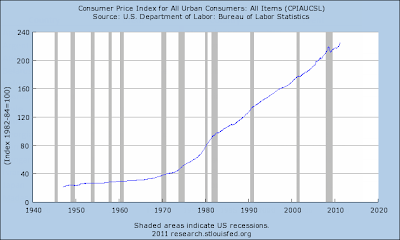


Prices did not stay negative long, but there is an unmistakable dip, the first dip since the Great Depression.

Whether the measure is credit, credit marked-to-market, or prices we had deflation.

More tellingly, we had deflation based on numerous conditions that one would expect to see in deflation: falling asset prices, falling treasury yields, rising junk bond yields, a rising US dollar, falling commodity prices, reduced speculation, etc.

The question now is whether or not we will see deflation again, and if so how quickly.

Inflation vs. Deflation

The Us is certainly in a period of inflation now by my model. Home prices are making new lows and credit is in a funk, but most conditions appear inflationary at the moment.

Indeed if you believe the US will be in periods of inflation more often that deflation you may very well be correct, especially if your measure is the CPI. However, credit is a better measure than prices.

Consumer prices in Japan barely fell over the course of a 25 year period. Yet is is silly to argue that Japan never went in deflation. The conditions associated with deflation were frequent and persistent: falling consumer demand, the wiping out of excess leverage, a rising saving rate, and falling asset prices plagued Japan for decades.

My thesis has been the US would slip in and out of deflation for a number of years, just as Japan did.

I see no good reason to change that call. I expect another plunge in credit marked-to-market and another plunge in commodities. I expect another surge higher in the US dollar.

Yet, I have no faith in the grand super-cycle deflation theory where literally everything crashes.
I see no reason to predict the S&P 500 will drop to 200, or gold to $250.

Japan did not collapse yet, but it could. Moreover, Japan's debt at 200% of GDP shows just how out of hand things might get before the market imposes its will. Japan is a far better candidate for massive inflation than the US at the moment.

All it would take to sink Japan is a collapse in exports and a rise in interest rates to 3%. At 3% or so, interest on the national debt would consume 100% of Japan's revenue.

With that backdrop, the myopic focus on the US seems silly.

Unlike super-deflationist Robert Prechter, I expect gold to hold its value over the mid-term (another swoon is always possible) as the Fed fights massive deflationary forces of excess leverage, excess debt, boomer demographics, global wage arbitrage, cutbacks in state and local governments, and most importantly - consumer attitudes towards debt.

In the final analysis, it's all about attitudes. The Fed cannot force consumers or businesses to borrow or banks to lend (and it wouldn't for reasons stated, even if it could). In a fiat credit-based system, that is what matters.

Mike "Mish" Shedlock
http://globaleconomicanalysis.blogspot.com
Click Here To Scroll Thru My Recent Post List

Last 10 Posts


Copyright 2009 Mike Shedlock. All Rights Reserved.
View My Stats