MISH'S
Global Economic
Trend Analysis

Recent Posts

Taxpayer Friendly Sites

Alphabetical Links

Friday, January 19, 2007 11:26 PM


Credit Swaps And Bond Yields


Moody's is reporting Bonds Safest in at Least 4 Years, Credit Swaps Show.

By Shannon D. Harrington

The risk of owning corporate debt is the lowest in at least four years after housing data bolstered confidence that the worst of the residential real estate slump is over, according to traders who bet on corporate creditworthiness in the credit-default swap market.

"There's some optimism that credit quality will continue to remain strong and default rates will remain low," said Ira Jersey, a strategist at Credit Suisse in New York. "Homebuilders did pretty well because of housing starts and permit numbers. Certainly, with the jobless claims being low, people will have money to spend."

Credit-default swaps on homebuilders fell to the lowest in more than eight months as housing data lifted confidence that home sales are rebounding from last year's 18 percent drop, the worst plunge since 1990. A decline in the price of credit-default swap suggests improving perceptions of credit quality.

Contracts on $10 million in bonds of D.R. Horton Inc., the biggest U.S. homebuilder, fell to $65,100 from $73,000 Jan 12, CMA Datavision prices show. The price is the lowest since May.

"A lot of people are calling for the bottom of the market, and by mid-2007 we should see some sort of recovery," said CreditSights Inc. analyst Sarah Rowin in New York. "Although earnings are going to be down, the builders could come off relatively intact."

CDO Sales

The derivatives helped CDO sales surge last year to a record $497.1 billion, 81 percent more than in 2005, Morgan Stanley analysts said this month. The funds, which are sliced up according to risk and sold as bonds, appeal to investors because they can offer higher yields than the assets being pooled.

Credit-default swaps, which were conceived to protect bondholders against default and pay the buyer face value in exchange for the securities if a company does default, have become one of the best gauges of shifts in credit quality.

An estimated $26 trillion in the contracts are outstanding, the International Swaps and Derivatives Association said in September. Derivatives are financial instruments derived from stocks, bonds, loans, currencies and commodities, or linked to specific events like changes in the weather or interest rates.
Let's see if we can take this apart piece by piece.

Shannon Harrington: "The risk of owning corporate debt is the lowest in at least four years."

Mish: No the "risk" is not the lowest. Yield spreads have compressed because the willingness to take on risk is at its highest point in at least four years. Spreads between junk and investment grade debt have collapsed. Do not confuse optimism with risk. An inverted yield curve suggests this optimism is not warranted, nor is the bounce in housing starts that significant. This all reminds me of the continued optimism in JDSU and CIEN in the Nazcrash of 2001 before they eventually lost over 90% of their value.

Ira Jersey: "There's some optimism that credit quality will continue to remain strong and default rates will remain low. Certainly, with the jobless claims being low, people will have money to spend."

Mish: Well you certainly have that optimism part right but you are confusing jobless claims with money to spend. A negative savings rate for 18 consecutive months suggests that consumers are spending money they do not have. Also note that we are continuing to lose high paying manufacturing jobs for low paying jobs at Walmart and Pizza hut. Also note that Mortgage Equity Withdrawal (MEW) is drying up as a source of funding. That is less money in pockets to spend. Finally, even IF consumers had more money to spend, at some point they will stop spending it. Debt burdens are at an all time high. That debt must be paid off. For spending to dramatically rise, both jobs and wages (not just for the fat cats) have to rise. That is not happening as global wage arbitrage and outsourcing continues unabated.

Shannon Harrington: "A decline in the price of credit-default swap suggests improving perceptions of credit quality."

Mish: Exactly. Please do not confuse perceptions with reality. Do not confuse perceptions with risk either.

Sarah Rowin: "A lot of people are calling for the bottom of the market, and by mid-2007 we should see some sort of recovery. Although earnings are going to be down, the builders could come off relatively intact."

Mish: Does bottom calling mean it will happen or does it represent unwarranted optimism? How many bottom calls were there when the Naz started plunging from the peak over 5000? Has anyone bothered to look at cash and inventory levels on homebuilders? Sarah, please take a look at homebuilder corporate statements. They are running out of both cash and profits, while inventories are soaring.

Morgan Stanley: CDO sales surged last year to a record $497.1 billion, 81 percent more than in 2005. The funds, which are sliced up according to risk and sold as bonds, appeal to investors because they can offer higher yields than the assets being pooled.

Mish: We will take a look at the "appeal" of higher yields in a chart below.

International Swaps: An estimated $26 trillion in the contracts are outstanding, the International Swaps and Derivatives Association said in September.

Mish: Wow. On the theory that "the bigger the bet the safer things must be" this must be a sure sign that "Corporate Bonds Are Safe".

Let's take a look at a chart of Moody's Baa Corporate Bonds to see what it might be saying.

Moody's Baa Bonds


Above chart by sharelynx.com.
Moody's Baa Bonds
Baa - Bonds and preferred stock which are rated Baa are considered as medium-grade obligations (i.e., they are neither highly protected nor poorly secured). Interest payments and principal security appear adequate for the present but certain protective elements may be lacking or may be characteristically unreliable over any great length of time. Such bonds lack outstanding investment characteristics and in fact have speculative characteristics as well.
Baa bonds are just one step above junk. Yields are close to 6%.

Bank Deals - Best Rates shows that you can get up 6.19% for 6 months at some places. Hmmm. Lets see, do you want 6.19% on a 100% guaranteed bet or approximately the same thing on bonds rated one step above junk? Inquiring minds want to know what if anything is "appealing" about the risk/reward shown in that chart.

On that thought the Mish telepathic question lines are open. Hmmm. I am being flooded with calls. Fortunately the ideas expressed are all similar. They go something like this. "Mish, you are trashing corporate bonds at a mere 6% or so but if I recall correctly you like 10 year treasuries that yield even less. Please explain"

10 Year Treasuries


Above chart by sharelynx.com, modified by Mish.

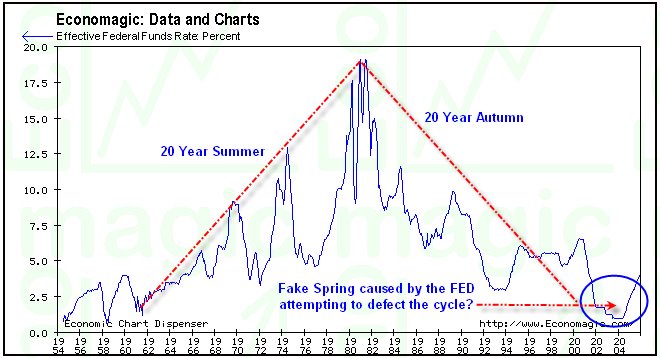
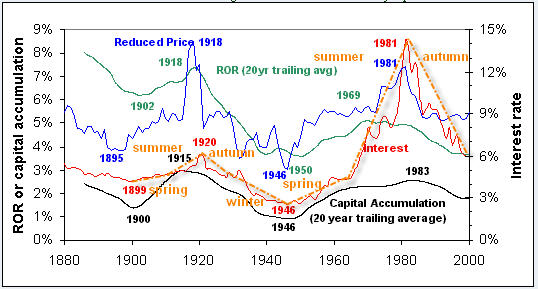
Some newcomers might be confused about the seasons on the above chart. Those seasons correspond to something called the K-Cycle. K-Cycles are long. The last K-cycle Autumn peak was in 1929. That was followed by the great depression. With companies going bankrupt in the early 1930's the last place you wanted to be was in corporate bonds. Those in treasuries did great. Safety vs. "perceived safety" is the key. Although I am not calling for another depression, I am merely pointing out that the economic conditions are very similar. This case was presented in 1929 Revisited.

Interest Rate Interpretation of the K-Cycle


K-Cycle longer term view


If we are headed into "winter" the last place you want to be is in junk bonds. Even if we are not headed into "winter" where is the risk/reward for junk bonds when you can get nearly the same yields in CDs?

No matter how you slice it, credit swaps have pushed corporate yield spreads far into the blatantly complacent level where risk is enormous and rewards are slim. That is exactly the opposite of what Shannon Harrington is suggesting.

Mike Shedlock / Mish
http://globaleconomicanalysis.blogspot.com/

Wednesday, January 17, 2007 9:33 PM


Ponzi Financing On Interest Rate Swaps


Bloomberg is reporting Pennsylvania Taxpayers Lose in Interest Rate Swap.

The third-poorest city in Pennsylvania is a lot poorer because of a 28-year bet on interest rates that already has gone awry.

The Reading, Pennsylvania, school district, which has 18,323 students, this week must pay $230,000 to Deutsche Bank AG, Germany's largest bank, because it's on the losing side of a wager that long-term interest rates will rise faster than short- term interest rates. In April, the board rushed approval of the so-called interest rate swap in eight days after its adviser said the transaction may earn the district $16 million by 2034.

While Reading's taxpayers are liable for the loss, bankers and advisers already have pocketed $1 million in fees for arranging the swap, enough to buy 11 Mercedes-Benz S-550 sedans. This week's payment to Deutsche Bank would have covered the school district's monthly utility bill.

"It was all done in a real hurry," said Keith Stamm, the only member of the board to vote against the deal. "The whole board is so desperate to try to find a way to raise money, they see this floated in front of them as a big-time amount of money and they want to go forward with it."

Local governments from Augusta, Georgia, to Oakland, California, are being lured by similar opportunities to speculate with derivatives created by the world's biggest banks. Most of the $400 billion of private agreements sold to municipalities escape taxpayers' notice and are little understood by the public officials and administrators who approve them.

The school board paid Frankfurt-based Deutsche Bank $575,000 to arrange the contract, known as a constant maturity swap, and awarded $400,000 to its financial advisers, including Reading-based Concord Public Financial Advisors Inc. and lawyers for arranging the trade, school officials said.

Ted Meyer, a spokesman for Deutsche Bank in New York, declined to comment on whether the agreement, also called a yield-curve swap, was suitable for the school district.

Dennis Kelley, the school district's director of finance, said he was "surprised" to learn he owes $230,000. He said the district would pay the money using proceeds from another interest-rate swap.

"Nobody Questioned It"

"It was arcane, nobody questioned it," Cinfici said. "Everything was presented to us at the last minute. I said, `Well, I'll trust in the guys' judgment."

More than 70 Pennsylvania school districts have notified the state they planned swaps with banks including Morgan Stanley, Wachovia Corp. and JPMorgan since 2003, when state legislators permitted them.
Is there any wonder now why profits at Goldman, Merrill, etc are soaring?

Top 5 Reasons for Interest Rate Swaps

5) "It was arcane, nobody questioned it"
4) "It was all done in a real hurry"
3) "Well, I'll trust in the guys' judgment"
2) "The whole board is so desperate to try to find a way to raise money"
1) "The district can pay the money owed using proceeds from another interest-rate swap"

If this is not ponzi financing at its finest, what is?

Mike Shedlock / Mish
http://globaleconomicanalysis.blogspot.com/

12:51 AM


Japanese Economic Data


Let's take a look at some current economic reports about Japan.

Hemscott is reporting Japan monetary base falls for 10th straight month in Dec

TOKYO (XFN-ASIA) - Japan's monetary base fell for the 10th consecutive month in December when it dropped by 20.0 pct from a year earlier to 90.466 trln yen, preliminary data from the Bank of Japan showed. The year-on-year fall last month was the fifth steepest on record, and smaller than the record 22.3 pct drop in November.

The monetary base dropped in March last year for the first time in more than five years following an end to the central bank's easy credit policy and it has been shrinking since then as the central bank was steadily draining surplus funds in short-term money markets.

On March 9 last year, the BoJ ended a five-year-old super-loose monetary policy under which it flooded the short-term money market with excess cash to keep short-term interest rates near zero in a bid to defeat deflation.
Obviously "flooding the short-term money market with excess cash to keep short-term interest rates near zero in a bid to defeat deflation" was a totally failed policy. Yet for some reason people think it will have a different effect here if and when we get to the same point.

Japan Today is reporting Japanese bank lending posts 1st rise in 10 years
TOKYO — The average daily balance of Japanese bank lending expanded 1.2% from a year earlier to 384.86 trillion yen in 2006, the first rise in 10 years, the Bank of Japan said Friday.

After adjustment for special factors, the loan balance rose 2.1% in 2006, posting its first gain since the central bank made year-on-year data available for comparison in 1999.
This rise in credit (lending) is a very significant event. Unless it is an outlier, Japan's deflation is over.

The Japan Times is reporting Japan's savings rate hit a record low 3.1% in fiscal 2005.
Saturday, Jan. 13, 2007
Japan's savings rate in fiscal 2005 fell for the eighth straight year to a record-low 3.1 percent, the Cabinet Office said Friday, indicating growth in household income is slow and senior citizens are dipping into their savings.

The savings rate, or the share of savings as a percentage of total household disposable income, in the year to last March dropped by 0.3 percentage point from the previous year.

The fiscal 2005 rate, the lowest since the government began to compile savings data in 1955, was less than one-seventh of the peak of 23.1 percent posted in 1975.

The Japanese savings rate is expected to fall further as baby boomers reach retirement age in the coming years and more people start to live off their savings.

The Cabinet Office also said Japan's fiscal 2005 national income, which includes employee and corporate income, increased 1.3 percent from the previous year to 367.6 trillion yen, marking the third straight year of growth.
This is particularly interesting. The much ballyhooed Japanese saver is now saving a record low 3.1%. In Q&A on the Psychology of Deflation I stated:
When it comes to spending one also has to remember that it was not that long ago that the savings rate in the US was 8%. That savings rate steadily declined to the point where it went negative for 18 consecutive months. What can not continue will not continue by definition. A negative savings rate can not continue forever. There will be a trend reversal in the US back towards the norm on savings and sooner or later a trend reversal back towards spending in Japan. After a 20 year bout with deflation in Japan it is too easy to say they are a nation of savers. Likewise after a massive 20 year spending spree in the US it is easy to project that trend forever into the future. Neither trend can last forever.
With Japan's enormous national debt, interest rates poised to rise, and Japanese savers no longer saving at a massive rate, it will be interesting to watch the Yen.

Bloomberg is reporting Japan's Producer Prices Rise at Slowest Pace in Year
Jan. 16 (Bloomberg) -- Japan's producer prices rose at the slowest pace in a year in December as oil costs fell, easing pressure on companies to pass expenses on to consumers.

Thirty-four straight months of rising producer prices haven't spurred inflation, undermining the Bank of Japan's case that interest rates, the lowest among major economies, should be increased. Central bank Governor Toshihiko Fukui and his policy board will begin a two-day meeting tomorrow to decide whether to raise the key overnight lending rate from 0.25 percent.
Thirty-four straight months of rising producer prices haven't spurred inflation because inflation is not about prices at all, especially producer prices. Inflation is about expanding credit. But we have seen a significant inflationary shift with bank lending rising in conjunction with a decrease in the savings rate.

Reuters is reporting BOJ unlikely to raise rates this week.
TOKYO, Jan 16 (Reuters) - The Bank of Japan is unlikely to raise interest rates this week as central bankers felt it was necessary to monitor further whether consumer prices and spending were picking up enough, media reports said on Tuesday.

The reports caught off guard investors who had thought a BOJ rate increase to 0.5 percent was a done deal. These expectations had grown after a number of earlier Japanese newspaper reports saying such a move was coming at a two-day BOJ policy meeting ending on Thursday.

The turnabout came just as Japan's finance minister signaled that the government would not try to block a possible credit tightening this week, stoking expectations that the BOJ would raise interest rates to the highest level since 1995.

"We should continue to monitor (personal consumption and consumer prices) to confirm the spillover effect on the household sector" from the strong corporate sector, Kyodo quoted a BOJ source as saying.
This focus on prices is going to cause Japan lots of grief. In fact, it already has. People will spend when they are willing and able and not before. Businesses will borrow and banks will lend when they are both willing and able and not before. Thus a rise in bank lending for the first time in ten years is quite significant. We will find out soon enough if Japan hikes, but even if so, a .50% rate can hardly be considered restrictive in the face of a pickup in credit.

Perhaps Japan will be shocked out of their complacency by a severe plunge in the Yen. This of course is exactly the opposite of what nearly everyone (especially dollar bears) expects to happen. Should a collapse in the Yen force an unexpected series of hikes in Japan, an enormous whipsaw in the Yen and the carry trade is likely.

Mike Shedlock / Mish
http://globaleconomicanalysis.blogspot.com/

Monday, January 15, 2007 11:27 PM


Leading Economic Indicators


The Conference Board publishes various lists of Business Cycle Indicators. Those indicators are categorized as leading, coincident, or lagging. This post will take a look at indicators 6 through 10 on the list of leading economic indicators. Indicators 1 through 5 will be covered in a second post at a later date.

Leading Indicators

  1. Average weekly hours, manufacturing
  2. Average weekly initial claims for unemployment insurance
  3. Manufacturers’ new orders, consumer goods and materials
  4. Vendor performance, slower deliveries diffusion index
  5. Manufacturers’ new orders, nondefense capital goods
  6. Building permits, new private housing units
  7. Stock prices, 500 common stocks
  8. Money supply, M2
  9. Interest rate spread, 10-year Treasury bonds less federal funds
  10. Index of consumer expectations
S&P 500


Looking at the above chart I find it hard to believe that anyone thinks the stock market is a valid indicator of anything.

Starting in 1960 and using a decline of 10% as some sort of leading indicator would have generated five false positives, one miss, and one success. At the start of the 1980 recession the S&P was up year over year about 5%, at the start of the 1982 double dip recession the S&P was up close to 30%, at the start of the 1991 recession the S&P was up over 10%, and at the start of the 2001 recession the S&P was nearly flat. The S&P did not decline 10% before during or after the 1960 recession. As a coincident indicator the results would have picked up 1982 and 1991 but would still have missed 1960 and 1980. In 1987 and 2003 the stock market declined nearly 20% but there was no recession.

Just for fun let's take a look at the Dow Jones Home Construction Index


Did the above chart "lead anything" or did the index peak a month or so after the June 13th 2005 Time Magazine Home $weet Home cover?

Time and time again I hear "The stock market acts six months in advance" Six months in advance of what? I fail to see how it is acting six months in advance of anything. If one is looking for leading economic indicators, the stock market is surely not one of them.

Also note that if one wants a stock market indicator the economy is surely not it. Look at the plunging GDP in comparison to the stock market for recent proof. Look at the homebuilder chart above for recent proof. Look at the historic S&P 500 chart for proof. Seriously, the S&P is a hopeless leading economic indicator and the economy is an equally hopeless stock market indicator.

Yet the myth (and the weighting) that the stock market is a leading indicator still persists. It's no wonder that nearly everyone is confused given that nearly everyone is looking for correlations that simply do not exist.

Consumer Sentiment


This chart of the University of Michigan Consumer Sentiment Index seems to have some merit as a coincident indicator but little as a leading indicator, at least in the timeframe for which this data is available. The indicator also suffers from what seems to be a high percentage of false positives per correct call. As a coincident indicator it has 3 false positive and 4 successes. One could draw the trigger line differently to avoid the false positives but then the big recession in 1982 would be missed entirely.

Housing Permits


Seven out of the last eight times the annual rate of change on permits was negative 20% or lower, the economy went into a recession (not counting the current situation). Currently the chart shows that building permits in November dropped 31% from the year earlier level.

In all seven recessions since 1959 building permits declined year over year. Using the 0% line as a threshold would have picked up the recession in 2001 but would have also resulted in false signals in 1965, 1985, 1987, and 1996 as well. This can be summarized as seven out of seven with four false positives.

Using 20% as the threshold the only false signal was 1987 but there would have also been a missed signal in 2001. This can be summarized as six out of seven with one false positive and one miss.

This is actually a reasonably good performance, especially if one uses a cross of the 0% line as a strong warning signal while waiting for continued confirmation. Note that dips below the 0% line tend to occur well before the onset of recessions. Leading indicators are supposed to lead and this one does. A crossover of 0% is a strong warning and a continuation below the zero line shows that a recession is likely.

Money Supply

In Money Supply and Recessions I introduced M' (M Prime) as a leading indicator based on sound Austrian principles and definitions of money. Those who have not seen how or why I came up with M' can click on the above link to see just what M' is all about. What follows now is a recap of M' vs. M2 as a leading indicator.

M Prime


Leaving the current status as unknown, 6 of the last 6 recessions were marked by a major dip in M Prime. Note how the indicator clearly led the recession. Also note that 6 of 8 sustained dips below an annual growth rate of 5% in M' led to a recession. On that basis we have 2 potential false signals (1985 and 1995).

M2


Unlike M', the direction of M2 does not seem to give clear economic signals. Note that M2 was rising into the double dip recession of 1982 and rising into the 1991 recession as well. Also note that the single largest dip in M2 was in 1993 while M' was soaring. The years between 1992 and 1995 are all problematic. Finally note that unlike M' where a dip below 5% annual growth was a huge warning sign, the dotted line above shows no such significance. M' seems to be far superior to M2 as a leading indicator.

M Prime CPI Adjusted


On a CPI adjusted basis we see that there has been a recession on 6 of 7 sustained dips below the zero line of year over year growth in M'. The 1985 excursion below 0% was extremely brief in stark contrast to all of the labeled recessions and thus can be discounted. 1995 is still a miss but nowhere near as pronounced as compared to M' unadjusted. 1995 also happens to correspond to the start of a huge ramp-up in sweeps. Perhaps that is significant and perhaps not. Nonetheless, M' CPI adjusted gives a cleaner signal, arguably calling for 7 recessions of which 6 happened.

The above chart clearly shows M' CPI adjusted to be a strong leading economic indicator.

M2 CPI Adjusted


M2 CPI adjusted is certainly an improvement over M2 CPI unadjusted. Note however, that the 1982 and 2001 signals are not as strong as the corresponding M' CPI adjusted signals. The M2 adjusted signal for 2001 was particularly weak. More problematic for M2 adjusted vs. M' adjusted is the mass of jello between 1988 and 1996. M' adjusted was clearly giving an "all clear" zero cross signal by 1992 while M2 adjusted gyrated for years and did not really give an "all clear" until 1998. Furthermore M2 adjusted actually dipped back below the zero line in 1997 while M' adjusted was soaring upward. Both M2 and M' missed around the 1996 timeframe but even here M2 did worse both in terms of an actual low and the jello that preceded it.

10yr Treasury minus FF Rate Spread


A dip below zero preceded 6 of 6 recessions since 1965. Unfortunately it generated 5 false positives as well. Of course one can set the line at -1 in which there were only 3 false positive. Or one can set the line at -2 in which case there was 1 false positive and 1 miss. Still, it would be much nicer if we did not have such curve fitting. Can we do better than this indicator?

The Yield Curve


The above chart was generated by subtracting the symbol $IRX from $TNX where $IRX is a 13 week discount and the latter a 10 year yield. Ideally both would be yields but the difference is not that great on the the 13 week. We we use free data when available, and that data not only works well it also happens to be free.

This chart is almost perfect. A three month to 10 year inversion is 6 for 6 with one false positive in 1966. The current situation is considered unknown.

Note how the above chart does not confirm the false signal on the 0% line cross in 1995 of the previously shown real (CPI adjusted) M' chart. Unfortunately the false signal in 1967 on this chart predates the beginning of our M' series of charts, but I suspect there was non-conformation in the other direction, with M' not confirming the this chart.

Comments From Paul Kasriel
  • The "real" unadjusted monetary base (bank reserves plus currency) seems to provide fewer false recession signals than does real M2 growth. That does not necessarily mean that the real base does a better overall job of forecasting real GDP, just that it does a better job of forecasting official recessions. Mish notes: "Real" in this case means inflation adjusted via the PCE price deflator, and "unadjusted monetary base" means a non-seasonally adjusted monetary base.
  • I have used the PCE price deflator to get "real" rather than the CPI for purely arbitrary reasons here, not theoretical -- I don't have time to explain now, but it is not a big issue. Mish note: There is a potentially confusing mix of terminology here but none of the charts in this post were seasonally adjusted (except perhaps for consumer sentiment and on that I am unsure). Our inflation adjustments used the CPI, and any references to "real" in what I wrote (as opposed to what Kasriel wrote) means CPI adjusted. As Kasriel suggests there is little difference between the two. We tried both and settled on using the CPI because that that is what Shostak did as explained in Money Supply and Recessions.
  • Starting with the recession of 1970, a negative spread on the 10-yr Treasury minus the fed funds rate in conjunction with a contracting year-over-year change in monetary base/CPI has predicted recessions with no false signals. In Q3 and Q4 of 2005, the real monetary base contracted but the interest rate spread still was positive. Now, the interest rate spread has turned negative, but the real monetary base is no longer contracting -- just barely. Mish note: The 10yr minus the 3 month spread by itself has no false positives and no misses since 1970.
Final Thoughts
  • Real M' is a very good leading indicator. It also performs better in theory and practice in comparison with Real M2. Real M2 performs better than M2, and M' performs better than M2. M' is thus a better indicator than M2 no matter how it is compared (real or not).
  • The 10yr minus the 3 month is an exceptional leading indicator. It works better in practice than using the 10 yr minus the FF rate.
  • No false signals were given by the 10yr minus the 3 month spread since 1970. False signals were given by spreads using the FF rate alone.
  • No false signals were given by a combination of Real Monetary Base and the 10yr minus the FF Rate spread (as per Kasriel but not shown).
  • Housing permits provide a valid leading signal. When the 0% line is decisively penetrated, a recession usually follows.
  • The S&P 500 is simply not a valid leading economic indicator. It is at best a marginal coincident indicator and perhaps should be ignored altogether. There are just too many false and/or missed signals.
  • Consumer sentiment may have some value as a coincident indicator but it does not function well as a leading indicator.
This post is an attempt to find a methodology that makes theoretical sense and works well in practice too. Five of the ten widely used leading indicators were reviewed, one of which should be discarded outright, one redefined as a coincident indicator, one (housing permits) is valid as it stands, and two leading indicator components had substitutes that seem to work far better in both theory and practice.

The charts show that M' and the 10yr minus the 3 month spread are both superior to similar indicators that are on the list. As time permits, I will take a look at the remaining 5 widely used leading indicators. Thanks once again to Bart at NowAndFutures for providing many charts based on specifications that I requested, and also to Paul Kasriel at the Northern Trust for his time and comments.

Mike Shedlock / Mish
http://globaleconomicanalysis.blogspot.com/


Copyright 2009 Mike Shedlock. All Rights Reserved.
View My Stats