MISH'S
Global Economic
Trend Analysis

Recent Posts

.

Tuesday, June 06, 2006


Mish's Movie Review


It's now time for a brand new feature: Mish's Movie Review.

Mish Notes: There are political parts to this post. Your options are to stop reading right now, read the movie review and then stop (politics does not start until the section "Three Questions" towards the very end), or simply ignore the politics and concentrate on the message. Sometimes it is hard to separate politics from the economy and this is one of those times. I think there is an economic message behind certain recent political numbers. I talk about those numbers towards the very end.

The first movie on today's list is "Men In Green".


We had a sneak preview of "Men In Green" on June 5th 2006 and quite frankly I was unimpressed. Following is the actual dialog by widely acclaimed actor $BenBernanke from a critical scene in the movie:

With the economy now evidently in a period of transition, monetary policy must be conducted with great care and with close attention to the evolution of the economic outlook as implied by incoming information. Given recent developments, the medium-term outlook for inflation will receive particular scrutiny. There is a strong consensus among the members of the Federal Open Market Committee that maintaining low and stable inflation is essential for achieving both parts of the dual mandate assigned to the Federal Reserve by the Congress. In particular, the evidence of recent decades, both from the United States and other countries, supports the conclusion that an environment of price stability promotes maximum sustainable growth in employment and output and a more stable real economy. Therefore, the Committee will be vigilant to ensure that the recent pattern of elevated monthly core inflation readings is not sustained.

Toward this end, and taking full account of the lags with which monetary policy affects the economy, the Committee will seek a trajectory for the economy that aligns economic activity with underlying productive capacity. Achieving this balance will foster sustainable growth and help to forestall one potential source of inflation pressure. In addition, the Committee must continue to resist any tendency for increases in energy and commodity prices to become permanently embedded in core inflation. The best way to prevent increases in energy and commodity prices from leading to persistently higher rates of inflation is by anchoring the public's long-term inflation expectations. Achieving this requires, first, a strong commitment of policymakers to maintaining price stability, which my colleagues and I share, and, second, a consistent pattern of policy responses to emerging developments as needed to accomplish that objective.

Our economy has reaped ample rewards in recent years from the achievement and maintenance of price stability. Although challenges confront us, as they always do, I am confident that we will be able to preserve those hard-won benefits while promoting sustainable economic growth.
What could possibly be more boring? Where are the guns blazing and helicopters leaking $100 bills over New York, Chicago, and Los Angeles? Imagine the frenzy of helicopters leaking trillions of dollars in cash over major cities as compared to this lame scenery.

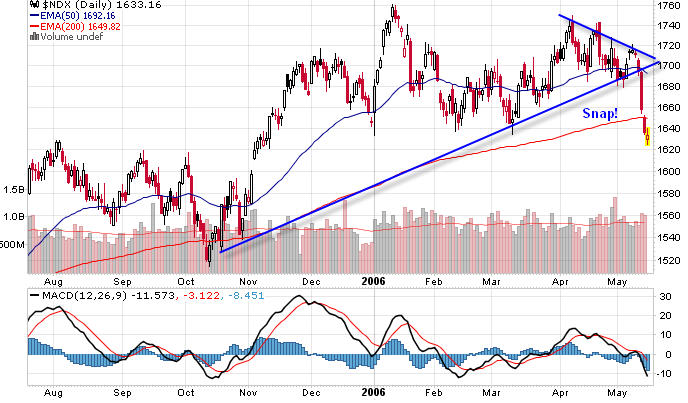
My understanding is the end of this movie has not yet been finalized, but on the basis of today's preview, I have to vote two thumbs down to "Men In Green". The stock market today (Monday June 5th 2006) was as unimpressed with the script as I was. Can this movie be salvaged? Not without a major rewrite.

A Few Good Men

The next movie on our list is a potentially exciting remake of "A Few Good Men". For reasons that will soon become apparent I will not be able to vote on this movie. Following are the script changes from the original as proposed by Snooky on Silicon Investor. Here goes:
Greenspan: You want answers?
mishedlo: I think I'm entitled to them.
Greenspan: You want answers?
mishedlo: I want the truth!
Greenspan: You can't handle the truth! Son, we live in a world that has markets. And those markets have to be guarded by men with dollars. Who's gonna do it? You? You, Patron? I have a greater responsibility than you can possibly fathom. You weep for Refco and you curse the Treasury. You have that luxury. You have the luxury of not knowing what I know: that Refco's death, while tragic, probably saved money. And my existence, while grotesque and incomprehensible to you, saves money...You don't want the truth. Because deep down, in places you don't talk about at parties, you want me in those markets. You need me in those markets.
We use words like honor, code, loyalty...we use these words as the backbone to a life spent defending something. You use 'em as a punchline.
I have neither the time nor the inclination to explain myself to a man who rises and sleeps under the blanket of the very liquidity I provide, then questions the manner in which I provide it! I'd rather you just said thank you and went on your way. Otherwise, I suggest you pick up a dollar bill and stand a post. Either way, I don't give a damn what you think you're entitled to!
mishedlo: Did you order the coupon pass?
Greenspan: (quietly) I did the job you sent me to do.
mishedlo: Did you order the coupon pass?
Greenspan: You're goddamn right I did!!
For comparison purposes, here is the original dramatic scene from "A Few Good Men".

Those interested in the origins of the name "Mish" are now alerted that "Mish" is a shortened version of Mishedlo. Mishedlo was a userid I had while working in the banking industry. It seems that many banks use 1-2 characters from a person's first name and the remaining characters from their last name to formulate userids (8 characters maximum on IBM mainframes). I had similar userids at four or five places I worked at. (Secure huh?). Many times if you know who works for a bank you can figure out their userid. All that remains is to hack the password. Harris Bank (now owned by the Bank of Montreal) had me on their list of employees as of last year even though I have not worked there since 2000. For those who were curious about the name "Mish", that is the rest of the story.

Snooky, your remake is much appreciated. For obvious reason I can not give either a thumbs up or a thumbs down honest appraisal of your rewrite.

OK. Enough of movie reviews. Let's get back to reality.
Anecdotal evidence is rapidly piling up that Greenspan and Bernanke have overshot.
Given that Fed policy changes are lagging, as is job growth, as are home sales, it appears Bernanke is fighting the battle that should have been waged years ago.

Standard Pacific Latest Numbers

Please consider homebuilder Standard Pacific orders were down 41%.
Home-building stocks traded down Monday after another builder, Standard Pacific Corp.(SPF), joined the growing number of builders reporting a steep decline in housing demand in the current quarter and announcing plans to ratchet down earnings guidance for 2006.

The Irvine, Calif., home builder issued a statement late Friday indicating that orders plummeted 41% in April and May - one of the biggest dropoffs in demand reported yet by a home builder. The news left Wall Street wondering if the sector is heading for a cliff rather than the soft landing that many had been touting.

Standard Pacific cited a surge in cancellations and continued softening demand in many of the company's larger markets, especially in Southern California, Northern California, Florida and Arizona. This was partly offset by higher orders in Texas and Colorado.

The company said it expects to lower its earnings guidance and cut its delivery target for 2006 when it updates its guidance at the end of July.

New York Stock Exchange-listed shares of Standard Pacific traded recently at $28.42, down $1.58, or 5.3%.

Standard Pacific is the latest home builder to issue a statement warning Wall Street of weaker-than-anticipated housing demand and an earnings shortfall. Pulte Homes Inc. (PHM), Hovnanian Enterprises Inc. (HOV), Ryland Group Inc. (RYL) and luxury builder Toll Brothers Inc. (TOL) all have reported a hefty pullback in demand and cut earnings guidance for 2006.

However, Standard Pacific's 41% order decline appears to be the steepest dropoff yet. Pulte said its orders fell 29%, while Ryland's orders were off 35% in the first two months of the quarter. Hovnanian's orders dropped 20% and Toll's fell 32% in their fiscal second quarters.

The news has left some analysts wondering if the sector is heading for a crash - and not a short-term correction.
Pulte's Latest Numbers
                   Pulte Homes, Inc.
Preliminary Net New Order Data
April and May Results

New orders: 2006 2005
------------ -------
Northeast 514 871
Southeast 1,708 2,493
Midwest 797 1,176
Central 1,169 1,492
West 2,259 3,096
------------ --------
6,447 9,128
============ =======
Cancellation Rate: 27.4% 14.8%
Orders are falling and cancellation rates are soaring. Yet we are in the very beginning of an economic downturn.

Job Numbers

The latest job numbers were nothing but a complete disaster. The numbers were so bad I hardly know where to begin. If this was a movie, it would be a horror story. Let's start with Birth/Death assumptions.

Birth Death Assumptions

For new readers Birth/Death refers to assumptions about estimated jobs created or lost at this point in a recovery due to the creation or loss of businesses as opposed to the birth or death rate of individuals. (Click on graph for an enhanced view)


Once again according to the Birth/Death assumptions 211,000 jobs were presumed to have been created in May of 2006 even as the past two months figures were revised lower. How long the BLS can get away with this nonsense is anyone's guess, but eventually the public has to wonder if it would be more accurate if the L was dropped from BLS.

Arguably the most critical number is the number of Part-Time Employed For Economic Reasons. That number was up over 159,000. It is an enormous number that is roughly twice the level of the headline growth for all jobs. Let that sink in. 159,000 people wanted full time employment but could not find it for "economic reasons". They are not counted as unemployed nor are those who benefits have expired, nor are those who just simply gave up. Unemployment would be 10% and rising if we counted it the way it was counted 20 years ago.

Quite honestly it gets tiring refuting such nonsense month after month, year in and year out. Let's look at it another way.

Three Questions
  1. Do you really think Bush's approval rating would be under 30% if jobs were plentiful, and wages were rising?
  2. Do you think there would be a concern about kicking out illegal immigrants if jobs were plentiful?
  3. Do you really think there would be a discussion about building a wall on the Mexican border if immigrants were not taking jobs US citizens wanted?
I try and avoid politics but it is not always possible. At some point, no matter what the propaganda is, the public will simply stop believing the lies they are told. Lies and distortions about the CPI, or jobs, or the cost of gasoline, or medical expenses, or education can be hidden only for so long. Everyone knows I dislike this administration. My personal opinion is irrelevant. Bush's approval ratings under 30% are another matter. From a moral point of view the public would probably not care a rat's ass how many innocent Iraqis we killed if it created jobs here. That is the simplistic as well as the sad but unfortunate state of affairs. The fact of the matter is the only real source of jobs during this recovery was (past tense) housing. Housing is stalling and the public is responding.

I would like to believe that Bush's numbers reflect his ineptitude in Iraq, but to believe that would only be fooling myself. Bush's numbers are low because the economy is sinking, no more no less. That is not a moral judgment (unfortunately) but an economic one and like it or not I see little reason for those numbers to turn around.

Given that Wall Street seems to like Bush, we could be in for a very rough ride if Democrats take control of the House or the Senate or both. You may agree or disagree with my obvious dislike of Bush, but from an economic standpoint his approval rating numbers are what they are, and those numbers are pathetic. I am but one vote out of millions, yet the undeniable fact is the general population has had enough. Whether or not you agree with my personal opinions or not, look at public sentiment towards this administration and ask yourself if you want to be long this market. This post is not about politics or movies or housing, it is about making money. On the other hand politics is money and the politics have changed.

Mike Shedlock / Mish
http://globaleconomicanalysis.blogspot.com/


Nightmare Carry Trade Scenario


I have been thinking about the nightmare carry trade scenario.
In other words what is the worst possible situation for carry trade players?
For those unfamiliar with the term "carry trade" I will use the definition found on Freebuck.Com.

Carry trade - The speculation strategy that borrows an asset at one interest rate, sells the asset, then invests those funds into a different asset that generates a higher interest rate yield. Profit is acquired by the difference between the cost of the borrowed asset and the yield on the purchased asset.


Nightmare Scenario

I view the nightmare scenario something like the following.

  1. End of quantitative easing (QE) in Japan
  2. End of ZIRP in Japan (Rising interest rates)
  3. Rising interest rates in Europe
  4. Falling interest rates in the US
  5. Tightening credit in the US
  6. A rising YEN vs. the US$
Quantitative Easing

Quantitative Easing has already ended in Japan. Quantitative Easing simply means excessive printing of money by the Bank of Japan in order to defeat deflation that has been raging for about 18 years.

I believe that ZIRP (zero interest rate policy) and QE (quantitative easing) prolonged Japan's deflation but for now that is irrelevant. The key point is that both are about to come to an end. Proof of the end of QE can be found in the following chart courtesy of Contrary Investor.


As you can see, money supply in Japan nearly doubled between 2001 and 2006. Hedge funds could borrow YEN at zero % and invest in the US stock market, or gold, or silver, or after all of these rate hikes get 5% in US treasuries. The only real worry was the YEN rising in value more than the return on other investments. With Japan unwilling to let the YEN rise, players piled high on the carry trade.

From a US$ perspective, when interest rates were slashed to 1%, another possible carry trade was to borrow funds in US$ and invest in gold, silver, or equities. With the S&P dividend ratio under 2% and interest rates close to 5%, the US carry trade slowly died with each rate hike.

Rising interest rates in Europe and Japan, and falling rates in the US (a global equalization of interest rates) will end more of these carry trades.

Contrary Investor points out "meaningful rate of change decline in the Japanese monetary base have preceded each meaningful US recession of the last three decades. Large percentage drops occurred in '73/'74, '79/'80, 1990, and 2000. If indeed history has the chance of repeating itself ahead, what should we now be expecting for the macro US economy as we look directly at current Japanese monetary base contraction?"

Speculation in various markets is extreme as noted by trillions of dollars worth of derivatives floating around. The unwinding of those derivatives and any related carry trades is not likely to be a smooth event. In Financial War Games I talked about the ECB running "stress tests" to see if they could handle a derivative meltdown. We might just be put to the test. Clearly we are at a serious crossroads of the greatest liquidity experiment the world has ever seen, with multiple players, in multiple countries, doing mind boggling things with tremendous leverage. Right now, the Fed is in a Quandary about what to do. In spite of that, Bernanke thinks the Fed can magically control the global economy with a looming US recession on top of a housing bubble bust. It is the height of hubris.

ZIRP

QE is toast. Let's consider the end of ZIRP (Zero Interest Rate Policy).
Bloomberg is reporting Yosano Says Japan Must Eventually Say Deflation Over.
May 30 (Bloomberg) -- Japan's government will eventually need to declare an end to deflation, Economic and Fiscal Policy Minister Kaoru Yosano said.

"At some point citizens will need to be told by academics or politicians that sustained price declines have ended," said Yosano, who was speaking to lawmakers in Tokyo today. "Hardly any consumers are under the impression that prices are falling."

Japan's core consumer prices have risen for the past six months, signaling the economy's tussle with more than seven years of deflation is ending. Rising prices and an expanding economy may prompt the Bank of Japan to raise borrowing costs for the first time in almost six years as soon as July, economists say.

Chief Cabinet Secretary Shinzo Abe reiterated separately that the central bank should keep borrowing costs near zero to support the economy. He said the bank and the government need to work together to end deflation and ensure prices don't resume falling. Abe was speaking to reporters at a regular news conference in Tokyo today.
For now, Japan seems unwilling to let interest rates rise as evidenced by the Financial Times article BoJ injects $13bn into market to cut rates.
The Bank of Japan on Monday injected a massive Y1,500bn ($13.3bn, €10.5bn, £7.2bn) into the money market as it desperately sought to keep overnight interest rates under control.

The injection came as overnight rates once again tested the 0.1 per cent ceiling, calling into question the central bank's ability to keep rates at "effectively zero" in line with its stated policy.
The market is attempting to force Japan to hike. Japan is resisting. With a national debt of 150% of GDP how much longer can Japan resist? A rising YEN would be bad for those borrowing in YEN and investing in US treasuries. A rising dollar is bad for those borrowing US$ and buying gold, silver, or falling US$ denominated assets. The cross currents on some of these trades are significant, even though the YEN and the dollar can not both fall relative to each other. What can happen however is falling asset prices (stocks, gold, silver, copper, equities) at a rate greater than any interest rate differential. That is likely in a monetary tightening situation as we are seeing in both Japan and the US.

EU Money Supply

Writing for Financial Sense Market Wrap Up on May 31st, Paul Nolte had this interesting commentary.
Many fingers are pointing to money supply (or lack of M3 being reported) as a key to the "blown-up" US economy. However, the reality points to places outside the US. The various Ms are running at relatively low year over year rates – MZM 3.9%, M2 4.5% and M1 a measly 1.8%. This contrasts with the big inflation years during the 70s & 80s when these aggregates were well over 10% (and sometimes north of 15%). Even the monetary base is growing at a 4% rate, less than one third of the pace of the early 90s. So where is the liquidity coming from? One place is Europe, where the European Central Banks are boosting money supply by a torrid 8% annual rate. While “Helicopter Ben” may have a tough name to overcome in the months ahead, investors need to look elsewhere when complaining about excessive monetary growth.
Bingo. Once again "Dollar Bears" only point out what the US is doing, forgetting about gross distortions in Japan, Europe and the UK. Long term this is of course good for gold, but short term the unwinding of various carry trades can wreck havoc on those that are over leveraged.

With that excessive expansion of credit in Europe, interest rates in the EU are poised to rise. Please be prepared to click off number 3 on the list above, if and when it happens.

Fed Pause

Number 4 is a given. The Fed at some point will pause. The unwinding of the housing bubble in the US assures it. The question is when. The problem if they do not pause is the blowup of the housing bubble will accelerate, and the problem if they do is a potential bond market revolt. Jobs here are the key. Falling jobs in conjunction with a housing bubble bust will let the Fed get away with a pause and subsequent cuts. This of course is where it gets complicated. Will Japan react to slowing US demand by attempting to weaken the YEN yet again? If internal demand in China and Japan picks up, Japan can perhaps happily keep hiking. If not, can Japan can abruptly end QE and go back to ZIRP to fight one more round of deflation? I think not.

Everyone talks about hyperinflation in the US. What happens to Japan if they stay on their current QE/ZIRP path forever? At some point a national debt at 150% of GDP matters even if "they owe it to themselves". It might seem funny to be talking about massive inflation in Japan but under the right circumstances I could foresee a loss of faith in the YEN. Typically emergence from K-Winter is a slow event with slowly rising inflation, but with central bankers everywhere taking all sorts of untried experiments with liquidity, some sort of major currency problem with the YEN is possible. If the BOJ changes its mind about QE (something I do not expect) then a loss of faith in the YEN is certainly possible. It is a scenario that is on virtually no one's radar, yet it is not really that far fetched (even if at this point it is unlikely). Yet, everyone assumes the US$ will blow up. The contrarian in me suggests that if a huge currency problem of some sort emerges, it just may be elsewhere. Perhaps this scenario unfolds some time down the road in a panic move by Japan to reinstate QE.

Credit Tightening

Let's move on to number 5. Is credit tightening in the US so unlikely? I think not. All it takes to kick it off is accelerating housing declines. The ultimate nightmare scenario for US housing would be a situation where long term mortgage rates decouple from the 10 year treasury note and stubbornly refuse to drop in the face easing actions by the Fed. I view that as a possibility that I have not heard discussed elsewhere. Rising default risk could potentially change mortgage lending standards in situations where large down payments are not made. Regardless of whether that specific scenario unfolds consumer credit is showing signs of stress and money supply growth is far greater in the EU and China than it is in the US. In fact, money supply in China is up a staggering 22% as noted in 9th Inning Liquidity. Falling home prices, falling jobs, and a correction of the negative savings rate in the US is all that it will take for huge credit problems in the US to surface. At this point all three of those seem extremely likely.

A Rising YEN

Some have argued that with interest rates in Japan at zero, a modest rise in interest rates to 1% will not stop the YEN carry trade. Borrow at 1% in Japan get 4-5% in the US, what could be simpler? I disagree. A rise in the YEN greater than the interest rates differential would cause a loss for YEN carry trade players. Assume for a second that rates in the US fall to 4% and rise in Japan to 1%. At that point the US treasury yield will still be over double the dividend yield on the S&P (a situation not that great for US$ carry trade players). And from the perspective of the YEN carry trader, all it would take to wipe out profits would be a mere 3% rise in the YEN. Notice that it would not take a collapse of the US$ to cause huge problems. A mere 6% move vs. the YEN would cause a tremendous amount of damage. I suppose one could try and hedge that currency risk, but ask yourself how well Fannie Mae has done hedging their interest rate risk. It may not be the easiest thing to do. An additional problem for Japan is that a rising YEN would hurt Japanese exports. That might not bode well for the Japanese stock markets. As long as Japan could slow the rise of the YEN via ZIRP and QE policies, YEN carry trade players had the green light to pour it on. That green light is now a brightly flashing yellow (possibly even red) given that every increase in Japanese interest rates will help fuel a rise in the YEN.

There you have it: The nightmare carry trade scenario. All in all it looks closer than anyone might have thought. Perhaps that is the message of a 100 point plunge in gold, copper going down lock limit several times, silver ramping to the moon just to fall off a cliff, various emerging markets indices plunging, as well as global equity markets taking a collective nose dive.

Should a nightmare unwinding of various carry trades unfold as I expect it to, "dry powder", as in cold hard cash just may be a good thing to have.

Mike Shedlock / Mish
http://globaleconomicanalysis.blogspot.com/

Sunday, June 04, 2006


Point of Maximum Risk


I found an interesting chart last week on the point of maximum financial risk. I would like to give proper credit, but I am unsure of the original source. The coloured highlights are mine.


What may be unique is the last US equity cycle never got to despondency. Perhaps we reached despondency on various Nasdaq issues, but stocks in general did not get to typical bear market troughs, and investors (as opposed to speculators) never really threw in the towel. Indeed one short panic was quickly overturned with the DOW almost getting back to a new all time high, and the Russell making a new all time high. Various emerging markets exploded in a flood of liquidity as speculators have returned in full force fueled by various carry trades and an unsustainable housing boom.

Given that it took Japan 18 years to hit bottom, is it really possible the US managed to pull off a cycle reversal after a 3 year decline? One question then is "where are we at in the cycle?" The second relevant question is "For What?" Most likely the last US equity downturn was interrupted by the biggest liquidity experiment the world has ever seen with Japan, China, and the US all taking part. On the other hand, gold and commodities seem to be on the rebound perhaps approaching optimism. Japan has clearly bottomed and arguably somewhere near hope or relief. It is impossible to measure these points with pinpoint accuracy but some things are so out of whack that relative judgments are easily possible.

Treasury Spreads

One measure of investors willingness to take on risk is a measure of Treasury spreads to junk. The following chart is thanks to Orkrious on Silicon Investor. He plots spreads daily and posts his chart weekly. The coloured highlights and trendlines are mine.


How much lower can junk spreads get? Corporations have been even going to the junk bond market to raise money for the sole purpose of stock buybacks. Image going in debt to buy back shares of stocks after a 3 year equity runup? Does that make any sense (except for insiders selling into those buybacks?). It certainly does not seem to make much sense from the point of view of the investor.

The pertinent question is: Is this a trend reversal or will risk junkies plow back in? Given the recent action in the stock markets worldwide I sense a shift away from risk. That will not bode well for the markets if it continues. Indeed it appears that Global Liquidity is in the 9th Inning. I will have a followup piece on Monday or Tuesday about various carry trades that will help tie all of these ideas together.

Another way to look at risk spreads is emerging market spreads vs. US Treasuries.
There was a very interesting historical chart posted last week on Minyanville by Professor Bennet Sedacca on Lehman Brothers Emerging Markets Yields vs. US Treasuries. The key point (if the chart is not assessable to you) is that the spread between emerging market debt and US Treasuries has shrunk from over 900 basis points in October of 2002 to about 150 basis points in early 2006.

Bennet Sedacca has been hitting them out of the ballpark on Minyanville with his treasury analysis and he is a key reason why I am a subscriber. At any rate, that low spread is another sign of near unbelievable appetite for risk. Such risk is seldom rewarded over the long haul.

PE Levels

Another measure of risk is PE levels. With various market cheerleaders touting high earnings and sinking PEs, one might think that stocks are reasonably valued here. Not so fast, says John P. Hussman of Hussman Funds in a recent article entitled The End of Excellent Earnings. Following is the key chart from the article. Once again the red annotations are mine. I also cleaned up years and percentages a bit to make them more readable.


Hussman writes:

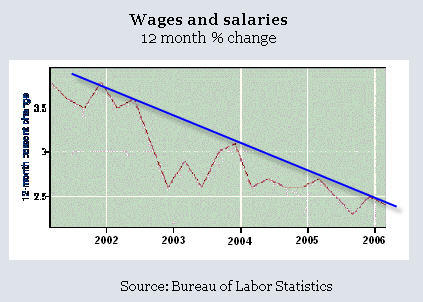
The blue line (right scale) depicts U.S. corporate profits as a percentage of nominal GDP. The violet line (left scale, smoothed) depicts U.S. personal disposable income as a percentage of nominal GDP, using an inverted scale – a rising line means a falling disposable income share. Notice that increasing corporate profits as a share of GDP generally come at the expense of wage earners' share, and vice versa.

The extent of this widening in profit share and profit margins is unprecedented, and isn't something that's likely to be sustained in a competitive economy. Historically, profit margins have been strongly mean reverting, with large swings as the economy moves between recessions and recoveries. Importantly, it doesn't take a plunging economy or falling revenues to hurt profit margins – even a deceleration of growth is typically enough to put downward pressure on margins.

So while profit margins are at record highs, disposable income as a percentage of GDP is closing in on record lows. Once profits become a large share of GDP and unemployment falls to relatively low levels, earnings growth is typically disappointing over the following 2-3 years. With corporate profits pushing above 9% of GDP, the unemployment rate at just 4.6%, and S&P 500 earnings at the top of their 6% long-term growth channel, investors should not be at all surprised to see “surprising” wage inflation, accompanied by disappointing profit margins and weak earnings growth in the next few years.
The above are a few key highlights from an excellent piece. I recommend clicking on the link above and reading the entire article. Some people on various stock boards that I post on have been critical of Hussman's timing at various points this year, but not me. Just because risk is rapidly rising does not mean stocks will immediately fall.

One of Hussman's comments that I find interesting is a warning about rising wages. With outsourcing still in full swing and spreading rapidly from manufacturing to the service sector, I see no reason for strong wage growth. On the other hand, once everything has been outsourced that can be outsourced, wages may have nowhere to go but up. Also we do not yet know what the final immigration bill will look like, or if one will get passed at all. There could be huge unforeseen consequences of an ill-time or poorly written immigration bill.

I can also see how wages might rise (for those that have a job - eg wages at Walmart rise), even as huge numbers of job losses occur in the housing sector. Wages went down with rapidly rising productivity. Will wages rise on falling productivity? Will wages rapidly rise in China and India? Regardless of what wages do for those who have a job, I expect mammoth layoffs in the housing sector and that will cause rapidly escalating bankruptcies and foreclosures as well as "time preference shock" for consumers with money. The savings rate has nowhere to go but up, and that alone does not bode well for an economy hooked on ever expanding credit.

Signs of Excessive Risk Taking
  1. Junk bond spreads vs treasuries are extremely low
  2. Emerging market spreads vs treasuries are extremely low
  3. Negative savings rate in the US - First time since the 1930's
  4. Housing values 4-5 standard deviations above the norm vs rents
  5. Housing values 4-5 standard deviations above wage growth
  6. Various emerging market equities rising 100% or more in less than a year
  7. Forty percent of homes sold in 2004 and 2005 were second homes or for investments
  8. Signs of speculation in various commodities and currencies
  9. Rampant increase in derivatives
  10. Lending standards are still falling in spite of rising bankruptcies and foreclosures
  11. Stock buybacks easily financed with junk bond offerings
On average those investing in equities when the scales are so lopsided towards risk taking as they now seem to be are seldom rewarded over the long haul. That is what I am saying, that is what Hussman seems to be saying, that is what many of the astute professors on Minyanville seem to be saying. Yet warnings are certainly the last thing on the mind of most Wall Street pundits at the moment.

Did anyone learn a thing from the Nascrash of 2000? If so, what? Once again, it's as if everyone seems to think they can get out at or near the top. Not only is that mathematically impossible, I get the strong feeling that most players are not even aware of the enormous rise in risks even as there are clear signs that the global liquidity ship is beginning to sink.

Mike Shedlock / Mish
http://globaleconomicanalysis.blogspot.com/

Thursday, June 01, 2006


9th Inning Liquidity


The Financial Times is reporting Dollar plunges on Paulson appointment.

The US dollar fell sharply on Tuesday as Hank Paulson, Goldman Sachs’ chief executive, was named as the new US Treasury secretary, replacing the increasingly pressurized John Snow.

Mr. Paulson has extensive links with China and some saw him as potentially better equipped than his predecessor to encourage Beijing, and the wider emerging Asian bloc, to allow a faster appreciation of the renminbi in order to help reduce global economic imbalances.

Beijing has allowed the renminbi to crawl just 1 per cent higher against the dollar since last July’s 2.1 per cent revaluation, with the currency falling to a nine-week low of Rmb8.032 on Tuesday. The importance of this issue was made clear by George W. Bush, US president, who said one of Mr. Paulson’s objectives would be to ensure the currency flexibility of the US’s trading partners.

"China has not taken kindly to pounding the pulpit and speakers who seem to convey an antagonistic approach," said Michael Woolfolk, senior currency strategist at Bank of New York. "Mr. Paulson has considerable experience in China and is well regarded over there. He could reinvigorate the discussions over currency policy."

He added: "Paulson represents a window of opportunity to accomplish a soft landing to a rapidly growing global imbalances problem. If anyone is capable of carrying this off, he is one of the best placed. The 'strong dollar' policy may quite quickly have an epitaph written for it: 'rest in peace'."
Strong Dollar Policy?

It is obvious to any thinking person that the US has had anything but a strong dollar policy. In fact a "weak dollar policy" dates all the way back to Nixon scrapping the gold standard.

More recently Treasury Secretary Snow defined a "Strong Dollar" as one that was had to counterfeit, while doing anything and everything to talk the US$ down. Since the US has been doing one thing and saying another it should be perfectly clear that the US wants a weaker dollar to help exports. Sometimes I wonder if this is nothing more than a "macho game" where strong=good and weak=bad. The US wants a strong military, strong security, and a strong economy, so of course we have to stand up for a "strong dollar" even if behind the scenes we are do everything we can to destroy it.

Unfortunately at 18-1 or 20-1 wage differentials between the US and China/India the current account deficit can not be closed by currency changes unless one proposes that the US$ will fall 90%.

The question then becomes "90% against what?" Is the RMB or YEN or anything else worth 90% more than the US$? If so why?

Weak Yen Policy?

No country that I know of wants their currency to rise at all let alone by 90% or even 50%. In fact, Japan injected $13bn into the market to prevent interest rates from rising (which would strengthen the YEN).
The Bank of Japan on Monday injected a massive Y1,500bn ($13.3bn, €10.5bn, £7.2bn) into the money market as it desperately sought to keep overnight interest rates under control.

The injection came as overnight rates once again tested the 0.1 per cent ceiling, calling into question the central bank’s ability to keep rates at “effectively zero” in line with its stated policy.
The problem for Japan is that the market seems bound and determined to force Japan into hiking. That will of course be horrid for the carry trade. I will have more commentary on the carry trade later this week. For now, let's consider whether or not the US$ is overvalued vs. the RMB.

China’s Monetary Expansion

One of my favorite economists is Frank Shostak, so let's tune in to what he is saying. On May 2nd Shostak wrote an article about How China's monetary policy drives world commodity prices.
Based on the huge trade surplus with the United States, which stood at $114 bill in 2005, most analysts have concluded that the current rate of exchange of 8.017 yuan to the US dollar is far too high. However, what matters for the currency rate of exchange is the pace of money expansion relative to real economic growth — not the state of the trade account.

After falling to negative 1.2% in March 2001 the yearly rate of growth of the central bank balance sheet (monetary pumping) relative to real economic activity climbed to 28.2% in September 2005. In February this year the yearly rate of growth of the relative pumping stood at 22.1%.

In contrast, the yearly rate of growth of the Fed's balance sheet in relation to real economic activity fell from 11.6% in September 2001 to 0.9% in March this year.

Since China's monetary expansion relative to real economic activity has been accelerating whilst in the United States relative pumping has been decelerating, it follows that China's yuan has to depreciate against the US dollar. Yet the Chinese central bank kept the yuan unchanged against the US dollar at 8.29 from December 1996 to June 2005.


Now, the massive monetary expansion has given rise to a strong demand for capital goods (in order to expand the infrastructure). This in turn has lifted the demand for raw materials and oil. Under normal conditions if the exchange rate had been allowed to freely fluctuate the monetary pumping would have raised the price of dollars in terms of the yuan, thereby making the employment of various imported raw materials not a profitable proposition. However, once the exchange rate is kept unchanged then things become somewhat different.

The unchanged rate of exchange in fact reinforces the growing demand for raw materials. Keeping the rate of exchange unchanged whilst lowering the internal purchasing power of money through monetary pumping makes dollar-priced goods relatively less expensive for the holders of the yuan.

What allows China's central bank to sell US dollars at a subsidized rate is the massive stock of foreign reserves, which stood at US$875 billion in March this year versus US$169 billion in January 2001. If China were to appreciate its currency, as most experts advise, this, given loose money policy, will only reinforce demand for commodities from China.
Actions speak louder than words

The yearly rate of growth of the central bank balance sheet (monetary pumping) relative to real economic activity climbed to 28.2% in September 2005. In February this year the yearly rate of growth of the relative pumping stood at 22.1%.


Read the above then read it again until it makes sense. China has been pumping like mad, more so than the Fed. With China pumping and Japan's interest rates still hovering near zero, and with the UK's housing bubble at least as big as that in the US, is the US$ poised for the 50% drop that everyone thinks is coming? A better question is "will it drop even as much as 15% from here?"

Much of the answer to the above depends on interest rates in Japan, Europe, China, and the US, but it is by no means a certainty that the US$ is in any "short term" death spiral. Long term I think it could be in a death spiral (perhaps "IS BE" once Chinese internal demand picks up) but one can go broke trading such ideas. Just ask anyone extremely bullish on the YEN after China put in place currency bands or news that "Buffett was short the US$" hits the stands or better yet ask anyone shorting homebuilder stocks in 2004.

For now, it is clear the US housing bubble has popped and various emerging markets are blowing up. Bernanke has his test and for that matter so does China and so does Japan. No matter what anyone decides, the global liquidity game is clearly in the 9th inning. The consequences are just now starting to be felt.

Mike Shedlock / Mish
http://globaleconomicanalysis.blogspot.com/


An Ocean Of Cars


Following are some personal anecdotes on GM (fresh from today) as well as GM's latest sales numbers (May 2006).

The rear blinker went out for the second time on my wife's Grand-Am. (Please don't ask why we have a GM. It was not my idea). It was nothing serious, just a bulb. But I do not recall this happening to any other car I have had, and certainly not twice in a few months. In addition the car's gas cap warning light has been on for months for no reason that I can see. I did not mention the gas cap problem at the dealership as I was in a hurry.

Unlike a turn signal that does not work a faulty gas cap warning does not pose a safety hazard, so I decided to just let it be. As soon as I left, the seat belt warning light came on and stayed on for 10 minutes even though I had my seat belt on. That was a new problem. An unbuckle rebuckle operation did not help but after about 10 minutes, that warning light just went off on its own accord. The humorous part of this story is what happened inside the showroom.

I usually try and talk to the salesmen whenever I am there just to see how things are going. Every time it is apparent they are giving me a rah rah story so this time I did not even bother asking.

I got there about 5:00PM. There were 6 salesmen in the showroom in addition to the store manager. There were no customers other than me. I have never seen a showroom so dead. One of the salesmen approached me offering his assistance and I said I was just waiting for service. He then immediately turned his back on me threw his threw his arms up in the air and muttered out loud "service" and walked away.

I almost burst out laughing.

On a showroom table there was a box for a random drawing of some sort with a prize of a big flat screen TV for the winner. I read the rules to make sure it was not some stupid time-share thing where you had to be there to win. It was not. It seemed to be a legitimate contest sponsored by GM. You did not have to be present to win. However there were no entry forms. I asked one of the salesmen, sitting down doing nothing where the entry forms for the contest were. "Contest?" he said? "Yes, for this box right here", I replied. (The box was not more than 20 feet from his desk).

With six salesmen and the manager all sitting around doing nothing I thought that if I was in their shoes I would have been so bored I would have loved to help a customer with anything, including figuring out where the entry forms were for the GM drawing.

Anyway, the only reply I received was an "I don't know". The salesman never even left his chair to help me but two of them did keep chattering to each other and I overheard one of the say to another "An ocean of cars and no one to buy them". I had to refrain from laughing a second time.

A few minutes later the manager walked by and I asked him where the entry forms for the contest were. He too replied "What contest?" Once again I said "For this box right here". "Oh he replied, that contest is over". For the third time I about burst out laughing.

Here is this contest box sitting there, no one really knows much of anything about it, or cares to for that matter, even though it was a GM sponsored contest. Finally they decide the contest is over even though there is still a sign promoting it and a bunch of entries in the box that presumably should have been sent to some central location for a drawing that supposedly has already taken place.

One might have thought that after I asked they would have removed the sign and the box, but no. It was still sitting there after they finished replacing the bulb for the rear blinker.

"An ocean of cars and no one to buy them". Gee, I wonder why.

For those interested in the May GM sales numbers here they are:


I suppose GM can brag about some individual success stories but a quick look at the total volume of Hummers to GM's overall picture will tell you just how irrelevant those sales are. For now anyway, those with more money than brains seem more than willing to flaunt "I don't care what gas costs". We will see just long that trend lasts. In the meantime, those are bleak numbers no matter how you slice it.

Mike Shedlock / Mish
http://globaleconomicanalysis.blogspot.com/

Wednesday, May 31, 2006


Fed in a Quandary


The minutes of May 10 FOMC meeting were released today.
Here are a few key snips:

Participants discussed in some detail inflation expectations--a potentially important factor influencing future inflation trends. Some surveys suggested that inflation expectations had risen in recent weeks, but others implied that expectations were little changed.

On balance, participants judged that inflation expectations had risen somewhat--a development that would have to be taken into account in policymaking and warranted close monitoring--but remained contained.

Although the Committee discussed policy approaches ranging from leaving the stance of policy unchanged at this meeting to increasing the federal funds rate 50 basis points, all members believed that an additional 25 basis point firming of policy was appropriate today to keep inflation from rising and promote sustainable economic expansion.

Recent price developments argued for another firming step at today's meeting. Core inflation recently had been a bit higher than had been expected, and several members remarked that core inflation was now around the upper end of what they viewed as an acceptable range. Moreover, a number of factors were augmenting the upside risks to inflation: the surge in energy and commodity prices, some recent weakness in the foreign exchange value of the dollar, and the possibility that the apparent increase in inflation expectations could, if it persisted, impart momentum to inflation

At the same time, members also saw downside risks to economic activity. For example, the cumulative effect of past monetary policy actions and the recent rise in longer-term interest rates on housing activity and prices could turn out to be larger than expected. Still, it seemed most likely that, with modest further policy action, including a 25 basis point firming today, growth in activity would moderate gradually over coming quarters, pressures on resources would remain limited, and core inflation would stay close to levels experienced over the past year.

Given the risks to growth and inflation, Committee members were uncertain about how much, if any, further tightening would be needed after today's action. In view of the risk that the outlook for inflation could worsen, the Committee decided to repeat the indication in the policy statement released after the March meeting that some further policy firming could be required.

Members debated the appropriate characterization of inflation expectations in the statement. Low and stable inflation expectations were key to the attainment of the Committee's dual objectives of price stability and maximum sustainable economic growth. However, the apparent pickup in longer-term expectations, while worrisome, was relatively small. They remained within the range seen over the past couple of years, and the increase could well reverse before long. Accordingly, it appeared appropriate to characterize inflation expectations again as "contained."
Dow Jones summed it up as follows:

*DJ FOMC: May Minutes: Upside Inflation, Downside Econ Risks
*DJ FOMC: Debate Ranged From No Fed Funds Change To 50BP Hike
*DJ FOMC: Rise In Price Expectations 'Worrisome' But Small
*DJ FOMC: Inflation Expectations Warrant 'Close Monitoring'
*DJ FOMC: Staff Forecasts Inflation To Slow Later In '06
*DJ FOMC: Unsure How Much 'If Any' More Tightening Needed
*DJ FOMC: Lagged Rate Impact On Housing Could Be Larger
*DJ FOMC: Lower Dollar Could Add To Inflation Pressures


Fed in a Box

Those minutes prove the Fed is in a box and is essentially clueless about what to do. Some wanted to pause while others wanted a 50BP hike. In the end they all agreed to go down on the sinking ship together by agreeing to agree. It was a unanimous vote in favor of a 25 BP hike.

At least in the UK we see policy makers willing to dissent. The last BOE meeting had a three way split with some voting to pause, some to hike, and one to cut.

It is notable that finally after 16 consecutive rate hikes the Fed finally put a 50 basis point rate hike on the table just as housing is getting crucified in many places. They are also worried about inflation expectations while at the same time unsure if any more hikes are needed.

I have said it before and will repeat it again. The lagging effects of 16 consecutive hikes, in light of action in housing as well as rising bankruptcies makes it extremely likely the Fed has already overshot.

Given that this Fed created the housing bubble in the wake of a stock market bubble the Fed also helped create, why anyone thinks the Fed has any clue what they are doing is simply beyond me. Past bubbles and those minutes clearly prove the Fed is guessing. Then again, given that the greatest liquidity experiment in the history of mankind was openly undertaken by numerous central banks over the last few years (most notably the Fed and the BOJ) it should not be too surprising that the Fed is guessing.

We can top that off with $Ben Bernanke who actually believes price targeting can work in a global economy burdened by peak oil, outsourcing, trillions of dollars of derivatives floating around, and interest rates ranging from 0% in Japan to 2% in Europe to 5% in the US. All I can say is that it can't be done.

Bernanke is the wrong person for the wrong job at the wrong time. For more discussion on the silliness of price targeting, please consider Inflation Monster Captured. Targeting prices is like trying to catch your tail. The job is wrong because the job should not exist. The man is wrong because price targeting can't work. The time is wrong simply because it was never right and never will be. The Fed should be abolished and the market should set rates. The market can not possibly do any worse than the bubbles blown by the Greenspan and Bernanke Fed.

The Fed is in a quandary because of the mess they helped create. There are no good solutions from here, yet the talk from Wall Street is as if some sort of miracle soft landing that keeps the consumer spending without going bankrupt is about ready to happen. No chance.

Mike Shedlock / Mish
http://globaleconomicanalysis.blogspot.com/

.
Copyright 2009 Mike Shedlock. All Rights Reserved.
View My Stats