|
|
. |
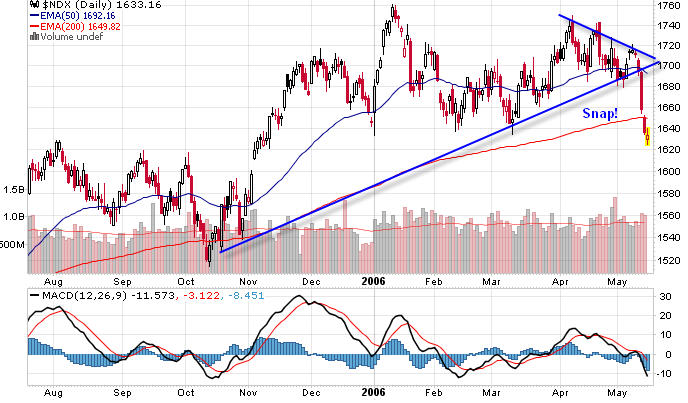
On May 21st Greenspan all but assured a housing collapse was coming with his statement Stable prices replacing boom
Former Federal Reserve Chairman Alan Greenspan said the five-year housing "boom is over," though prices won't fall nationally.
"We're not about to go into a situation where prices will go down," Greenspan, 80, said in response to questions Thursday evening at a reception in New York hosted by the Bond Market Association. There is "no evidence home prices are going to collapse."
Greenspan echoed comments earlier in the day by his successor, Ben S. Bernanke, who said housing is undergoing a "very orderly and moderate cooling," and that central bankers are monitoring the market to help shape their analysis of the economy's performance. With his "permanently high plateau" call, Greenspan all but assured prices are about ready to collapse. Bear in mind there was no evidence of a Nasdaq crash in Spring of 2000 either. But given that Greenspan has been wrong at every critical juncture in his entire career, we know housing is will collape sooner or later. Actually his position is peculiar to say the least. He claimed there was a bubble in stocks in 1994, he embraced the productivity miracle in 1999-2000 looking for upside in the economy as shown by Fed minutes, then after the bubble burst claimed that bubbles could only be detected after they pop. Now he is claiming "very orderly and moderate cooling where prices where prices will not go down". This is of course reminiscent of esteemed economist Irving Fisher's statement in October 1929: "Stock prices have reached what looks like a permanently high plateau." Head CheerleaderOf course Greenspan has company with his call. Please consider statements made by David Lereah, head cheerleader for the National Association of Realtors: "There is no real estate bubble. More than 50 people turned out for an investor seminar recently hosted by Keyes Company/Realtors and held at Belaire Boca, a community of luxury condominiums and townhomes in Boca Raton.
The featured speaker for the evening was David Lereah, senior vice president/chief economist for the National Association of Realtors. Lereah is also the author of "Why The Real Estate Boom Will Not Bust & How You Can Profit From It: How To Build Wealth In Today's Expanding Real Estate Market."
Lereah was quick to make his message clear: "You don't need a boom for real estate to roar. The real estate boom is over but the real estate expansion is still here." Although homes are not selling as quickly right now, prices are still up. "There are no real estate bubbles, only balloons that expand and contract," he said.
Lereah substantiated that good news by presenting numerous facts. The 14-year real estate expansion (1991-2005) resulted in a U.S. mortgage market that increased tenfold during that time. Low mortgage rates resulted in a refinancing boom, as consumers became more comfortable with the process.
He said the real estate boom was caused by factors such as lenders being able to reduce financing costs; baby boomers reaching their peak earning years and trading up or buying second, third and vacation homes.
"Forty percent of all home sales in 2005 were second homes - investment properties and vacation homes - compared to about 9 percent 10 years ago," Lereah said.
"Real estate is not an irrational investment, but speculators purchased irrationally during the boom, especially in areas like Miami. This drove prices up, and many speculators took out interest-only loans. This produced a vulnerable real estate market," Lereah explained. "In 2006, we are cleansing the market of speculation."
In 2007, Lereah believes that the real estate market will continue to expand even if mortgage rates increase to 7 percent. "That is still low," he said.
He added that he is bullish on Florida, Arizona and Nevada because of even greater population increases. "The law of supply and demand works."
All of Lereah's real estate investments are in condominiums and townhomes because he doesn't want to be involved in maintaining them. "If you're Mr. Fix It, then it's okay to invest in a single-family home," he said. Cheerleader ReviewLet's analyze some of Lereah's statements shall we? "The law of supply and demand works." Yes, the law of supply and demand works. It is in fact one of the reasons Florida is crashing and will continue to crash. 50,000-100,000 condos being built in Miami-Dade should be proof enough. It is why people are walking away from $80,000 deposits. The market is saturated with condos and you are still recommending them. "Speculators purchased irrationally during the boom, especially in areas like Miami." Hmm It seems that contradicts the reasons to be bullish on Florida condos doesn't it? Besides were you admitting "irrational buying" a year ago or were you humming a different tune then? "Forty percent of all home sales in 2005 were second homes - investment properties and vacation homes - compared to about 9 percent 10 years ago." Seems to me this is evidence of a bubble. Who hasn't bought that is going to do so now at these inflated prices. Not only are rental prices 4 standard deviations above norm, purchasing second homes for investments seems wildly above normal as well. "The 14-year real estate expansion (1991-2005) resulted in a U.S. mortgage market that increased tenfold during that time. " Hmmm, you are proclaiming a tenfold increase in the mortgage market huh? It seems you ought to be writing reasons for Professor Piggington on why this is a bubble instead of denying it. "There are no real estate bubbles, only balloons that expand and contract." Even if this nonsensical statement was true, why would one be touting Florida, a market in clear contraction, with enormous inventory and insurance problems, instead of areas with less speculation? "If you're Mr. Fix It, then it's okay to invest in a single-family home." Even this seems like poor advice. In every boom I have seen, condos are the last to rise, the first to fall, and heaven help anyone that buys a poorly constructed condo. You may not have to fix it yourself but some has to, and typically at rates far greater than you might find for yourself. Tuckpointing repairs and the like are horrendously expensive and that is for Chicago. I can only begin to imagine the problems in hurricane zones. At times David Lereah appears to have a grasp of the underlying facts, yet manages to come to all of the wrong conclusions about what is happening and why. No one should be surprised by this. David Lereah is a paid cheerleader for the National Association of Realtors, not a real economist. Mike Shedlock / Mish http://globaleconomicanalysis.blogspot.com/
Stephen Roach is writing about a Wake-Up Call for Central Banking. Perhaps he has himself waken up from some kind of stupor when he suddenly turned bullish on the global economy right at the market top a couple weeks ago. Let's tune in.
I worry increasingly that history will not treat the recent record of central banking kindly. Inflation may well have been conquered — a conclusion financial markets are actively debating again — but that was yesterday's battle. Over the past six years, monetary authorities have turned the liquidity spigot wide open. This has given rise to an endless string of asset bubbles — from equities to bonds to property to risky assets (emerging markets and high-yield credit) to commodities. Central banks have ducked responsibility for this state of affairs. That could end up being a policy blunder of monumental proportions. A new approach to monetary policy is urgently needed.
By focusing solely on the inflation battle, there is now risk of losing a much bigger war. That's what the profusion of asset bubbles is telling us, in my view. The great triumph of central banking rings increasingly hollow in today's bubble-prone environment.
By consciously ignoring the perils of a mounting asset bubble — a stunning reversal, of course, from Alan Greenspan's original warning of "irrational exuberance" in the stock market in December 1996 — the Fed became entrapped in the dreaded multi-bubble syndrome. Stressing that it had learned the lessons of Japan, the US central bank was aggressive in easing in the aftermath of the bursting of the equity bubble. A new Governor by the name of Ben Bernanke led the charge at the time in arguing that the US central bank should use every means possible to avoid an unwelcome post-bubble deflation — including, if necessary, "unconventional" measures aimed at targeting the yield curve, providing subsidized bank credit, and even pegging the dollar (see his 21 November 2002 speech, "Deflation: Making Sure "It" Doesn't Happen Here"). With inflation low — and the risk of deflation actually rising at the time — the price-targeting Fed had no compunction about turning the liquidity spigot wide open. And so the miracle drug that was used as the cure for the first bubble created a dangerous addiction — systemic risk, in financial market parlance — that has fostered a string of asset bubbles. Unfortunately, that addiction has yet to be broken.
When inflation is low and a price-targeting central bank pushes nominal interest rates down to unusually low levels, there are new risks to confront — namely, asset bubbles. Central banks that let economies "rip" because inflation risks are minimal, are asking for trouble. That doesn't mean monetary authorities should target asset prices. It does mean, however, that there are times when asset markets need to be taken into consideration in the setting of monetary policy. A low nominal interest rate regime is precisely one of those times.
America's Federal Reserve is increasingly isolated in arguing that asset markets should be ignored in the setting of monetary policy. In fact, its new chairman is the academic high priest of inflation targeting — embracing an even tighter rules-based approach than his predecessor. Asset bubbles are, at best, an after-thought in a strict inflation-targeting regime. Therein lies the potential for a strategic policy blunder: The US central bank has yet to develop an exit strategy from the multi-bubble syndrome that the Fed, in its zeal for inflation targeting, has spawned. Moreover, as one bubble begets another, excess asset appreciation has become a substitute for income-based saving — forcing the US to import surplus saving from abroad in order to sustain economic growth. And, of course, the only way America can attract that capital is by running a massive current-account deficit. In other words, not only has the Fed's approach given rise to a seemingly endless string of asset bubbles, but it has also played a major role in fostering global imbalances.
Central banks deserve great credit for waging a successful battle against inflation. To their credit, this war is never over — monetary authorities must always remain alert to the possibilities of a resurgence of inflation. But policy strategies have been surprisingly unprepared to cope with the pitfalls that emerge as economies near the hallowed ground of price stability. Nor have inflation-targeting monetary authorities shown themselves to be adaptable to changing circumstances, such as IT-enabled productivity enhancement and globalization. To the extent rules-bound central banks operate in a vacuum and fail to appreciate the impact of these powerful structural headwinds, they may be biased toward injecting too much liquidity into the system. The multi-bubble experience of the past six years is a wake-up call for central banks. A new approach to monetary policy is urgently needed. I do not think that "Central banks deserve great credit for waging a successful battle against inflation" but at least most of the rest of what he had to say sounded more like the Roach I used to know. The reason there should be zero credit given to central banks for a successful battle against inflation is they did nothing to foster it. In fact they blew asset bubble after asset bubble so why should anyone give them credit for that? Money supply exploded out of control under the Greeenspan Fed. It was only because of global wage arbitrage, outsourcing, and a productivity boom caused by the internet that inflation SEEMED low. Inflation was not low if one understands what inflation really is: growth in money supply an credit as discussed in Inflation: What the heck is it?. Now Bernanke is even more intent on price targeting than was Greenspan. It is a policy doomed to failure as I mentioned in Inflation Monster Captured. Sometimes money flows into houses and stock and bonds instead of goods and services. Sometimes productivity improvements mask inflation. Sometimes falling commodity prices mask inflation. Of course I am talking about "real inflation" as measured by increases in money supply as opposed to hedonically adjusted price inflation as seen through the eyes of central bankers.
The last paragraph is exactly what made a fool out of Greenspan. In the mid-to-late 1990's, "real inflation" (a rampant increase in money supply), was masked by productivity improvements, falling oil prices, and falling prices of goods from Asia. Greenspan called it a "productivity miracle". It was a "miracle" indeed. Rampant increases in money supply fueled the 2000 stock market bubble and spawned nonsensical talk about "new paradigms". Then in sheer panic "after the bubble pops" adjustments that he likes to make, Greenspan refused to allow a recession run its course. Instead he slashed interest rates to 1%, fueling the biggest housing bubble the world has ever seen. Here we are three short years later now facing a "new paradigm" in housing, with debt levels far worse at both consumer and governmental levels. Given that Bernanke is even more focused on prices than Greenspan was, Roach is right to be worried. Our economic policies are clearly broken and and the Fed and government spending are right at the heart of the mess. Both are to blame. A new approach is certainly needed as there is now hell to pay for the horrid economic policies of the last 18 years. I suggest the following. 1)Eliminate fractional reserve lending 2)Let the market set interest rates 3)Abolish the Fed 4)Rein in government spending 5)Return to the gold standard Can this all happen at once? Of course not. It would probably plunge the US into an instant depression if it was tried. Furthermore, one can have sound money without a gold standard, gold just makes the enforcement easier(see Gold's Honest Discipline). Fractional reserve lending can be curtailed over time as can government spending. One way or another, unsound economic practices and serial bubble blowing will be halted or the market will force it at the worst possible time. The wake-up call may be loudly ringing but the big fear is that both the Fed and Congress are deaf. Mike Shedlock / Mish http://globaleconomicanalysis.blogspot.com/
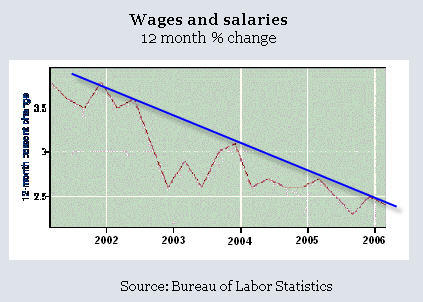
Buried deep in a Billmon Post last week was a critical chart and a few words of wisdom on why this is NOT a repeat of the inflation scene of the 70's and 80's. Most reading his post probably missed the key idea in a potpourri of other ideas. Let's take a look.
Wages and Salaries
We would need to see a lot faster wage growth -- growth at or exceeding the current 3% core CPI rate -- before I would think about buying a piece of the inflation is coming back story.

And while those kind of wage gains are not impossible I definitely don't see it right now. What we have, in other words, is almost pure cost-push inflation -- instead of the wage-price spiral that made the '70s such an interesting time to live through, financially speaking.
At some point, presumably when the extra disposable income derived from that last mortgage refi runs out, households are going to have to suck it in. Indeed it looks like it's already started -- retail sales are weakening and the Amazon-sized river of imports flowing in from points east (or west, if you live in California) has actually slowed a bit.
Meanwhile, job growth has decelerated, jobless claims are creeping up and housing starts finally appear to be, well, stopping.
That indeed is the heart of the matter. I have been harping about this for what seems like ages. Everyone is in some sort of "Inflation Scare" AFTER 16 consecutive rate hikes. Does this make any sense? I suppose it does to those that are perpetually gloomy on the US$ or US treasuries who probably now feel vindicated by this blip up in treasury yields.
It all comes down to wages and housing and jobs. Without meaningful rises in employment and wages, the former above the birth rate plus the rate of immigration (both illegal and illegal), and the latter above the TRUE cost of living, inflation really does not have a chance. Yes at 1% we had sustainable inflation. An incredible housing boom was the result. The better question (looking ahead) is "What Now?"
Has Inflation Won Out?
I have been asked countless times what it would take for me to throw in my "deflation towel", oddly enough(or perhaps not) most of those questions have come in the last few months right on the verge of victory. Unlike Stephen Roach (a Morgan Stanley permabear who suddenly and without reason turned bullish about two weeks ago), I am not reversing course here.
Is that illogical? I think not. I have many times stated what will change my mind. It is really simple: "wage increases, job growth, and housing that does not bust". I see little reason to change course now. In fact, treasuries are probably a screaming buy.
Primer on Inflation
Most people screaming "inflation" do not know what it really is. Those that think "Inflation = Price Increases" are sadly mistaken. In fact that is one of the reasons why we see repetitive bubbles being blown by the Fed.
If you think inflation = price rises, I suggest reading the following:
- Inflation: What the heck is it?
- Inflation Monster Captured
- Marc Faber shatters prevailing market myths
One of the reasons for these repetitive bubbles is the Fed does not itself know what inflation is. They think they can micromanage the economy when all they are doing is chasing their tale due to the lagging effect of their actions. At some point, and I think we are at that point right now, a sort of economic zugzwang is reached. I spoke about this in Red Queen Race. Here is the critical diagram.  In economic terms, there is no magic mirror. Bernanke is trapped in "Wonderland" but unlike Alice has no way out. Bernanke gets to choose between hyperinflation and deflation. The moment he can not run fast enough, the US economy will implode. If he runs too fast, the value of the US dollar as well as the Fed’s power will both come to a very abrupt stop. Economic CheckmateIn effect Bernanke is in Zugzwang and he does not even know it. Eventually Bernanke (like the Bank of Japan) will have to choose deflation. The reason is simple: hyperinflation will end the game, which in turn would eliminate the wealth of the Fed as well as all of their power. I do not know if Billmon is an inflationist or a deflationist or either. Personally I think the latter (neither). What I do know is that without wage growth and with a housing bust, inflation is extremely unlikely to raise its head. While everyone else is looking at the oil scare in the 70's as the model, virtually no one is looking at Japan of the 90's as the model. I am betting on the latter. PS to Billmon: Whatever graphic package you are using it seems worse than google software that I am using that only handles JPEG images as opposed to GIF images. I touched up the years on your chart as well as adding a trendline to show just how pathetic this recovery has been wage wise. But... beggars can't be choosy. Nice article. Mike Shedlock / Mish http://globaleconomicanalysis.blogspot.com/
|
. |
|
To sign up for a free copy of our Monthly Client Newsletter, please register your email address at the bottom of the Sitka Pacific Commentary Page.
Buy Gold and Silver Online at GoldMoney
The Best Way to Buy Gold and Silver
Disclaimer:The content on this site is provided as general information only and should not be taken as investment advice. All site content, including advertisements, shall not be construed as a recommendation to buy or sell any security or financial instrument, or to participate in any particular trading or investment strategy. The ideas expressed on this site are solely the opinions of the author(s) and do not necessarily represent the opinions of sponsors or firms affiliated with the author(s). The author may or may not have a position in any company or advertiser referenced above. Any action that you take as a result of information, analysis, or advertisement on this site is ultimately your responsibility. Consult your investment adviser before making any investment decisions.
Comment Guidelines: Comments should be succinct, constructive and relevant to the story. We encourage engaging, diverse and meaningful commentary. Comments that include personal attacks, racial, religious, or ethnic slurs are not permitted. We continuously review and remove any inappropriate comments.